JNTUK R20 1-1 Computer Engineering Workshop Material PDF Download

JNTUK R20 1-1 Computer Engineering Workshop Material PDF Download

Students those who are studying JNTUK R20 CSE Branch, Can Download Unit wise R20 1-1 Computer Engineering Workshop (CEW) Material/Notes PDFs below.

jntuk-materials

JNTUK R20 1-1 Computer Engineering Workshop Material PDF Download

OBJECTIVES:

  • Explain the internal parts of a computer, peripherals, I/O ports, connecting cables
  • Demonstrate basic command line interface commands on Linux
  • Teach the usage of Internet for productivity and self paced lifelong learning
  • Describe about Compression, Multimedia and Antivirus tools
  • Demonstrate Office Tools such as Word processors, Spreadsheets and Presentation tools

Computer Hardware:

Experiment 1: Identification of peripherals of a PC, Laptop, Server and Smart Phones: Prepare a report containing the block diagram along with the configuration of each component and its functionality, Input/ Output devices, I/O ports and interfaces, main memory, cache memory and secondary storage technologies, digital storage basics, networking components and speeds.

Operating Systems:

Experiment 2: Virtual Machine setup:

  • Setting up and configuring a new Virtual Machine
  • Setting up and configuring an existing Virtual Machine
  • Exporting and packaging an existing Virtual Machine into a portable format

Experiment 2: Operating System installation:

Installing an Operating System such as Linux on Computer hardware.

Experiment 3: Linux Operating System commands:

  • General command syntax o Basic help commands
  • Basic File system commands o Date and Time
  • Basic Filters and Text processing
  • Basic File compression commands
  • Miscellaneous: apt-get, vi editor

Networking and Internet:

Experiment 4: Networking Commands:

ping, ssh, ifconfig, scp, netstat, ipstat, nslookup, traceroute, telnet, host, ftp, arp, wget,route

Experiment 5: Internet Services:

  • Web Browser usage and advanced settings like LAN, proxy, content, privacy, security, cookies, extensions/ plugins
  • Antivirus installation, configuring a firewall, blocking pop-ups
  • Email creation and usage, Creating a Digital Profile on LinkedIn

Productivity Tools:

Experiment 6: Basic HTML tags, Introduction to HTML5 and its tags, Introduction to CSS3 and its properties. Preparation of a simple website/ homepage, Assignment: Develop your home page using HTML Consisting of your photo, name, address and education details as a table and your skill set as a list.

Features to be covered:- Layouts, Inserting text objects, Editing text objects, Inserting Tables, Working with menu objects, Inserting pages, Hyper linking, Renaming, deleting, modifying pages, etc.,

Internet of Things (IoT): IoT fundamentals, applications, protocols, communication models, architecture, IoT devices Office Tools:

Experiment 7: Demonstration and Practice on Text Editors like Notepad++, Sublime Text, Atom, Brackets, Visual code, etc

Experiment 8: Demonstration and practice on Microsoft Word, Power Point, Microsoft Excel

Experiment 9: Demonstration and practice on LaTeX and produce professional pdf documents.

Download The Complete Material PDF


TEXT BOOKS:

  1. Computer Fundamentals, Anita Goel, Pearson Education, 2017
  2. PC Hardware Trouble Shooting Made Easy, TMH

REFERENCE BOOKS:

  1. Essential Computer and IT Fundamentals for Engineering and Science Students, Dr.N.B.Vekateswarlu, S.Chand

e-Resources:

Computer Ports

OUTCOMES:

  • Assemble and disassemble components of a PC
  • Construct a fully functional virtual machine, Summarize various Linux operating system commands,
  • Recognize characters & extract text from scanned images, Create audio files and podcasts
ANU 38th Convocation Notification 2021 – Apply Online @ anu.ac.in

ANU 38th Convocation Notification 2021 – Apply Online @ anu.ac.in

ANU

Applications are invited for the 38th Convocation of Acharya Nagarjuna University for conferring Research, Post-Graduate, Professional, Under-Graduate Degrees and Diplomas including Distance Education and Private Study together with Prizes or Medals of the candidates who completed their courses of study during the academic year 2015-16. The exact date of holding the Convocation will be notified later.

Eligible candidates may apply for the Convocation either ‘In Person‘ or In Absentia‘ on payment of prescribed fee. Only applications for Research and Post-Graduate Degree `In Person’ will be awarded their degrees at the Convocation. All other Degrees under `In Person’ Category will be sent to respective Colleges, immediately after the conduct of Convocation, for distribution to the candidates. ‘In Absentia’ Degrees will be sent to the Candidates by Registered Post within one month after the conduct of the Convocation.

Application forms can be obtained in person from the office of the Controller of Examinations, Acharya Nagarjuna University, Nagarjunanagar-522510 and also be downloaded from the University website www.anu.ac.in. The prescribed fee includes the cost of application is Rs.525/- be paid in favour of the Registrar, Acharya Nagarjuna University through SBI Challan/Demand Draft.

The duly filled in application, with all necessary enclosures along with the Passport size photo for the award of Original Degrees, will have to reach the Controller of Examinations, Acharya Nagarjuna University on or before 15th April, 2021. Applications received after the due date or incomplete applications will be rejected.

Download the Official Notification Here: Click Here

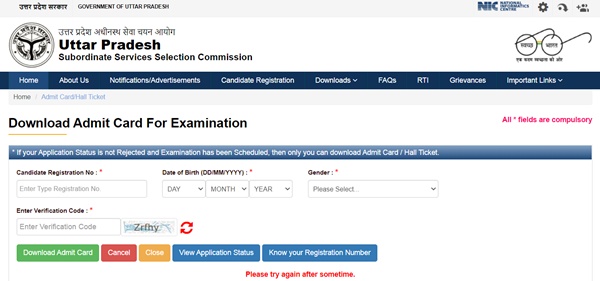
UPSSSC Assistant Boring Technician Admit Card 2021 – Download Exam Date @ upsssc.gov.in

UPSSSC Assistant Boring Technician Call Letter 2021, Written test Date: Uttar Pradesh Subordinate Service Selection Commission (UPSSSC) has announced the assistant boring technician written test round date as 25th April. Applicants who had sent their applications for ABT posts in UPSSSC can get ready for the written test round. The competition is expected to be high for ABT posts this year. The organization will conduct the assistant boring technician’s written test in a large number of places across Uttar Pradesh state. Competitors who are going to compete for UPSSSC Assistant boring Technician written test can download the hall tickets shortly from the official website, upsssc.gov.in. The admit card/hall ticket is a curtail document that needed to be carried to the examination. The exam invigilators will allow the candidates only after verifying their admit cards. Candidates with admit cards will only be allowed to attend the test. Hence all the competitors are instructed to download and carry the admit cards to the examination without fail. UPSSSC Assistant Boring Technician Hall Ticket release date, downloading process, and guidelines for the written test round were mentioned in the following article.

UPSSSC Assistant Boring Technician Admit Card 2021 – Download Exam Date @ upsssc.gov.in

 UPSSSC Assistant Boring Technician Admit Card 2021

Uttar Pradesh Subordinate Service Selection Commission (UPSSSC) is the state government organization that provides many services for various associated government organizations. UPSSSC has recently released the notification for 486 Assistant boring technician Posts. Across from the Uttar Pradesh, many of the candidates with suitable educational qualification have applied for the UPSSSC ABT posts. The organization accepted applications from contenders during the application dates. UPSSSC selects the suitable candidates through written test (preliminary and mains) and interview/document verification rounds. Candidates qualifying all the rounds with good merit will be finally appointed in Assistant Boring Technician posts in Uttar Pradesh.

UPSSSC Assistant Boring Technician Admit Card 2021 – Important Details

Organization NameUttar Pradesh Subordinate Service Selection Commission
Post NameAssistant Boring Technician
Number Of Vacancies486 Posts
Exam Date25th April 2021
CategoryAdmit Card
Admit Card Release Date2nd week of April 2021 – Expected
Official Siteupsssc.gov.in

Download UPSSSC Assistant Boring Technician Call Letter 2021, Test Center District Name Details @ upsssc.gov.in

The UPSSSC is going to conduct the assistant boring technician written test round on 25th April as per the schedule. All the applicants can get ready to attend the test. As the admit card is the most required document needed to attend the test, competitors need to download it, print, and keep it safe to carry to the examination. The admit card link is going to be get activated before 10 days of the examination [approximately]. Competitors going to attend the ABT written test on 25th April can expect the admit cards in 2nd week of April [Tentatively]. As soon as the organization releases the admit cards, competitors can download it and can check the details from it.

UPSSSC Assistant Boring Technician Admit Card 2021 contains the following details.

  • Examination venue
  • Date of the test
  • Timings of the test
  • Candidate’s name
  • Register number/hall ticket number
  • Date of birth of the candidate
  • Father’s/Mother’s Name
  • Candidate’s signature
  • Candidate’s Photograph
  • And other details, guidelines.

Hopefuls competing for the UPSSSC ABT examination on 24th April will have to attend the test along with the admit cards. Candidates must report at the examination hall before 30 minutes of the examination. Also, candidates need to carry any of the valid identity proof copy along with the hall ticket. The identity proof that the competitors can carry is,

  • Aadhar Card
  • PAN Card
  • Passport
  • Driving Licence
  • Ration Card
  • Or any others.

Download UPSSSC ABT Admit Card 2021 Available Soon

Download Exam Date Notice : Available

Steps to download UPSSSC Assistant boring technician hall ticket 2021

  1. Go to UPSSSC website, upsssc.gov.in or directly click on the hall ticket download link provided below.
  2. On the homepage, you can find the admit card download link.
  3. Click on the link and enter the login credentials.
  4. Tap on the submit button.
  5. The admit card gets downloaded.
  6. Take a printout of it and keep it safe; carry the admit card and identity proof while going to the examination.
When Will be Released UPSSSC Assistant Boring Technician Admit Card 2021?

Expected in 1st week of April

For How Many Posts, UPSSSC Assistant Boring Technician Exam will be Conducted?

486 posts.

What is the Exam date of UPSSSC Assistant Boring Technician?

25th April 2021

Where can we download UPSSSC Admit Card 2021 for ABT?

WE will be given direct call letter links in our website i.e jntufastupdates.com . just enter application number and date of birth to get admit card.

NYKS Volunteer Result 2021 (Today) – 13206 Merit List, Selected Candidates

NYKS Volunteer Result 2021, Selected Candidates List – National Youth Volunteer Interview Candidates List : Nehru Yuva Kendra Sangathan (NVKS) board has recently announced the result date for volunteer posts. Aspirants who applied for NYKS volunteer posts have attended the interview rounds from 25th February 2021 to 8th March 2021. Aspirants who applied for the NYKS Volunteer posts were guided to appear for the interview round in the allotted schedule. The organization has announced that the interview results will be announced on 16th March. Based on the merit of aspirants in the interview round, the NKYS board is going to announce the NYKS Volunteer selection list. Candidates who cleared the interview round with good merit and mentioned in the selection list will have to join the NYKS Volunteer posts on 1st April 2021. Candidates will be recruited as volunteers across India. After they have been recruited, the organization will pay a good pay scale as per the norms. For more details about the NYKS Volunteer result, selection list/merit list 2021, check the following article.

NYKS Volunteer Result 2021 – 13206 Volunteer Merit List, Selected Candidates

NYKS Volunteer Result 2021

Nehru Yuva Kendra Sangathan (NVKS) is the central government organization established in 1972. It is the largest and unique grassroots-level youth organization in the world. Every year the organization notifies the volunteer posts inviting applications from the eligible young candidates. Recently, the NYKS volunteer recruitment notification has been released for 13206 posts. Many of the aspirants interested to work for NYKS have sent their online applications during the application dates. Candidates will be selected through the interview round. Aspirants who perform the interview round with good merit will be finally shortlisted for NYKS Volunteer posts. Selected candidates will be recruited across the nation with a good pay scale and intensives.

NYKS Volunteer Result 2021, Selection List Download – Important Details

Organization NameNehru Yuva Kendra Sangathan
Post NameVolunteer
Number of Posts13206 
LocationAcross India
Interview Date25th February to 08th March 2021
CategoryResult
Results Release DateExpected on 16th March 2021
Joining Date1st April 2021
Official Sitenyks.nic.in

Download NYKS Volunteer Interview Selected candidates List 2021 @ nyks.nic.in

Candidates who applied for NYKS Volunteer posts 2021 and took part in the interview rounds from 25th February to 8th March 2021 can get ready to check the interview result on 15th March 2021. The NYKS Volunteer selection list/ merit list 2021 will be released on NYKS’s official website, nyks.nic.in. The NYKS Volunteer merit list contains the name of the candidate, register number, marks scored in the interview round, qualifying status, and other details. Candidates who clear the interview round with a good score and listed in the merit list will be placed in the volunteer posts across the nation with a good pay scale. To check the NYKS Volunteer result 2021 visit the official website, nyks.nic.in.

Download NYKS Volunteer Result Selection list 2021 | Link 2Expected today

NYKS Volunteer Result & Merit List 2021 – Downloading Process

  • Visit the NYKS official website, nyks.nic.in.
  • Login with the required login credentials.
  • On the homepage, NYKS Volunteer Result, Merit list/selection list 2021 link will be available on 15th March.
  • Click on the link and check the result status.
  • Candidates selected for the volunteer posts will be intimated through the email for posting.
IS Released NYKS Volunteer Result 2021?

Expected To be Released today on 16th March.

How Can We Check NYKS Volunteer Selected Candidates List 2021 for Interview?

Official will release, NYKS Volunteer selection list and score card. we will be update direct link in our website once after announcement.

What are the No of Vacancies Available ?

13206

What is the Joining Date after NYKS Volunteer Selection List 2021?

Selected candidates should join by 1st April 2021

JNTUK R16 3-2 Cyber Security Material/Notes PDF Download

JNTUK R16 3-2 Cyber Security Material/Notes PDF Download

Students those who are studying JNTUK R16 CSE Branch, Can Download Unit wise R16 3-2 Cyber Security (CS) Material/Notes PDFs below.

jntuk-materials

JNTUK R16 3-2 Cyber Security Material/Notes PDF Download

OBJECTIVES:

  • The Cyber security Course will provide the students with foundational Cyber Security principles, Security architecture, risk management, attacks, incidents, and emerging IT and IS technologies.
  • Students will gain insight into the importance of Cyber Security and the integral role of Cyber Security professionals.

UNIT-1

Introduction to Cybercrime: Introduction, Cybercrime: Definition and Origins of the Word, Cybercrime and Information Security ,Who are Cybercriminals? , Classifications of Cybercrimes, Cybercrime: The Legal Perspectives, Cybercrimes: An Indian Perspective, Cybercrime and the Indian ITA 2000, A Global Perspective on Cybercrimes, Cybercrime Era: Survival Mantra for the Netizens

Download UNIT-1 Material PDF | Reference-2

UNIT-2

Cyber offenses: How Criminals Plan Them –Introduction, How Criminals Plan the Attacks, Social Engineering, Cyber stalking, Cyber cafe and Cybercrimes, Botnets: The Fuel for Cybercrime, Attack Vector Cloud Computing.

Download UNIT-2 Material PDF | Reference-2

UNIT-3

Cybercrime Mobile and Wireless Devices: Introduction, Proliferation of Mobile and Wireless Devices, Trends in Mobility, Credit Card Frauds in Mobile and Wireless Computing Era, Security Challenges Posed by Mobile Devices, Registry Settings for Mobile Devices, Authentication Service Security, Attacks on Mobile/Cell Phones, Mobile Devices: Security Implications for Organizations, Organizational Measures for Handling Mobile, Organizational Security Policies and Measures in Mobile Computing Era, Laptops.

Download UNIT-3 Material PDF | Reference-2

UNIT-4:

Tools and Methods Used in Cybercrime: Introduction, Proxy Servers and Anonymizers, Phishing, Password Cracking, Key loggers and Spywares, Virus and Worms, Trojan Horses and Backdoors, Steganography, DoS and DDoS Attacks, SQL Injection, Buffer Overflow, Attacks on Wireless Networks, Phishing and Identity Theft: Introduction, Phishing, Identity Theft (ID Theft)

Download UNIT-4 Material PDF | Reference-2

UNIT-5:

Cybercrimes and Cyber security: Why Do We Need Cyber laws: The Indian Context, The Indian IT Act, Challenges to Indian Law and Cybercrime Scenario in India, Consequences of Not Addressing the Weakness in Information Technology Act, Digital Signatures and the Indian IT Act, Information Security Planning and Governance, Information Security Policy Standards, Practices, The information Security Blueprint, Security education, Training and awareness program, Continuing Strategies.

Download UNIT-5 Material PDF | Reference-2

UNIT-6:

Understanding Computer Forensics: Introduction, Historical Background of Cyber forensics, Digital Forensics Science, The Need for Computer Forensics, Cyber forensics and Digital Evidence, Forensics Analysis of E-Mail, Digital Forensics Life Cycle, Chain of Custody Concept, Network Forensics, Approaching a Computer Forensics Investigation, Computer Forensics and Steganography, Relevance of the OSI 7 Layer Model to Computer Forensics, Forensics and Social Networking Sites: The Security/Privacy Threats, Computer Forensics from Compliance Perspective, Challenges in Computer Forensics, Special Tools and Techniques, Forensics Auditing, Antiforensics

Download UNIT-6 Material PDF | Reference-2


TEXT BOOKS:

  1. Cyber Security: Understanding Cyber Crimes, Computer Forensics and Legal Perspectives, Nina Godbole, SunitBelapure, Wiley.
  2. Principles of Information Security, MichealE.Whitman and Herbert J.Mattord, Cengage Learning

REFERENCE BOOKS:

  1. Information Security, Mark Rhodes, Ousley, MGH.

OUTCOMES:

  • Cyber Security architecture principles
  • Identifying System and application security threats and vulnerabilities
  • Identifying different classes of attacks
  • Cyber Security incidents to apply appropriate response
  • Describing risk management processes and practices
  • Evaluation of decision making outcomes of Cyber Security scenarios

JNTUK R16 3-2 Internet of Things Material/Notes PDF Download

JNTUK R16 3-2 Internet of Things Material/Notes PDF Download

Students those who are studying JNTUK R16 CSE Branch, Can Download Unit wise R16 3-2 Internet of Things (IOT) Material/Notes PDFs below.

jntuk-materials

JNTUK R16 3-2 Internet of Things Material/Notes PDF Download

OBJECTIVES:

  • Identify problems that are amenable to solution by AI methods, and which AI methods may be suited to solving a given problem.
  • Formalize a given problem in the language/framework of different AI methods (e.g., as a search problem, as a constraint satisfaction problem, as a planning problem, as a Markov decision process, etc).
  • Implement basic AI algorithms (e.g., standard search algorithms or dynamic programming).
  • Design and carry out an empirical evaluation of different algorithms on problem formalization, and state the conclusions that the evaluation supports.

UNIT-1

The Internet of Things: An Overview of Internet of things,Internet of Things Technology, behind IoTs Sources of the IoTs, M2M Communication, Examples OF IoTs, Design Principles For Connected Devices

Download UNIT-1 Material PDF | Reference-2

UNIT-2

Business Models for Business Processes in the Internet of Things ,IoT/M2M systems LAYERS AND designs standardizations ,Modified OSI Stack for the IoT/M2M Systems ,ETSI M2M domains and High-level capabilities ,Communication Technologies, Data Enrichment and Consolidation and Device Management Gateway Ease of designing and affordability

Download UNIT-2 Material PDF | Reference-2

UNIT-3

Design Principles for the Web Connectivity for connected-Devices, Web Communication protocols for Connected Devices, Message Communication protocols for Connected Devices, Web Connectivity for connected-Devices.

Download UNIT-3 Material PDF | Reference-2

UNIT-4

Internet Connectivity Principles, Internet connectivity, Application Layer Protocols: HTTP, HTTPS, FTP, Telnet.

Download UNIT-4 Material PDF | Reference-2

UNIT-5

Data Acquiring, Organizing and Analytics in IoT/M2M, Applications/Services/Business Processes, IOT/M2M Data Acquiring and Storage, Business Models for Business Processes in the Internet Of Things, Organizing Data, Transactions, Business Processes, Integration and Enterprise Systems.

Download UNIT-5 Material PDF | Reference-2

UNIT-6

Data Collection, Storage and Computing Using a Cloud Platform for IoT/M2M Applications/Services, Data Collection, Storage and Computing Using cloud platform Everything as a service and Cloud Service Models, IOT cloud-based services using the Xively (Pachube/COSM), Nimbits and other platforms Sensor, Participatory Sensing, Actuator, Radio Frequency Identification, and Wireless, Sensor Network Technology, Sensors Technology ,Sensing the World.

Download UNIT-6 Material PDF | Reference-2


TEXT BOOKS:

  1. Internet of Things: Architecture, Design Principles And Applications, Rajkamal, McGraw Hill Higher Education
  2. Internet of Things, A.Bahgya and V.Madisetti, Univesity Press, 2015

REFERENCE BOOKS:

  1. Designingthe Internet of Things, Adrian McEwen and Hakim Cassimally, Wiley
  2. Getting Started with the Internet of Things CunoPfister , Oreilly

OUTCOMES:

  • Demonstrate knowledge and understanding of the security and ethical issues of the Internet of Things
  • Conceptually identify vulnerabilities, including recent attacks, involving the Internet of Things
  • Develop critical thinking skills Compare and contrast the threat environment based on industry and/or device type

JNTUK R16 3-2 Artificial Intelligence Material/Notes PDF Download

JNTUK R16 3-2 Artificial Intelligence Material/Notes PDF Download

Students those who are studying JNTUK R16 CSE Branch, Can Download Unit wise R16 3-2 Artificial Intelligence (AI) Material/Notes PDFs below.

jntuk-materials

JNTUK R16 3-2 Artificial Intelligence Material/Notes PDF Download

OBJECTIVES:

  • To have a basic proficiency in a traditional AI language including an ability to write simple to intermediate programs and an ability to understand code written in that language.
  • To have an understanding of the basic issues of knowledge representation and blind and heuristic search, as well as an understanding of other topics such as minimax, resolution, etc. that play an important role in AI programs.
  • To have a basic understanding of some of the more advanced topics of AI such as learning, natural language processing, agents and robotics, expert systems, and planning

UNIT-1

Introduction to artificial intelligence: Introduction ,history, intelligent systems, foundations of AI, applications, tic-tac-tie game playing, development of ai languages, current trends in AI

Download UNIT-1 Material PDF | Reference-2

UNIT-2

Problem solving: state-space search and control strategies :Introduction, general problem solving, characteristics of problem, exhaustive searches, heuristic search techniques, iterativedeepening a*, constraint satisfaction

Problem reduction and game playing: Introduction, problem reduction, game playing, alphabeta pruning, two-player perfect information games

Download UNIT-2 Material PDF | Reference-2

UNIT-3

Logic concepts: Introduction, propositional calculus, proportional logic, natural deduction system, axiomatic system, semantic tableau system in proportional logic, resolution refutation in proportional logic, predicate logic

Download UNIT-3 Material PDF | Reference-2

UNIT-4

Knowledge representation: Introduction, approaches to knowledge representation, knowledge representation using semantic network, extended semantic networks for KR, knowledge representation using frames advanced knowledge representation techniques: Introduction, conceptual dependency theory, script structure, cyc theory, case grammars, semantic web

Download UNIT-4 Material PDF | Reference-2

UNIT-5

Expert system and applications: Introduction phases in building expert systems, expert system versus traditional systems, rule-based expert systems blackboard systems truth maintenance systems, application of expert systems, list of shells and tools

Download UNIT-5 Material PDF | Reference-2

UNIT-6

Uncertainty measure: probability theory: Introduction, probability theory, Bayesian belief networks, certainty factor theory, dempster-shafer theory Fuzzy sets and fuzzy logic: Introduction, fuzzy sets, fuzzy set operations, types of membership functions, multi valued logic, fuzzy logic, linguistic variables and hedges, fuzzy propositions, inference rules for fuzzy propositions, fuzzy systems.

Download UNIT-6 Material PDF | Reference-2


TEXT BOOKS:

  1. Artificial Intelligence- Saroj Kaushik, CENGAGE Learning,
  2. Artificial intelligence, A modern Approach , 2nded, Stuart Russel, Peter Norvig, PEA
  3. Artificial Intelligence- Rich, Kevin Knight, Shiv Shankar B Nair, 3rded, TMH
  4. Introduction to Artificial Intelligence, Patterson, PHI

REFERENCE BOOKS:

  1. Atificial intelligence, structures and Strategies for Complex problem solving, -George F Lugar, 5thed, PEA
  2. Introduction to Artificial Intelligence, Ertel, Wolf Gang, Springer
  3. Artificial Intelligence, A new Synthesis, Nils J Nilsson, Elsevier

OUTCOMES:

  • Identify problems that are amenable to solution by AI methods, and which AI methods may be suited to solving a given problem.
  • Formalize a given problem in the language/framework of different AI methods (e.g., as a search problem, as a constraint satisfaction problem, as a planning problem, as a Markov decision process, etc).
  • Implement basic AI algorithms (e.g., standard search algorithms or dynamic programming).
  • Design and carry out an empirical evaluation of different algorithms on problem formalization, and state the conclusions that the evaluation supports.

JNTUK R16 3-2 Design and Analysis of Algorithms Material PDF Download

JNTUK R16 3-2 Design and Analysis of Algorithms Material PDF Download

Students those who are studying JNTUK R16 CSE Branch, Can Download Unit wise R16 3-2 Design and Analysis of Algorithms (DAA) Material/Notes PDFs below.

jntuk-materials

JNTUK R16 3-2 Design and Analysis of Algorithms Material PDF Download

OBJECTIVES:

  • Analyze the asymptotic performance of algorithms.
  • Write rigorous correctness proofs for algorithms.
  • Demonstrate a familiarity with major algorithms and data structures.
  • Apply important algorithmic design paradigms and methods of analysis.
  • Synthesize efficient algorithms in common engineering design situations

UNIT-1

Introduction: What is an Algorithm, Algorithm Specification, Pseudocode Conventions Recursive Algorithm, Performance Analysis, Space Complexity, Time Complexity, Amortized Complexity, Amortized Complexity, Asymptotic Notation, Practical Complexities, Performance Measurement.

Download UNIT-1 Material PDF

UNIT-2

Dived and Conquer: General Method, Defective Chessboard, Binary Search, Finding the Maximum and Minimum, Merge Sort, Quick Sort, Performance Measurement, Randomized Sorting Algorithms.

Download UNIT-2 Material PDF

UNIT-3

The Greedy Method: The General Method, Knapsack Problem, Job Sequencing with Deadlines, Minimum-cost Spanning Trees, Prim’s Algorithm, Kruskal’s Algorithms, An Optimal Randomized Algorithm, Optimal Merge Patterns, Single Source Shortest Paths.

Download UNIT-3 Material PDF

UNIT-4

Dynamic Programming: All – Pairs Shortest Paths, Single – Source Shortest paths General Weights, String Edition, 0/1 Knapsack, Reliability Design

Download UNIT-4 Material PDF

UNIT-5

Backtracking: The General Method, The 8-Queens Problem, Sum of Subsets, Graph Coloring , Hamiltonian Cycles.

Download UNIT-5 Material PDF

UNIT-6

Branch and Bound: The Method, Least cost (LC) Search, The 15-Puzzle: an Example, Control Abstraction for LC-Search, Bounding, FIFO Branch-and-Bound, LC Branch and Bound, 0/1 Knapsack Problem, LC Branch-and Bound Solution, FIFO Branch-and-Bound Solution, Traveling Salesperson.

Download UNIT-6 Material PDF


TEXT BOOKS:

  1. Fundamentals of computer algorithms E. Horowitz S. Sahni, University Press
  2. Introduction to AlgorithmsThomas H. Cormen, PHI Learning

REFERENCE BOOKS:

  1. The Design and Analysis of Computer Algorithms, Alfred V. Aho, John E. Hopcroft, Jeffrey D. Ullman
  2. Algorithm Design, Jon Kleinberg, Pearson.

OUTCOMES:

  • Argue the correctness of algorithms using inductive proofs and invariants.
  • Analyze worst-case running times of algorithms using asymptotic analysis.
  • Describe the divide-and-conquer paradigm and explain when an algorithmic design situation calls for it. Recite algorithms that employ this paradigm. Synthesize divide-andconquer algorithms. Derive and solve recurrences describing the performance of divideand-conquer algorithms.
  • Describe the dynamic-programming paradigm and explain when an algorithmic design situation calls for it. Recite algorithms that employ this paradigm. Synthesize dynamicprogramming algorithms, and analyze them.
  • Describe the greedy paradigm and explain when an algorithmic design situation calls for it. Recite algorithms that employ this paradigm. Synthesize greedy algorithms, and analyze them.

JNTUK R16 3-2 Data Warehousing and Mining Material PDF Download

JNTUK R16 3-2 Data Warehousing and Mining Material PDF Download

Students those who are studying JNTUK R16 CSE Branch, Can Download Unit wise R16 3-2 Data Warehousing and Mining (DWDM) Material/Notes PDFs below.

jntuk-materials

JNTUK R16 3-2 Data Warehousing and Mining Material PDF Download

OBJECTIVES:

  • Students will be enabled to understand and implement classical models and algorithms in data warehousing and data mining.
  • They will learn how to analyze the data, identify the problems, and choose the relevant models and algorithms to apply.
  • They will further be able to assess the strengths and weaknesses of various methods and algorithms and to analyze their behavior.

UNIT-1

Introduction: Why Data Mining? What Is Data Mining?1.3 What Kinds of Data Can Be Mined?1.4 What Kinds of Patterns Can Be Mined?Which Technologies Are Used?Which Kinds of Applications Are Targeted?Major Issues in Data Mining.Data Objects and Attribute Types,Basic Statistical Descriptions of Data,Data Visualization, Measuring Data Similarity and Dissimilarity

Download UNIT-1 Material PDF | Reference-2 | Ref-3

UNIT-2:

Data Pre-processing: Data Preprocessing: An Overview,Data Cleaning,Data Integration,Data Reduction,Data Transformation and Data Discretization

Download UNIT-2 Material PDF | Reference-2 | Ref-3

UNIT-3

Classification: Basic Concepts, General Approach to solving a classification problem, Decision Tree Induction: Working of Decision Tree, building a decision tree, methods for expressing an attribute test conditions, measures for selecting the best split, Algorithm for decision tree induction.

Download UNIT-3 Material PDF | Reference-2 | Ref-3

UNIT-4:

Classification: Alterative Techniques, Bayes’ Theorem, Naïve Bayesian Classification, Bayesian Belief Networks

Download UNIT-4 Material PDF | Reference-2 | Ref-3

UNIT-5

Association Analysis: Basic Concepts and Algorithms: Problem Defecation, Frequent Item Set generation, Rule generation, compact representation of frequent item sets, FP-Growth Algorithm. (Tan &Vipin)

Download UNIT-5 Material PDF | Reference-2 | Ref-3

UNIT-6

Cluster Analysis: Basic Concepts and Algorithms:Overview: What Is Cluster Analysis? Different Types of Clustering, Different Types of Clusters; K-means: The Basic K-means Algorithm, K-means Additional Issues, Bisecting K-means, Strengths and Weaknesses; Agglomerative Hierarchical Clustering: Basic Agglomerative Hierarchical Clustering Algorithm DBSCAN: Traditional Density Center-Based Approach, DBSCAN Algorithm, Strengths and Weaknesses. (Tan &Vipin)

Download UNIT-6 Material PDF | Reference-2 | Ref-3


TEXT BOOKS:

  1. Introduction to Data Mining: Pang-Ning Tan & Michael Steinbach, Vipin Kumar, Pearson.
  2. Data Mining concepts and Techniques, 3/e, Jiawei Han, Michel Kamber, Elsevier.

REFERENCE BOOKS:

  1. Data Mining Techniques and Applications: An Introduction, Hongbo Du, Cengage Learning.
  2. Data Mining : VikramPudi and P. Radha Krishna, Oxford.
  3. Data Mining and Analysis – Fundamental Concepts and Algorithms; Mohammed J. Zaki, Wagner Meira, Jr, Oxford
  4. Data Warehousing Data Mining & OLAP, Alex Berson, Stephen Smith, TMH.

OUTCOMES:

  • Understand stages in building a Data Warehouse
  • Understand the need and importance of preprocessing techniques
  • Understand the need and importance of Similarity and dissimilarity techniques
  • Analyze and evaluate performance of algorithms for Association Rules.
  • Analyze Classification and Clustering algorithms

JNTUK R16 3-2 Software Testing Methodologies Material PDF Download

JNTUK R16 3-2 Software Testing Methodologies Material PDF Download

Students those who are studying JNTUK R16 CSE Branch, Can Download Unit wise R16 3-2 Software Testing Methodologies (STM) Material/Notes PDFs below.

jntuk-materials

JNTUK R16 3-2 Software Testing Methodologies Material PDF Download

OBJECTIVES:

  • Describe the principles and procedures for designing test cases.
  • Provide supports to debugging methods.
  • Acts as the reference for software testing techniques and strategies

UNIT-1

Introduction: Purpose of Testing, Dichotomies, Model for Testing, Consequences of Bugs,Taxonomy of Bugs. Flow graphs and Path testing: Basics Concepts of Path Testing, Predicates, Path Predicates andAchievable Paths, Path Sensitizing, Path Instrumentation, Application of Path Testing.

Download UNIT-1 Material PDF | Reference-2 | Ref-3

UNIT-2:

Transaction Flow Testing: Transaction Flows, Transaction Flow Testing Techniques. Dataflow testing: Basics of Dataflow Testing, Strategies in Dataflow Testing, Application of Dataflow Testing.

Download UNIT-2 Material PDF | Reference-2 | Ref-3

UNIT-3:

Domain Testing: Domains and Paths, Nice & Ugly Domains, Domain testing, Domains andInterfaces Testing, Domain and Interface Testing, Domains and Testability. Paths, Path products and Regular expressions: Path Products & Path Expression, Reduction Procedure, Applications, Regular Expressions & Flow Anomaly Detection.

Download UNIT-3 Material PDF | Reference-2 | Ref-3

UNIT-4:

Syntax Testing: Why, What and How, A Grammar for formats, Test Case Generation, Implementation and Application and Testability Tips. Logic Based Testing: Overview, Decision Tables, Path Expressions, KV Charts, and Specifications.

Download UNIT-4 Material PDF | Reference-2 | Ref-3

UNIT-5:

State, State Graphs and Transition Testing: State Graphs, Good & Bad State Graphs, State Testing, and Testability Tips. III Year – II Semester L T P C 4 0 0 3 Graph Matrices and Application:-Motivational overview, matrix of graph, relations, power of a matrix, node reduction algorithm.

Download UNIT-5 Material PDF | Reference-2 | Ref-3

UNIT-6:

Software Testing Tools: Introduction to Testing, Automated Testing, Concepts of Test Automation, Introduction to list of tools like Win runner, Load Runner, Jmeter, About Win Runner ,Using Win runner, Mapping the GUI, Recording Test, Working with Test, Enhancing Test, Checkpoints, Test Script Language, Putting it all together, Running and Debugging Tests, Analyzing Results, Batch Tests, Rapid Test Script Wizard.

Download UNIT-6 Material PDF | Reference-2 | Ref-3


TEXT BOOKS:

  1. Software testing techniques – Boris Beizer, Dreamtech, second edition.
  2. Software Testing- Yogesh Singh, Camebridge

REFERENCE BOOKS:

  1. The Craft of software testing – Brian Marick, Pearson Education.
  2. Software Testing, 3rd edition, P.C. Jorgensen, Aurbach Publications (Dist.by SPD).
  3. Software Testing, N.Chauhan, Oxford University Press.
  4. Introduction to Software Testing, P.Ammann&J.Offutt, Cambridge Univ.Press.
  5. Effective methods of Software Testing, Perry, John Wiley, 2nd Edition, 1999.
  6. Software Testing Concepts and Tools, P.NageswaraRao, dreamtech Press
  7. Win Runner in simple steps by Hakeem Shittu, 2007Genixpress.
  8. Foundations of Software Testing, D.Graham& Others, Cengage Learning.

OUTCOMES:

  • Understand the basic testing procedures.
  • Able to support in generating test cases and test suites.
  • Able to test the applications manually by applying different testing methods and automation tools.
  • Apply tools to resolve the problems in Real time environment.