TS EAMCET Exam Dates 2021 – ECET, PGECET Exam Dates

TS EAMCET Exam Dates 2021 – ECET, PGECET Exam Dates

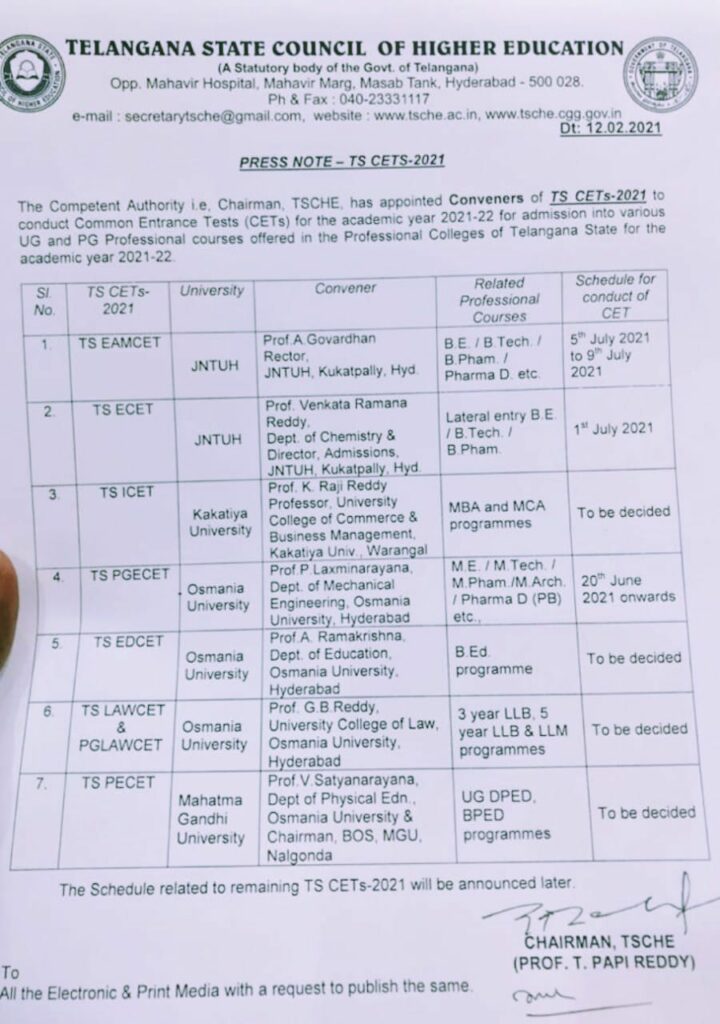
Telangana government has released the TS CET examinations dates 2021. As per the Schedule Exams will be Conduct the engineering, agriculture and medical common entrance test (Eamcet) from 5th July to 9th July, 2021, engineering common entrance test (Ecet) on 1st July, 2021 and TS PGECET exam held from 20th June, 2021 onwards.

Telangana

The Competent Authority i.e Chairman, TSCHE, has appointed conveners of TS CETs-2021 to conduct common entrance tests (CETs) for the academic year 2021-22 for admission into various UG and PG professional courses offered in the professional colleges of telangana state for the academic year 2021-22.

TS Cet exam dates 2021

జులై 5 నుండి 9 వరకు తెలంగాణ ఎంసెట్ ప్రవేశ పరీక్ష.. జులై 1న ఈసెట్ జూన్ 20న పీజీ సెట్.

  • TS EAMCET 2021: 5th July to 9th July, 2021
  • TS ECET 2021: 1st July, 2021
  • TS ICET 2021: To be Decided
  • TS PGECET 2021: 20th June, 2021 onwards
  • TS EDCET 2021: To be Decided
  • TS Lawcet 2021: To be Decided

JNTUK R16 3-1 Transportation Engineering – II Material PDF Download

JNTUK R16 3-1 Transportation Engineering – II Material PDF Download

Students those who are studying JNTUK R16 Civil Branch, Can Download Unit wise R16 3-1 Transportation Engineering – II Material/Notes PDFs below.

jntuk-materials

JNTUK R16 3-1 Transportation Engineering – II Material PDF Download

OBJECTIVES:

  • To know various components and their functions in a railway track
  • To acquire design principles of geometrics in a railway track.
  • To know various techniques for the effective movement of trains.
  • To acquire design principles of airport geometrics and pavements.
  • To know the planning, construction and maintenance of Docks and Harbours.

A.RAILWAY ENGINEERING

UNIT-1

Components of Railway Engineering: Permanent way components – Railway Track Gauge – Cross Section of Permanent Way – Functions of various Components like Rails, Sleepers and Ballast –Rail Fastenings – Creep of Rails- Theories related to creep – Adzing of Sleepers- Sleeper density – Rail joints.

Download UNIT-1 Material PDF

UNIT-2

Geometric Design of Railway Track: Alignment – Engineering Surveys – Gradients- Grade Compensation- Cant and Negative Super elevation- Cant Deficiency – Degree of Curve – safe speed on curves – Transition curve – Compound curves – Reverse curves – Extra clearance on curves – widening of gauge on curves – vertical curves – cheek rails on curves.

Download UNIT-2 Material PDF

UNIT-3

Turnouts & Controllers: Track layouts – Switches – Design of Tongue Rails – Crossings – Turnouts – Layout of Turnout – Double Turnout – Diamond crossing – Scissors crossing. Signal Objectives – Classification – Fixed signals – Stop signals – Signalling systems – Mechanical signalling system – Electrical signalling system – System for Controlling Train Movement – Interlocking – Modern signalling Installations.

Download UNIT-3 Material PDF

B.AIRPORT ENGINEERING

UNIT-4

Airport Planning & Design: Airport Master plan – Airport site selection – Air craft characteristics – Zoning laws – Airport classification – Runway orientation – Wind rose diagram – Runway length – Taxiway design – Terminal area and Airport layout – Visual aids and Air traffic control.

Download UNIT-4 Material PDF

UNIT-5

Runway Design: Various Design factors – Design methods for Flexible pavements – Design methods for Rigid pavements – LCN system of Pavement Design – Airfield Pavement Failures – Maintenance and Rehabilitation of Airfield pavements – Evaluation & Strengthening of Airfield pavements – Airport Drainage – Design of surface and subsurface drainage. C.DOCKS & HARBOURS

Download UNIT-5 Material PDF

UNIT-6

Planning, Layout, Construction & Maintenance Of Docks & Harbors: Classification of ports – Requirement of a good port – classification of Harbors – Docks – Dry & wet docks – Transition sheds and workhouses – Layouts; Quays – construction of Quay walls – Wharves – Jetties – Tides – Tidal data and Analysis – Break waters – Dredging – Maintenance of Ports and Harbors – Navigational aids.

Download UNIT-6 Material PDF


TEXT BOOKS:

  1. Railway Engineering, Satish Chandra and Agarwal M. M., Oxford University Press, New Delhi
  2. Airport Engineering, Khanna & Arora – Nemchand Bros, New Delhi.
  3. Docks and Harbor Engineering, Bindra S.P. – Dhanpathi Rai & Sons, New Delhi.

REFERENCE BOOKS:

  1. Railway Engineering, Saxena & Arora – Dhanpat Rai, New Delhi.
  2. Transportation Engineering Planning Design, Wright P. H. & Ashfort N. J., John Wiley & Sons.
  3. Transportation Engineering Volume II, C Venkatramaiah, 2016, Universities Press, Hyderabad.
  4. Transportation Engineering, Railways, Airports, Docks & Harbours, Srinivasa Kumar R, University Press, Hyderabad
  5. Airport Engineering Planning & Design, Subhash C. Saxena, 2016, CBS Publishers, New Delhi.
  6. Highway, Railway, Airport and Harbor Engineering, Subramanian K. P, Scitech Publications (India) Pvt Limited, Chennai
  7. Airport Engineering, Virendra Kumar, Dhanpat Rai Publishers, New Delhi.

OUTCOMES:

  • Design geometrics in a railway track.
  • Design airport geometrics and airfield pavements.
  • Plan, construct and maintain Docks and Harbours.

JNTUK R16 3-1 DDRCS Material/Notes PDF Download

JNTUK R16 3-1 DDRCS Material/Notes PDF Download

Students those who are studying JNTUK R16 Civil Branch, Can Download Unit wise R16 3-1 Design & Drawing of Reinforced Concrete Structures Material/Notes PDFs below.

jntuk-materials

JNTUK R16 3-1 DDRCS Material/Notes PDF Download

OBJECTIVES:

  • Familiarize Students with different types of design philosophies
  • Equip student with concepts of design of flexural members
  • Understand Concepts of shear, bond and torsion
  • Familiarize students with different types of compressions members and Design
  • Understand different types of footings and their design

UNIT-1

Introduction: a) Working stress method: Design codes and handbooks, loading standards – Dead, live, wind and earthquake loads, Elastic theory: design constants, modular ratio, neutral axis depth and moment of resistance for balanced, under-reinforced and over-reinforced sections. Design of singly and doubly reinforced beams.

b) Limit State Design: Concepts of limit state design – Basic statistical principles – Characteristic loads –Characteristic strength – Partial load and safety factors – representative stress-strain curves for cold worked deformed bars and mild steel bars. Assumptions in limit state design – stress – block parameters – limiting moment of Resistance. All units i.e. from unit II to unit VI are to be taught in Limit State Design.

UNIT-2

Design for Flexure: Limit state analysis and design of singly reinforced sections- effective depth- Moment of Resistance- Doubly reinforced and flanged (T and L) beam sections- Minimum depth for a given capacity- Limiting Percentage of SteelMinimum Tension Reinforcement-Maximum Flexural Steel- Design of Flanged Sections (T&L)- Effective width of flange –Behavior- Analysis and Design.

UNIT-3

Design for Shear, Torsion and Bond: Limit state analysis and design of section for shear and torsion – concept of bond, anchorage and development length, I.S. code provisions. Design examples in simply supported and continuous beams, detailing. Limit state design for serviceability: Deflection, cracking and code provision, Design of formwork for beams and slabs.

UNIT-4

Slabs: Classification of slabs, design of one – way slabs, one way continuous slab using IS Coefficients (Conventional) –Design of two – way slabs-simply supported and various edge conditions using IS Coefficients .

UNIT-5

Design of Compression members: Effective length of a column, Design of short and long columns – under axial loads, uniaxial bending and biaxial bending – Braced and un-braced columns – I S Code provisions.

UNIT-6

Footings: Different types of footings – Design of isolated footings – pedestal, square, rectangular and circular footings subjected to axial loads, uni-axial and bi-axial bending moments.

Download links

DDRCS/T.T.S-1

DDRCS/T.T.S-2

DDRCS/TWO WAY

DDRCS/TWO WAY SLAB

DDRCS/UNIT-3

DDRCS/SP=16 CHARTS

DDRCS/is.456.2000

DDRCS/D.SLENDER COLUMN


NOTE: All the designs to be taught in Limit State Method

Following plates should be prepared by the students.

  • Reinforcement detailing of T-beams, L-beams and continuous beams.
  • Reinforcement detailing of columns and isolated footings.
  • Detailing of one-way, two-way and continuous slabs and waist-slab staircase.

FINAL EXAMINATION PATTERN: The end examination paper should consist of Part A and Part B. Part A consists of two questions in Design and Drawing out of which one question is to be answered. Part B should consist of five questions and design out of which three are to be answered. Weightage for Part – A is 40% and Part- B is 60%.

TEXT BOOKS:

  1. Limit State Design, A. K. Jain

2. Design of Reinforced concrete Structures, N. Subrahmanyian

3. Reinforced Concrete Structures, S. Unnikrishna Pillai & Devdas Menon, Tata Mc.Graw Hill, New Delhi.

REFERENCE BOOKS:

  1. R C C Design, B.C Punmia, A. K. Jain and A. K Jain. Lakshmi Publications
  2. Reinforced Concrete Structures, N. Krishna Raju & R. N. Pranesh, New Age Publications.

IS Codes:

1) IS -456-2000 Code of practice for Reinforced Concrete Structures (Permitted to use in examination hall)

2) IS – 875

3) SP-16

OUTCOMES:

  • Work on different types of design philosophies
  • Carryout analysis and design of flexural members and detailing
  • Design structures subjected to shear, bond and torsion
  • Design different type of compression members and footings

JNTUK R16 3-1 Structural Analysis – II Material PDF Download

JNTUK R16 3-1 Structural Analysis – II Material PDF Download

Students those who are studying JNTUK R16 Civil Branch, Can Download Unit wise R16 3-1 Structural Analysis – II Material/Notes PDFs below.

jntuk-materials

JNTUK R16 3-1 Structural Analysis – II Material PDF Download

OBJECTIVES:

  • Familiarize Students with Different types of Structures
  • Equip student with concepts of Arches
  • Understand Concepts of lateral Load analysis
  • Familiarize Cables and Suspension Bridges
  • Understand Analysis methods Moment Distribution, Kanis Method and Matrix methods

UNIT-1

Three Hinged Arches: Elastic theory of arches – Eddy’s theorem – Determination of horizontal thrust, bending moment, normal thrust and radial shear – effect of temperature. Hinges with supports at different levels. Two Hinged Arches: Determination of horizontal thrust, bending moment, normal thrust and radial shear – Rib shortening and temperature stresses, Tied arches – Fixed arches – (No analytical question).

Download UNIT-1 Material PDF

UNIT-2

Lateral Load Analysis Using Approximate Methods: application to building frames. (i) Portal Method (ii) Cantilever Method.

Download UNIT-2 Material PDF

UNIT-3

Cable Structures and Suspension Bridges: Introduction, characteristics of cable, analysis of cables subjected to concentrated and uniformly distributed loads, anchor cable, temperature stresses, analysis of simple suspension bridge, three hinged and two hinged stiffening girder suspension bridges.

Download UNIT-3 Material PDF

UNIT-4

Moment Distribution Method: Stiffness and carry over factors – Distribution factors – Analysis of continuous beams with and without sinking of supports – Portal frames – including Sway-Substitute frame analysis by two cycle.

Download UNIT-4 Material PDF

UNIT-5

Kani’s Method: Analysis of continuous beams – including settlement of supports and single bay portal frames with and without side sway.

Download UNIT-5 Material PDF

UNIT-6

Introduction to Matrix Methods: Flexibility methods: Introduction, application to continuous beams (maximum of two unknowns) including support settlements. Stiffness method: Introduction, application to continuous beams (maximum of two unknowns) including support settlements.

Download UNIT-6 Material PDF


TEXT BOOKS:

  1. Structural Analysis, T. S. Thandavamoorthy, Oxford university press, India.
  2. Structural Analysis, R.C. Hibbeler, Pearson Education, India
  3. Theory of Structures – II, B. C. Punmia, Jain & Jain, Laxmi Publications, India.
  4. Structural Analysis, C.S. Reddy, Tata Mc-Graw hill, New Delhi.

REFERENCE BOOKS:

  1. Intermediate Structural Analysis, C. K. Wang, Tata McGraw Hill, India
  2. Theory of structures, Ramamuratam, Dhanpatrai Publications.
  3. Analysis of structures, Vazrani & Ratwani – Khanna Publications.
  4. Comprehensive Structural Analysis-Vol. I & 2, R. Vaidyanathan & P. Perumal- Laxmi Publications Pvt. Ltd., New Delhi
  5. Structural Analysis I, P.N. Chandramouli. Yesdee Publishing Pvt Limited
  6. Structural Analysis, Aslam Kassimali, Cengage Learning
  7. Matrix Methods of Structural Analysis, P.N. Godbole, R. S.. Sonaparote, PHI Learning Pvt Limited

OUTCOMES:

  • Differentiate Determinate and Indeterminate Structures
  • Carryout lateral Load analysis of structures
  • Analyze Cable and Suspension Bridge structures
  • Analyze structures using Moment Distribution, Kani’s Method and Matrix methods

JNTUK R16 3-1 Engineering Geology Material PDF Download

JNTUK R16 3-1 Engineering Geology Material PDF Download

Students those who are studying JNTUK R16 Civil Branch, Can Download Unit wise R16 3-1 Engineering Geology Material/Notes PDFs below.

jntuk-materials

JNTUK R16 3-1 Engineering Geology Material PDF Download

OBJECTIVES:

  • To introduce the Engineering Geology as a subject in Civil Engineering
  • To enable the student to use subject in civil engineering applications.
  • To know the Geological history of India.

UNIT-1

Introduction: Branches of Geology, Importance of Geology in Civil Engineering with case studies Weathering: Weathering of rocks, Geological agents, weathering process of Rock, River process and their development.

Download UNIT-1 Material PDF

UNIT-2

Mineralogy And Petrology: Definitions of mineral, Structures of silicates and rock, Different methods of study of mineral and rock, The study of physical properties of minerals and rocks for megascopic study for the following minerals and rocks, Common rock forming minerals are Feldspar, Quartz Group, Olivine, Augite, Hornblende, Mica Group, Asbestos, Talc, Chlorite, Kyanite, Garnet, Calcite and other ore forming minerals are Pyrite, Hematite, Magnetite, Chlorite, Galena, Pyrolusite, Graphite, Chromite, Magnetite And Bauxite. Classification, structures, textures and forms of Igneous rocks, Sedimentary rocks, Metamorphic rocks, and their megascopic study of granite varieties, (pink, gray, green). Pegmatite, Dolerite, Basalt etc., Shale, Sand Stone, Lime Stone, Laterite, Quartzite, Gneiss, Schist, Marble, Khondalite and Slate and their importance in Civil Engineering.

Download UNIT-2 Material PDF

UNIT-3

Structural Geology: Strike, Dip and Outcrop study of common geological structures associating with the rocks such as Folds, Faults, Joints and Unconformitiesparts, types, mechanism and their importance in Civil Engineering–Indian stratigraphy. Aims of statigrtaphy, Principles, Geological time scour, Geological division in India, Major stratigraphic units in India.

Download UNIT-3 Material PDF

UNIT-4

Ground Water: Water table, Cone of depression, Geological controls of Ground Water Movement, Ground Water Exploration Techniques.

Earthquakes And Land Slides: Terminology, Classification, causes and effects, Shield areas and Seismic bells, Richter scale intensity, Precautions of building constructions in seismic areas. Classification of Landslides, Causes and Effects, measures to be taken prevent their occurrence at Landslides. Case studies.

Download UNIT-4 Material PDF

UNIT-5

Geophysics: Importance of Geophysical methods, Classification, Principles of Geophysical study by Gravity method, Magnetic method, Electrical methods, Seismic methods, Radiometric method and Electrical resistivity, Seismic refraction methods and Engineering properties of rocks.

Download UNIT-5 Material PDF

UNIT-6

Geology of Dams, Reservoirs And Tunnels: Types and purpose of Dams, Geological considerations in the selection of a Dam site. Life of Reservoirs Purpose of Tunnelling, effects, Lining of Tunnels. Influence of Geology for successful Tunnelling.

Download UNIT-6 Material PDF


TEXT BOOKS:

  1. Engineering Geology, N. Chenn Kesavulu, Laxmi Publications, 2nd Edition, 2014.
  2. Engineering Geology, Subinoy Gangopadhay, Oxford University press.

REFERENCE BOOKS:

  1. Engineering Geology, D. Venkat Reddy, Vikas Publishing House pvt. Ltd, 2013.
  2. Engineering Geology, Vasudev Kanithi, University Press.
  3. Engineering Geology for Civil Engineers P. C. Varghese, PHI learning pvt. Ltd.
  4. G Fundamentals of Engineering Geology’ P.G. Bell, B. S. P. Publications, 2012
  5. Geology for Engineers and Environmental Society, Alan E Kehew, person publications, 3rd edition.
  6. Engineer’s Geology by S. K. Duggal, H.K. Pandey, N. Rawd, McGraw Hill education.
  7. Engineering Geology, K. S. Valdiya, McGraw Hill.
  8. Environmental Geology, K. S Valdiya, Mcgraw Hill Publications, 2nd Edition.

OUTCOMES:

  • Identify and classify the geological minerals
  • Measure the rock strengths of various rocks
  • Classify and measure the earthquake prone areas to practice the hazard zonation
  • Classify, monitor and measure the Landslides and subsidence
  • Prepares, analyses and interpret the Engineering Geologic maps
  • Analyses the ground conditions through geophysical surveys.
  • Test the geological material and ground to check the suitability of civil engineering project construction.
  • Investigate the project site for mega/mini civil engineering projects.Site selection for mega engineering projects like Dams, Tunnels, disposal sites etc…

JNTUK R16 3-1 Management Science Material/Notes PDF Download

JNTUK R16 3-1 Management Science Material/Notes PDF Download

Students those who are studying JNTUK R16 Civil Branch, Can Download Unit wise R16 3-1 Management Science Material/Notes PDFs below.

jntuk-materials

JNTUK R16 3-1 Management Science Material/Notes PDF Download

OBJECTIVES:

  • To familiarize with the process of management and to provide basic insight into select contemporary management practices
  • To provide conceptual knowledge on functional management and strategic management.

UNIT-1

Introduction to Management: Concept –nature and importance of Management –Generic Functions of Management – Evaluation of Management thought- Theories of Motivation – Decision making process-Designing organization structure- Principles of organization – Organizational typology- International Management: Global Leadership and Organizational behavior Effectiveness(GLOBE) structure

Download UNIT-1 Material PDF | Reference-2

UNIT-2

Operations Management: Principles and Types of Management – Work study- Statistical Quality Control- Control charts (P-chart, R-chart, and C-chart) Simple problems- Material Management: Need for Inventory control- EOQ, ABC analysis (simple problems) and Types of ABC analysis (HML, SDE, VED, and FSN analysis).

Download UNIT-2 Material PDF | Reference-2

UNIT-3

Functional Management: Concept of HRM, HRD and PMIR- Functions of HR ManagerWage payment plans(Simple Problems) – Job Evaluation and Merit Rating – Marketing Management- Functions of Marketing – Marketing strategies based on product Life Cycle, Channels of distributions. Operationlizing change through performance management.

Download UNIT-3 Material PDF | Reference-2

UNIT-4

Project Management: (PERT/CPM): Development of Network – Difference between PERT and CPM Identifying Critical Path- Probability- Project Crashing (Simple Problems)

Download UNIT-4 Material PDF | Reference-2

UNIT-5

Strategic Management: Vision, Mission, Goals, Strategy – Elements of Corporate Planning Process – Environmental Scanning – SWOT analysis- Steps in Strategy Formulation and Implementation, Generic Strategy Alternatives. Global strategies, theories of Multinational Companies.

Download UNIT-5 Material PDF | Reference-2

UNIT-6

Contemporary Management Practice: Basic concepts of MIS, MRP, Justin- Time(JIT) system, Total Quality Management(TQM), Six sigma and Capability Maturity Model(CMM) Levies, Supply Chain Management , Enterprise Resource Planning (ERP), Business Process outsourcing (BPO), Business process Re-engineering and Bench Marking, Balanced Score Card

Download UNIT-6 Material PDF | Reference-2


TEXT BOOKS:

  1. Dr. P. Vijaya Kumar & Dr. N. Appa Rao, ‘Management Science’ Cengage, Delhi, 2012.
  2. Dr. A. R. Aryasri, Management Science’ TMH 2011.

REFERENCE BOOKS:

  1. Koontz & Weihrich: ‘Essentials of management’ TMH 2011
  2. Seth & Rastogi: Global Management Systems, Cengage learning , Delhi, 2011
  3. Robbins: Organizational Behaviour, Pearson publications, 2011
  4. Kanishka Bedi: Production & Operations Management, Oxford Publications, 2011
  5. Philip Kotler & Armstrong: Principles of Marketing, Pearson publications
  6. Biswajit Patnaik: Human Resource Management, PHI, 2011
  7. Hitt and Vijaya Kumar: Starategic Management, Cengage learning
  8. Prem Chadha: Performance Management, Trinity Press(An imprint of Laxmi Publications Pvt. Ltd.) Delhi 2015.
  9. Anil Bhat& Arya Kumar : Principles of Management, Oxford University Press, New Delhi, 2015.

OUTCOMES:

  • After completion of the Course the student will acquire the knowledge on management functions, global leadership and organizational behavior.
  • Will familiarize with the concepts of functional management project management and strategic management.

JNTUK B.Tech 3-1 Sem R16 Civil Materials Subject Wise PDF

JNTUK B.Tech 3-1 R16 Civil Materials: Students Can Download JNTUK 3-1 Civil Engineering R16 Regulation Materials/ E Note Books / Text Books Subject Wise From Below.

JNTUK B.Tech 3-1 Sem R16 Civil Materials Subject Wise PDF

jntuk-materials

Students of Jawaharlal Nehru Technological University Kakinada can avail of B.Tech 3-1 can avail of the materials for R16 regulation for various branches. Students can download JNTUK B.Tech 3-1 Sem R16 Civil Materials Subject Wise PDF from the links provided here. By tapping on the link, one can download materials for JNTUK 3-1 Sem Civil R16. The electronics and communication engineering Students can download the subject-wise materials PDFs collected from various sources. By referring to the materials one can gain knowledge to clear the exams with a good score. The course materials include Management Science, Engineering Geology, Structural Analysis -II, Design & Drawing of Reinforced Concrete, Structures Transportation Engineering – II and various other Civil related books of various popular authors. Check the following B.Tech R16 Civil 3-1 Materials PDFs and download them for free. 

JNTUK B.Tech 3-1 Sem R16 Civil Course Structure:

S. No.SubjectsLTPCredits
1Management Science43
2Engineering Geology43
3Structural Analysis -II43
4Design & Drawing of Reinforced Concrete Structures423
5Transportation Engineering – II43
6Concrete Technology Lab32
7Geology Lab32
8Transportation Engineering Lab32
Total Credits21

Also Check: JNTUK 3-1 Sem R16 Civil Syllabus

Download JNTUK 3-1 R16 Civil Materials PDF

Students who are pursuing the B.Tech 3-1 Civil R16 Regulation can check the text books, reference books, and e-resourses provided here for free. Students can get the complete chapter-wise information from their respective text books. And from the following information from the e-resourses, text books from the familer authors will provide the extra knowledge and understanding of each subject. Hence ts helps to score good in exams. Here we have collaboratively given the best JNTUK 3-1 R16 Civil materials at one place for the reference of students.

Management Science Material

Engineering Geology Material

Structural Analysis -II Material

Design & Drawing of Reinforced Concrete Structures Material

Transportation Engineering – II Material

JNTUK R20 1-1 Mathematics – II Material PDF Download

JNTUK R20 1-1 Mathematics – II Material PDF Download

Students those who are studying JNTUK R20 EEE Branch, Can Download Unit wise R20 1-1 Mathematics – II (M2) Material/Notes PDFs below.

jntuk-materials

JNTUK R20 1-1 Mathematics – II Material PDF Download

OBJECTIVES:

  • To instruct the concept of Matrices in solving linear algebraic equations
  • To elucidate the different numerical methods to solve nonlinear algebraic equations
  • To disseminate the use of different numerical techniques for carrying out numerical integration.
  • To equip the students with standard concepts and tools at an intermediate to advanced level mathematics to develop the confidence and ability among the students to handle various real world problems and their applications.

UNIT-1

Solving systems of linear equations, Eigen values and Eigen vectors: (10hrs) Rank of a matrix by echelon form and normal form – Solving system of homogeneous and nonhomogeneous linear equations – Gauss Elimination method – Eigen values and Eigen vectors and properties (article-2.14 in text book-1).

Download UNIT-1 Material PDF

Unit-2:

Cayley–Hamilton theorem and Quadratic forms: (10hrs) Cayley-Hamilton theorem (without proof) – Applications – Finding the inverse and power of a matrix by Cayley-Hamilton theorem – Reduction to Diagonal form – Quadratic forms and nature of the quadratic forms – Reduction of quadratic form to canonical forms by orthogonal transformation. Singular values of a matrix, singular value decomposition (text book-3).

Download UNIT-2 Material PDF

UNIT-3:

Iterative methods: (8 hrs) Introduction– Bisection method–Secant method – Method of false position– Iteration method – Newton-Raphson method (One variable and simultaneous equations) – Jacobi and Gauss-Seidel methods for solving system of equations numerically.

Download UNIT-3 Material PDF

UNIT-4:

Interpolation: (10 hrs) Introduction– Errors in polynomial interpolation – Finite differences– Forward differences– Backward differences –Central differences – Relations between operators – Newton’s forward and backward formulae for interpolation – Interpolation with unequal intervals – Lagrange’s interpolation formula– Newton’s divide difference formula.

Download UNIT-4 Material PDF

UNIT-5: Numerical differentiation and integration, Solution of ordinary differential equations with initial conditions: (10 hrs) Numerical differentiation using interpolating polynomial – Trapezoidal rule– Simpson’s 1/3rd and 3/8th rule– Solution of initial value problems by Taylor’s series– Picard’s method of successive approximations– Euler’s method – Runge-Kutta method (second and fourth order).

Download UNIT-5 Material PDF


TEXT BOOKS:

  1. B. S. Grewal, Higher Engineering Mathematics, 44th Edition, Khanna Publishers, 2018
  2. B. V. Ramana, Higher Engineering Mathematics, 6 th Edition, Tata McGraw Hill Education, 2007
  3. David Poole, Linear Algebra- A modern introduction, 4th Edition, Cengage, 2015

REFERENCE BOOKS:

  1. Steven C. Chapra, Applied Numerical Methods with MATLAB for Engineering and Science, Tata McGraw Hill Education, 4th Edition, 2018
  2. M. K. Jain, S.R.K. Iyengar and R.K. Jain, Numerical Methods for Scientific and Engineering Computation, New Age International Publications, 3rd Edition, 2020.
  3. Lawrence Turyn, Advanced Engineering Mathematics, CRC Press, 1st Edition 2014.

OUTCOMES:

  • develop the use of matrix algebra techniques that is needed by engineers for practical applications (L6)
  • solve system of linear algebraic equations using Gauss elimination, Gauss Jordan, Gauss Seidel (L3)
  • evaluate the approximate roots of polynomial and transcendental equations by different algorithms (L5)
  • apply Newton’s forward & backward interpolation and Lagrange’s formulae for equal and unequal intervals (L3)
  • apply numerical integral techniques to different Engineering problems (L3)
  • apply different algorithms for approximating the solutions of ordinary differential equations with initial conditions to its analytical computations (L3)

JNTUK R20 1-1 Mathematics – I Material PDF Download

JNTUK R20 1-1 Mathematics – I Material PDF Download

Students those who are studying JNTUK R20 Civil, CSE, ECE, EEE, Mech Branches, Can Download Unit wise R20 1-1 Mathematics – I (M1) Material/Notes PDFs below.

jntuk-materials

JNTUK R20 1-1 Mathematics – I Material PDF Download

OBJECTIVES:

  • To familiarize a variety of well-known sequences and series, with a developing intuition about the behaviour of new ones.
  • To enlighten the learners in the concept of differential equations and multivariable calculus.
  • To equip the students with standard concepts and tools at an intermediate to advanced level mathematics to develop the confidence and ability among the students to handle various real world problems and their applications.

UNIT-1

Sequences, Series and Mean value theorems: Sequences and Series: Convergences and divergence – Ratio test – Comparison tests – Integral test – Cauchy’s root test – Alternate series– Leibnitz’s rule. Mean Value Theorems (without proofs): Rolle’s Theorem – Lagrange’s mean value theorem – Cauchy’s mean value theorem – Taylor’s and Maclaurin’s theorems with remainders, Problems and applications on the above theorem.

Download UNIT-1 Material PDF

UNIT-2:

Differential equations of first order and first degree: Linear differential equations– Bernoulli’s equations –Exact equations and equations reducible to exact form. Applications: Newton’s Law of cooling– Law of natural growth and decay– Orthogonal trajectories– Electrical circuits.

Download UNIT-2 Material PDF

UNIT-3:

Linear differential equations of higher order: Homogeneous and Non-homogeneousdifferential equations of higher order with constant coefficients – with non-homogeneous term of the type eax, sin ax, cos ax, polynomials in xn , e axV(x) and xnV(x) – Method of Variation of parameters, Cauchy and Legendre’s linear equations. Applications: LCR circuit, Simple Harmonic motion.

Download UNIT-3 Material PDF

UNIT-4:

Partial differentiation: Introduction – Homogeneous function – Euler’s theorem– Total derivative– Chain rule– Jacobian – Functional dependence –Taylor’s and MacLaurin’s series expansion of functions of two variables. Applications: Maxima and Minima of functions of two variables without constraints and Lagrange’s method.

Download UNIT-4 Material PDF

UNIT-5:

Multiple integrals: Double and Triple integrals – Change of order of integration in double integrals – Change of variables to polar, cylindrical and spherical coordinates. Applications: Finding Areas and Volumes.

Download UNIT-5 Material PDF


TEXT BOOKS:

  1. B. S. Grewal, Higher Engineering Mathematics, 44th Edition, Khanna Publishers.
  2. B. V. Ramana,Higher Engineering Mathematics, 2007 Edition, Tata Mc. Graw Hill Education.

REFERENCE BOOKS:

  1. Erwin Kreyszig,Advanced Engineering Mathematics, 10th Edition, Wiley-India.
  2. Joel Hass, Christopher Heil and Maurice D. Weir, Thomas calculus, 14thEdition, Pearson.
  3. Lawrence Turyn,Advanced Engineering Mathematics, CRC Press, 2013.
  4. Srimantha Pal, S C Bhunia, Engineering Mathematics, Oxford University Press.

OUTCOMES:

  • utilize mean value theorems to real life problems (L3)
  • solve the differential equations related to various engineering fields (L3)
  • familiarize with functions of several variables which is useful in optimization (L3)
  • apply double integration techniques in evaluating areas bounded by region (L3)
  • students will also learn important tools of calculus in higher dimensions. Students will become familiar with 2- dimensional and 3-dimensional coordinate systems(L5 )