JNTUK R16 4-1 Optical Communication Material PDF Download

JNTUK R16 4-1 Optical Communication Material PDF Download

Students those who are studying JNTUK R16 ECE Branch, Can Download Unit wise R16 4-1 Optical Communication Material PDFs below.

jntuk-materials

JNTUK R16 4-1 Optical Communication Material PDF Download

OBJECTIVES : The student will be introduced to the functionality of each of the components that comprise a fiber-optic communication system

  • the properties of optical fiber that affect the performance of a communication link and types of fiber materials with their properties and the losses occur in fibers.
  • the principles of single and multi-mode optical fibers and their characteristics
  • working of semiconductor lasers, and differentiate between direct modulation and external electro-optic modulation.
  • Analyze the operation of LEDs, laser diodes, and PIN photo detectors (spectral properties, bandwidth, and circuits) and apply in optical systems.
  • Analyze and design optical communication and fiber optic sensor systems.
  • the models of analog and digital receivers.

UNIT-1

Overview of optical fiber communication – Historical development, The general system, advantages of optical fiber communications. Optical fiber wave guides- Introduction, Ray theory transmission, Total Internal Reflection, Acceptance angle, Numerical Aperture, Skew rays, Cylindrical fibers- Modes, V-number, Mode coupling, Step Index fibers, Graded Index fibers, Single mode fibers- Cut off wavelength, Mode Field Diameter, Effective Refractive Index, Related problems.

Download UNIT-1 Material PDF

UNIT-2

Fiber materials:- Glass, Halide, Active glass, Chalgenide glass, Plastic optical fibers. Signal distortion in optical fibers-Attenuation, Absorption, Scattering and Bending losses, Core and Cladding losses, Information capacity determination, Group delay, Types of Dispersion:- Material dispersion, Wave-guide dispersion, Polarization-Mode dispersion, Intermodal dispersion, Pulse broadening in Graded index fiber, Related problems.

Download UNIT-2 Material PDF

UNIT-3

Optical fiber Connectors-Connector types, Single mode fiber connectors, Connector return loss, Fiber SplicingSplicing techniques, Splicing single mode fibers, Fiber alignment and joint loss- Multimode fiber joints, single mode fiber joints.

Download UNIT-3 Material PDF | Reference-2

UNIT-4

Optical sources- LEDs, Structures, Materials, Quantum efficiency, Power, Modulation, Power bandwidth product. Injection Laser Diodes- Modes, Threshold conditions, External quantum efficiency, Laser diode rate equations, Resonant frequencies, Reliability of LED&ILD, Optical detectors- Physical principles of PIN and APD, Detector response time, Temperature effect on Avalanche gain, Comparison of Photo detectors, Related problems.

Download UNIT-4 Material PDF

UNIT-5

Source to fiber power launching – Output patterns, Power coupling, Power launching, Equilibrium Numerical Aperture, Laser diode to fiber coupling, Optical receiver operation- Fundamental receiver operation, Digital signal transmission, error sources, Receiver configuration, Digital receiver performance, Probability of Error, Quantum limit, Analog receivers.

Download UNIT-5 Material PDF

UNIT-6

Optical system design – Point-to- point links- Component choice and considerations, Link power budget, Rise time budget with examples, Line coding in Optical links, WDM, Necessity, Principles, Measurement of Attenuation and Dispersion, Eye pattern.

Download UNIT-6 Material PDF | Reference-2


TEXT BOOKS:

  1. Optical Fiber Communications – Gerd Keiser, Mc Graw-Hill International edition, 3rd Edition, 2000.

2. Optical Fiber Communications – John M. Senior, PHI, 2nd Edition, 2002.

REFERENCE BOOKS:

1. Fiber Optic Communications – D.K. Mynbaev , S.C. Gupta and Lowell L. Scheiner, Pearson Education,2005.

2. Text Book on Optical Fiber Communication and its Applications – S.C.Gupta, PHI, 2005.

3. Fiber Optic Communication Systems – Govind P. Agarwal , John Wiley, 3rd Ediition, 2004.

4. Fiber Optic Communications – Joseph C. Palais, 4th Edition, Pearson Education, 2004.

OUTCOMES

After going through this course the student will be able to:

  • Choose necessary components required in modern optical communications systems.
  • Design and build optical fiber experiments in the laboratory, and learn how to calculate electromagnetic modes in waveguides, the amount of light lost going through an optical system, dispersion of optical fibers.
  • Use different types of photo detectors and optical test equipment to analyze optical fiber and light wave systems.
  • Choose the optical cables for better communication with minimum losses Design, build, and demonstrate optical fiber experiments in the laboratory.
JNTUK R16 4-1 Radar Systems Material PDF Download

JNTUK R16 4-1 Radar Systems Material PDF Download

Students those who are studying JNTUK R16 ECE Branch, Can Download Unit wise R16 4-1 Radar Systems Material PDFs below.

jntuk-materials

JNTUK R16 4-1 Radar Systems Material PDF Download

OBJECTIVES : The student will be introduced to:

1. The Basic Principle of radar and radar range equation.

2. Different types of radars; CW, FM-CW, MTI and pulse Doppler radars.

3. Understand the different tracking techniques for radar.

4. Understand the characteristics of a matched filter receiver and its performance.

5. Understand the different types of displays, duplexers and antennas used in radar systems.

UNIT-1

Basics of Radar : Introduction, Maximum Unambiguous Range, simple Radar range Equation, Radar Block Diagram and Operation, Radar Frequencies and Applications. Prediction of Range Performance, Minimum Detectable Signal, Receiver Noise, Illustrative Problems. Radar Equation : Modified Radar Range Equation, SNR, probability of detection, probability of False Alarm, Integration of Radar Pulses, Radar Cross Section of Targets (simple targets – sphere, cone-sphere), Creeping Wave, Transmitter Power, PRF and Range Ambiguities, System Losses (qualitative treatment), Illustrative Problems.

Download UNIT-1 Material PDF | Reference-2

UNIT-2

CW and Frequency Modulated Radar : Doppler Effect, CW Radar – Block Diagram, Isolation between Transmitter and Receiver, Non-zero IF Receiver, Receiver Bandwidth Requirements, Applications of CW radar. Illustrative Problems FM-CW Radar: Range and Doppler Measurement, Block Diagram and Characteristics, FM-CW altimeter, Multiple Frequency CW Radar.

Download UNIT-2 Material PDF

UNIT-3

MTI and Pulse Doppler Radar: Introduction, Principle, MTI Radar with – Power Amplifier Transmitter and Power Oscillator Transmitter, Delay Line Cancellers – Filter Characteristics, Blind Speeds, Double Cancellation, N th Cancellation Staggered PRFs. Range Gated Doppler Filters. MTI Radar Parameters, Limitations to MTI Performance, MTI versus Pulse Doppler Radar.

Download UNIT-3 Material PDF

UNIT-4

Tracking Radar: Tracking with Radar, Sequential Lobing, Conical Scan, Mono pulse Tracking Radar – Amplitude Comparison Mono pulse (one- and two- coordinates), Phase Comparison Mono pulse, Tracking in Range, Acquisition and Scanning Patterns, Comparison of Trackers.

Download UNIT-4 Material PDF

UNIT-5

Detection of Radar Signals in Noise : Introduction, Matched Filter Receiver – Response Characteristics and Derivation, Correlation detection and Cross-correlation Receiver, Efficiency of Non-matched Filters, Matched Filter with Non-white Noise, Noise Figure and Noise Temperature.

Download UNIT-5 Material PDF

UNIT-6

Radar Receivers –Displays – types. Duplexers – Branch type and Balanced type, Circulators as Duplexers. Introduction to Phased Array Antennas – Basic Concepts, Radiation Pattern, Beam Steering and Beam Width changes, Series versus parallel feeds, Applications, Advantages and Limitations. Radomes.

Download UNIT-6 Material PDF


TEXT BOOKS:

1. Introduction to Radar Systems – Merrill I. Skolnik, TMH Special Indian Edition, 2nd Ed., 2007.

REFERENCE BOOKS:

1. Introduction to Radar Systems, 3rd edition – M.I. Skolnik, TMH Ed., 2005

2. Radar: Principles, Technology, Applications – Byron Edde, Pearson Education, 2004.

3. Radar Principles – Peebles, Jr., P.Z., Wiley, New York, 1998.

4. Principles of Modern Radar: Basic Principles – Mark A. Richards, James A. Scheer, William A. Holm, Yesdee,

5. Radar Engineering – GSN Raju, IK International.

OUTCOMES

After going through this course the student will be able to:

1. Derive the radar range equation and to solve some analytical problems.

2. Understand the different types of radars and its applications.

3. Understand the concept of tracking and different tracking techniques.

4. Understand the various components of radar receiver and its performanc.

JNTUK R19 2-1 MFCS Material PDF Download

JNTUK R19 2-1 MFCS Material PDF Download

Students those who are studying JNTUK R19 CSE Branch, Can Download Unit wise R19 2-1 Mathematical Foundations of Computer Science Material PDFs below.

jntuk-materials

JNTUK R19 2-1 Mathematical Foundations of Computer Science Material PDF Download

Course Objectives: This course is designed to:

  • To introduce the students to the topics and techniques of discrete methods and combinatorial reasoning
  • To introduce a wide variety of applications. The algorithmic approach to the solution of problems is fundamental in discrete mathematics, and this approach reinforces the close ties between this discipline and the area of computer science

Course Outcomes: At the end of the course student will be able to

  • Demonstrate skills in solving mathematical problems
  • Comprehend mathematical principles and logic
  • Demonstrate knowledge of mathematical modeling and proficiency in using mathematical software
  • Manipulate and analyze data numerically and/or graphically using appropriate Software
  • Communicate effectively mathematical ideas/results verbally or in writing

UNIT-1

Mathematical Logic: Propositional Calculus: Statements and Notations, Connectives, Well Formed Formulas, Truth Tables, Tautologies, Equivalence of Formulas, Duality Law, Tautological Implications, Normal Forms, Theory of Inference for Statement Calculus, Consistency of Premises, Indirect Method of Proof, Predicate Calculus: Predicates, Predicative Logic, Statement Functions, Variables and Quantifiers, Free and Bound Variables, Inference Theory for Predicate Calculus.

Download UNIT-1 Material PDF | Reference-2

UNIT-2

Set Theory: Sets: Operations on Sets, Principle of Inclusion-Exclusion, Relations: Properties, Operations, Partition and Covering, Transitive Closure, Equivalence, Compatibility and Partial Ordering, Hasse Diagrams,

Functions: Bijective, Composition, Inverse, Permutation, and Recursive Functions, Lattice and its Properties, Algebraic Structures: Algebraic Systems, Properties, Semi Groups and Monoids, Group, Subgroup and Abelian Group, Homomorphism, Isomorphism.

Download UNIT-2 Material PDF

UNIT-3

Combinatorics: Basis of Counting, Permutations, Permutations with Repetitions, Circular and Restricted Permutations, Combinations, Restricted Combinations, Binomial and Multinomial Coefficients and Theorems,

Number Theory: Properties of Integers, Division Theorem, Greatest Common Divisor, Euclidean Algorithm, Least Common Multiple, Testing for Prime Numbers, The Fundamental Theorem of Arithmetic, Modular Arithmetic, Fermat’s and Euler’s Theorems

Download UNIT-3 Material PDF

UNIT-4

Recurrence Relations: Generating Functions, Function of Sequences, Partial Fractions, Calculating Coefficient of Generating Functions, Recurrence Relations, Formulation as Recurrence Relations, Solving Recurrence Relations by Substitution and Generating Functions, Method of Characteristic Roots, Solving Inhomogeneous Recurrence Relations

Download UNIT-4 Material PDF

UNIT-5

Graph Theory: Basic Concepts, Graph Theory and its Applications, Sub graphs, Graph Representations: Adjacency and Incidence Matrices, Isomorphic Graphs, Paths and Circuits, Eulerian and Hamiltonian Graphs, Multigraphs, Bipartite and Planar Graphs, Euler’s Theorem, Graph Colouring and Covering, Chromatic Number, Spanning Trees, Prim’s and Kruskal’s Algorithms, BFS and DFS Spanning Trees.

Download UNIT-5 Material PDF


e-Resources:

Modules / Lectures

Text Books:

1) Discrete Mathematical Structures with Applications to Computer Science, J. P. Tremblay and P. Manohar, Tata McGraw Hill.

2) Elements of Discrete Mathematics-A Computer Oriented Approach, C. L. Liu and D. P. Mohapatra, 3rd Edition, Tata McGraw Hill.

Reference Books:

1) Discrete Mathematics for Computer Scientists and Mathematicians, J. L. Mott, A. Kandel and T. P. Baker, 2nd Edition, Prentice Hall of India.

2) Discrete Mathematical Structures, Bernand Kolman, Robert C. Busby and Sharon Cutler Ross, PHI.

3) Discrete Mathematics and its Applications with Combinatorics and Graph Theory, K. H. Rosen, 7th Edition, Tata McGraw Hill.

JNTUK R19 2-1 Computer Organization Material PDF Download

JNTUK R19 2-1 Computer Organization Material PDF Download

Students those who are studying JNTUK R19 CSE, IT Branch, Can Download Unit wise R19 2-1 Computer Organization Material PDFs below.

jntuk-materials

JNTUK R19 2-1 Computer Organization Material PDF Download

Course Objectives: The course objectives of Computer Organization are to discuss and make student familiar with the

  • Principles and the Implementation of Computer Arithmetic
  • Operation of CPUs including RTL, ALU, Instruction Cycle and Busses
  • Fundamentals of different Instruction Set Architectures and their relationship to the CPU Design
  • Memory System and I/O Organization
  • Principles of Operation of Multiprocessor Systems and Pipelining

Course Outcomes: By the end of the course, the student will

  • Develop a detailed understanding of computer systems
  • Cite different number systems, binary addition and subtraction, standard, floating-point, and micro operations
  • Develop a detailed understanding of architecture and functionality of central processing unit
  • Exemplify in a better way the I/O and memory organization
  • Illustrate concepts of parallel processing, pipelining and inter processor communication

UNIT-1

Basic Structure of Computers: Basic Organization of Computers, Historical Perspective, Bus Structures, Data Representation: Data types, Complements, Fixed Point Representation. Floating, Point Representation. Other Binary Codes, Error Detection Codes.

Computer Arithmetic: Addition and Subtraction, Multiplication Algorithms, Division Algorithms.

Download UNIT-1 Material PDF | Reference-2

UNIT-2

Register Transfer Language and Microoperations: Register Transfer language. Register Transfer Bus and Memory Transfers, Arithmetic Micro operations, Logic Micro Operations, Shift Micro Operations, Arithmetic Logic Shift Unit.

Basic Computer Organization and Design: Instruction Codes, Computer Register, Computer Instructions, Instruction Cycle, Memory – Reference Instructions. Input –Output and Interrupt, Complete Computer Description.

Download UNIT-2 Material PDF | Reference-2

UNIT-3

Central Processing Unit: General Register Organization, STACK Organization. Instruction Formats, Addressing Modes, Data Transfer and Manipulation, Program Control, Reduced Instruction Set Computer.

Microprogrammed Control: Control Memory, Address Sequencing, Micro Program example, Design of Control Unit.

Download UNIT-3 Material PDF | Reference-2

UNIT-4

Memory Organization: Memory Hierarchy, Main Memory, Auxiliary Memory, Associative Memory, Cache Memory, Virtual Memory.

Input-Output Organization: Peripheral Devices, Input-Output Interface, Asynchronous data transfer, Modes of Transfer, Priority Interrupts, Direct Memory Access.

Download UNIT-4 Material PDF | Reference-2

UNIT-5

Multi Processors: Introduction, Characteristics of Multiprocessors, Interconnection Structures, Inter Processor Arbitration.

Pipeline: Parallel Processing, Pipelining, Instruction Pipeline, RISC Pipeline, Array Processor.

Download UNIT-5 Material PDF


e-Resources:

Modules / Lectures

Link-2

Text Books:

1) Computer System Architecture, M. Morris Mano, Third Edition, Pearson, 2008.

2) Computer Organization, Carl Hamacher, Zvonko Vranesic, Safwat Zaky, 5/e, McGraw Hill, 2002.

Reference Books:

1) Computer Organization and Architecture, William Stallings, 6/e, Pearson, 2006.

2) Structured Computer Organization, Andrew S. Tanenbaum, 4/e, Pearson, 2005.

3) Fundamentals of Computer Organization and Design, Sivarama P. Dandamudi, Springer, 2006.

JNTUK R19 2-1 OOPS C++ Material PDF Download

JNTUK R19 2-1 OOPS C++ Material PDF Download

Students those who are studying JNTUK R19 CSE, IT Branch, Can Download Unit wise R19 2-1 Object Oriented Programming through C++ Material PDFs below.

jntuk-materials

JNTUK R19 2-1 Object Oriented Programming through C++ Material PDF Download

Course Objectives:

  • Describe the procedural and object oriented paradigm with concepts of streams, classes, functions, data and objects
  • Understand dynamic memory management techniques using pointers, constructors, destructors
  • Describe the concept of function overloading, operator overloading, virtual functions and polymorphism
  • Classify inheritance with the understanding of early and late binding, usage of exception handling, generic programming
  • Demonstrate the use of various OOPs concepts with the help of programs

Course Outcomes: By the end of the course, the student

  • Classify object oriented programming and procedural programming
  • Apply C++ features such as composition of objects, operator overloads, dynamic memory allocation, inheritance and polymorphism, file I/O, exception handling
  • Build C++ classes using appropriate encapsulation and design principles
  • Apply object oriented or non-object oriented techniques to solve bigger computing problems

UNIT-1

Introduction to C++: Difference between C and C++, Evolution of C++, The Object Oriented Technology, Disadvantage of Conventional Programming, Key Concepts of Object Oriented Programming, Advantage of OOP, Object Oriented Language.

Download UNIT-1 Material PDF | Reference-2

UNIT-2

Classes and Objects &Constructors and Destructor: Classes in C++, Declaring Objects, Access Specifiers and their Scope, Defining Member Function, Overloading Member Function, Nested class, Constructors and Destructors, Introduction, Constructors and Destructor, Characteristics of Constructor and Destructor, Application with Constructor, Constructor with Arguments parameterized Constructor, Destructors, Anonymous Objects.

Download UNIT-2 Material PDF | Reference-2

UNIT-3

Operator Overloading and Type Conversion & Inheritance: The Keyword Operator, Overloading Unary Operator, Operator Return Type, Overloading Assignment Operator (=), Rules for Overloading Operators, Inheritance, Reusability, Types of Inheritance, Virtual Base ClassesObject as a Class Member, Abstract Classes, Advantages of Inheritance, Disadvantages of Inheritance.

Download UNIT-3 Material PDF | Reference-2

UNIT-4

Pointers & Binding Polymorphisms and Virtual Functions: Pointer, Features of Pointers, Pointer Declaration, Pointer to Class, Pointer Object, The this Pointer, Pointer to Derived Classes and Base Class, Binding Polymorphisms and Virtual Functions, Introduction, Binding in C++, Virtual Functions, Rules for Virtual Function, Virtual Destructor.

Download UNIT-4 Material PDF

UNIT-5

Generic Programming with Templates & Exception Handling: Definition of class Templates, Normal Function Templates, Over Loading of Template Function, Bubble Sort Using Function Templates, Difference between Templates and Macros, Linked Lists with Templates, Exception Handling, Principles of Exception Handling, The Keywords try throw and catch, Multiple Catch Statements, Specifying Exceptions. Overview of Standard Template Library, STL Programming Model, Containers, Sequence Containers, Associative Containers, Algorithms, Iterators, Vectors, Lists, Maps.

Download UNIT-5 Material PDF


e-Resources:

Modules / Lectures

Link-2

Text Books:

1) A First Book of C++, Gary Bronson, Cengage Learning.

2) The Complete Reference C++, Herbert Schildt, TMH.

Reference Books:

1) Object Oriented Programming C++, Joyce Farrell, Cengage.

2) C++ Programming: from problem analysis to program design, DS Malik, Cengage Learning

3) Programming in C++, Ashok N Kamthane, Pearson 2nd Edition

JNTUK R19 2-1 Python Programming Material PDF Download

JNTUK R19 2-1 Python Programming Material PDF Download

Students those who are studying JNTUK R19 CSE, IT Branch, Can Download Unit wise R19 2-1 Python Programming Material PDFs below.

jntuk-materials

JNTUK R19 2-1 Python Programming Material PDF Download

Course Objectives:

  • The Objectives of Python Programming are
  • To learn about Python programming language syntax, semantics, and the runtime environment
  • To be familiarized with universal computer programming concepts like data types, containers
  • To be familiarized with general computer programming concepts like conditional execution, loops & functions
  • To be familiarized with general coding techniques and object-oriented programming

Course Outcomes:

  • Develop essential programming skills in computer programming concepts like data types, containers
  • Apply the basics of programming in the Python language
  • Solve coding tasks related conditional execution, loops
  • Solve coding tasks related to the fundamental notions and techniques used in objectoriented programming

UNIT-1

Introduction: Introduction to Python, Program Development Cycle, Input, Processing, and Output, Displaying Output with the Print Function, Comments, Variables, Reading Input from the Keyboard, Performing Calculations, Operators. Type conversions, Expressions, More about Data Output.

Data Types, and Expression: Strings Assignment, and Comment, Numeric Data Types and Character Sets, Using functions and Modules.

Decision Structures and Boolean Logic: if, if-else, if-elif-else Statements, Nested Decision Structures, Comparing Strings, Logical Operators, Boolean Variables. Repetition Structures: Introduction, while loop, for loop, Calculating a Running Total, Input Validation Loops, Nested Loops.

Download UNIT-1 Material PDF |Reference-2 | Reference-3

UNIT-2

Control Statement: Definite iteration for Loop Formatting Text for output, Selection if and if else Statement Conditional Iteration The While Loop

Strings and Text Files: Accessing Character and Substring in Strings, Data Encryption, Strings and Number Systems, String Methods Text Files.

Download UNIT-2 Material PDF | Reference-2

UNIT-3

List and Dictionaries: Lists, Defining Simple Functions, Dictionaries Design with Function: Functions as Abstraction Mechanisms, Problem Solving with Top Down Design, Design with Recursive Functions, Case Study Gathering Information from a File System, Managing a Program’s Namespace, Higher Order Function.

Modules: Modules, Standard Modules, Packages.

Download UNIT-3 Material PDF | Reference-2

UNIT-4

File Operations: Reading config files in python, Writing log files in python, Understanding read functions, read(), readline() and readlines(), Understanding write functions, write() and writelines(), Manipulating file pointer using seek, Programming using file operations

Object Oriented Programming: Concept of class, object and instances, Constructor, class attributes and destructors, Real time use of class in live projects, Inheritance , overlapping and overloading operators, Adding and retrieving dynamic attributes of classes, Programming using Oops support Design with Classes: Objects and Classes, Data modeling Examples, Case Study An ATM, Structuring Classes with Inheritance and Polymorphism

Download UNIT-4 Material PDF | Reference-2

UNIT-5

Errors and Exceptions: Syntax Errors, Exceptions, Handling Exceptions, Raising Exceptions, User-defined Exceptions, Defining Clean-up Actions, Redefined Clean-up Actions.

Graphical User Interfaces: The Behavior of Terminal Based Programs and GUI -Based, Programs, Coding Simple GUI-Based Programs, Other Useful GUI Resources. Programming: Introduction to Programming Concepts with Scratch.

Download UNIT-5 Material PDF | Reference-2


e-Resources:

Modules / Lectures

Text Books:

1) Fundamentals of Python First Programs, Kenneth. A. Lambert, Cengage.

2) Python Programming: A Modern Approach, Vamsi Kurama, Pearson.

Reference Books:

1) Introduction to Python Programming, Gowrishankar.S, Veena A, CRC Press.

2) Introduction to Programming Using Python, Y. Daniel Liang, Pearson.

JNTUK R19 2-1 Software Engineering Material PDF Download

JNTUK R19 2-1 Software Engineering Material PDF Download

Students those who are studying JNTUK R19 CSE, IT Branch, Can Download Unit wise R19 2-1 Software Engineering (Principles of Software Engineering) Material PDFs below.

jntuk-materials

JNTUK R19 2-1 Software Engineering Material PDF Download

Course Objectives: This course is designed to:

  • Give exposure to phases of Software Development, common process models including Waterfall, and the Unified Process, and hands-on experience with elements of the agile process
  • Give exposure to a variety of Software Engineering practices such as requirements analysis and specification, code analysis, code debugging, testing, traceability, and version control
  • Give exposure to Software Design techniques

Course Outcomes: Students taking this subject will gain software engineering skills in the following areas:

  • Ability to transform an Object-Oriented Design into high quality, executable code
  • Skills to design, implement, and execute test cases at the Unit and Integration level
  • Compare conventional and agile software methods

UNIT-1

The Nature of Software, The Unique Nature of WebApps, Software Engineering, The Software Process, Software Engineering Practice, Software Myths. A Generic Process Model, Process Assessment and Improvement, Prescriptive Process Models, Specialized Process Models, The Unified Process, Personal and Team Process Models, Process Technology.

Download UNIT-1 Material PDF | Reference-2

UNIT-2

Agility, Agility and the Cost of Change, Agile Process, Extreme Programming (XP), Other Agile Process Models, A Tool Set for the Agile Process, Software Engineering Knowledge, Core Principles, Principles That Guide Each Framework Activity, Requirements Engineering, Establishing the Groundwork, Eliciting Requirements, Developing Use Cases, Building the Requirements Model, Negotiating Requirements, Validating Requirements.

Download UNIT-2 Material PDF | Reference-2 | Ref-3

UNIT-3

Requirements Analysis, Scenario-Based Modeling, UML Models That Supplement the Use Case, Data Modeling Concepts, Class-Based Modeling, Requirements Modeling Strategies, FlowOriented Modeling, Creating a Behavioral Model, Patterns for Requirements Modelling, Requirements Modeling for WebApps.

Download UNIT-3 Material PDF

UNIT-4

Design within the Context of Software Engineering, The Design Process, Design Concepts, The Design Model, Software Architecture, Architectural Genres, Architectural Styles, Assessing Alternative Architectural Designs, Architectural Mapping Using Data Flow, Components, Designing Class-Based Components, Conducting Component-Level Design, Component-Level Design for WebApps, Designing Traditional Components, Component-Based Development.

Download UNIT-4 Material PDF | Reference-2

UNIT-5

The Golden Rules, User Interface Analysis and Design, Interface Analysis, Interface Design Steps, WebApp Interface Design, Design Evaluation, Elements of Software Qualtiy Assurance, SQA Tasks, Goals & Metrics, Statistical SQA, Software Reliability, A Strategic Approach to Software Testing, Strategic Issues, Test Strategies for Conventional Software, Test Strategies for Object-Oriented Software, Test Strategies for WebApps, Validation Testing, System Testing, The Art of Debugging, Software Testing Fundamentals, Internal and External Views of Testing, White-Box Testing, Basis Path Testing.

Download UNIT-5 Material PDF | Reference-2


e-Resources:

Modules / Lectures

Text Books:

1) Software Engineering a practitioner’s approach, Roger S. Pressman, Seventh Edition, McGraw Hill Higher Education.

2) Software Engineering, Ian Sommerville, Ninth Edition, Pearson.

Reference Books:

1) Software Engineering, A Precise Approach, PankajJalote, Wiley India, 2010.

2) Software Engineering, Ugrasen Suman, Cengage.

MP Vyapam Group 2 Admit Card 2021 (Released) @ peb.mp.gov.in

MPPEB Group 2 Admit Card/ Call Letter 2021 Download: Madhya Pradesh Professional Examination Board (MPPEB) also known as MP Vyapam is going to organize the written test for Group 2 (Sub Group-4) Posts – Data Entry Operator, Sahayak Sanparikshak, Kanishth Sahayak & Other Posts from 29th January to 4th February 2021. All the applicants have to prepare hard to crack the examination as the competition is higher for the MP Group II posts. Before going to attend the written test round, applicants have to download MP Vyapam Group II Admit Card 2021 to carry to the examination.

As every one of the competitors aware, the admit card/hall ticket is the most required document to carry to the examination. The hall ticket download link will e activated shortly on MP Vyapam official website, peb.mp.gov.in. As soon as the admit card link activated on the MPPEB official page, by tapping on the link, aspirants can download the exam call letter. After downloading it, take a printout of it and keep it safe to carry to the examination. Hall ticket is the must to carry document; the admit card verification will be done before allowing the candidates to proceed with the test. Candidates who fail to show the admit card at the time of verification will lose the chance to attend the test. The MP Vyapam Group II hall ticket release date, downloading process, and guidelines for the examination are given in the following article.

MP Vyapam Group 2 Admit Card 2021 @ peb.mp.gov.in

MP Vyapam Group 2 Admit Card 2021

Madhya Pradesh Professional Education Board is also known as MP Vyapam in the usual scenario. This is the state government organization that looks after various government-related works in the state. Annually, the organization announces various job notifications for the government-affiliated to it. MP Vyapam has recently released the notification for 250 Group 2 (Sub Group-4) Posts – Data Entry Operator, Sahayak Sanparikshak, Kanishth Sahayak & Other Posts to fill up the vacant positions in government schools of Madhya Pradesh. A large number of aspirants with suitable qualifications have applied for MP Vyapam Group 2 posts during the application dates. The MPPEB will shortlist the aspirants based on their merit in various rounds such as written tests, interview rounds. Candidates have to score good merit in all the rounds to get the job as a high school teacher in the state of Madhya Pradesh.  

MP Vyapam Assistant Gr 1 SG-4 Admit Card 2020 – Important Details

Name Of The OrganizationMadhya Pradesh Professional Examination Board (MPPEB)
Name Of The PostsGroup 2 (Sub Group-4) Posts – Data Entry Operator, Sahayak Sanparikshak, Kanishth Sahayak & Other Posts
Total Number Of Posts250 Posts
Exam Date29th January to 04th February 2021
CategoryAdmit Cards
Admit Card AvailabilityReleased on 21st January 2021
Official Portalpeb.mp.gov.in

Download MPPEB Group 2 Admit Card/ Hall Ticket 2021 & Exam City Center Name Details @ peb.mp.gov.in

The MPPEB board has scheduled the written test round for Group 2 (Sub Group 4) posts from 29th January to 4th February 2021. All the applicants who are going to participate in the written test round and waiting for the hall ticket can visit the official website, peb.mp.gov.in to download the exam call letter. The hall ticket/admit card is likely to be released before 10 days of the examination [tentatively]. Hence the hopefuls can check the official website on a frequent basis to download their hall tickets.  

Download MPPEB Group II hall ticket 2021 and observe the details of,

  • Examination venue
  • Date of the test
  • Timings of the test
  • Candidate’s name
  • Register number/hall ticket number
  • Date of birth of the candidate
  • Father’s/Mother’s Name
  • Candidate’s signature
  • Candidate’s Photograph
  • And other details, guidelines.

Hopefuls competing for the MP Vyapam Group 2 (Sub Group-4) Posts – Data Entry Operator, Sahayak Sanparikshak, Kanishth Sahayak & Other Posts,  and other posts will have to attend the test along with the admit cards. Also, candidates need to carry any of the valid identity proof copy along with the hall ticket. The identity proof that the competitors can carry is,  

  • Aadhar Card
  • PAN Card
  • Passport
  • Driving Licence
  • Ration Card
  • Or any others.

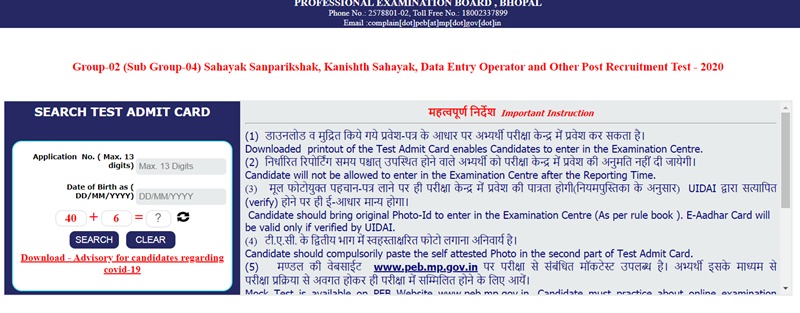
Madhya Pradesh Vyapam Group II Sub Gr IV Admit Card 2021Available Now

Steps to download MP Vyapam Gr II hall ticket 2021

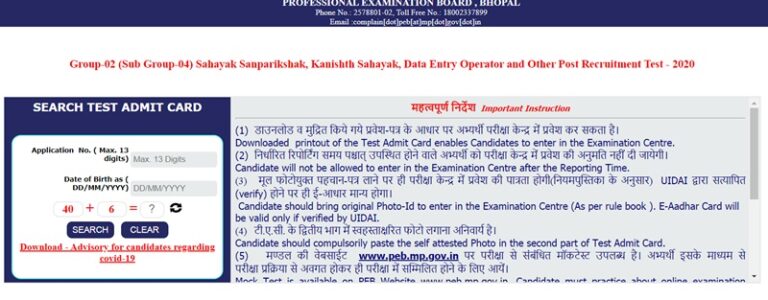
  1. Go to MP Vyapam Website, peb.mp.gov.in or directly click on the hall ticket download link provided below.
  2. On the homepage, you can find the admit card download link for all the announced posts.
  3. Click on the relevant link and enter the login credentials.
  4. Tap on the submit button.
  5. The admit card gets downloaded. Check all the details carefully from it.
  6. Take a printout of it and keep it safe; carry the admit card and identity proof while going to the examination.
IS Released MP Vyapam Group 2 Admit Card 2021?

Yes MPPEB Released Admit Card.

What are the Exam Dates of MP Vyappam Group 2?

29th January to 04th February 2021

What are the Documents Needed to carry along with Admit card to exam hall?

Any Govt Identification ID which is mentioned above.

OU MBA 2nd Sem Results 2020-21 (Released) – MBA II Sem Results @ osmania.ac.in

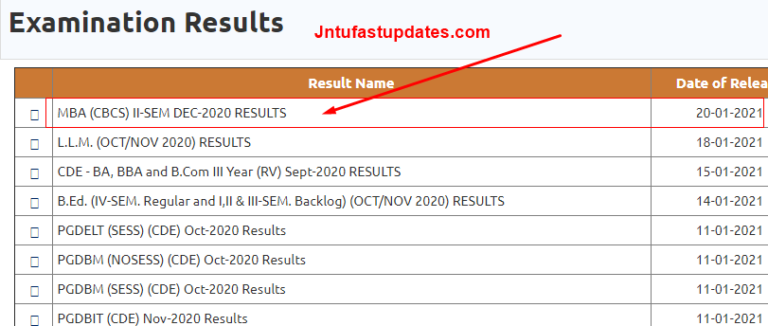
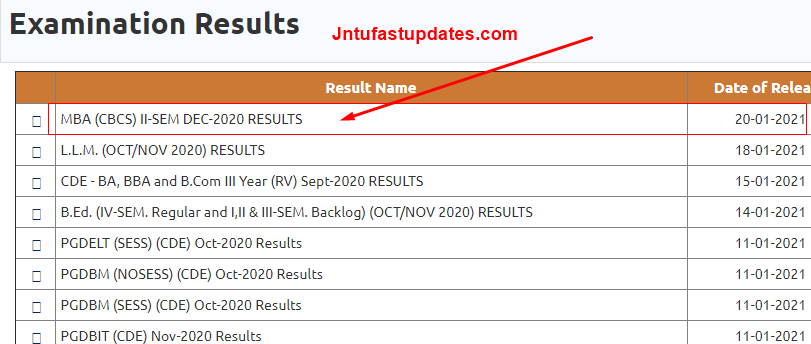
OU MBA 2nd Sem Results 2020-21: Osmania University has released OU MBA 2nd Sem Results 2020 at www.osmania.ac.in. Students may check their MBA (CBCS) II SEM DEC-2020 results below.

OU MBA 2nd Sem Results 2020-21 – MBA II Sem Results @ osmania.ac.in

osmania university

Students who had appeared for the Osmania University MBA 2nd Sem exams in December 2020, Can check their results from links given below.

Details Osmania University MBA 2nd Sem Result 2020

OrganizationOsmania University
Name of the ExaminationMBA (CBCS) 2nd Sem Dec 2020
OU MBA Result Release date20-01-2021
Status of OU MBA 2nd ResultAvailable Now
Official Websitewww.osmania.ac.in

OU MBA 2nd Sem Results Dec 2020Released on 20-01-2021

How to Check OU MBA 1st Sem Results 2020

1. Visit the Osmania University official website or Follow the above given URL

2. Enter 12 Digit “Hall Ticket Number”. Example : 100419673001, 100419673002 .

3. Hit “Submit” & you can view your result.

4. Save or Print it for future reference.

Note : Results Announced on 20-01-2021.

You may visit www.osmania.ac.in website to get more details about this Osmania University results.

Magadh University Result 2021 Part 3 (Released) – Part 1 2 B.A B.Com B.Sc Results @ magadhuniversity.ac.in

Magadh University Result 2021 Part 3 BA B.Sc B.Com: Magadh University announced the UG results for Part 3 B.A B.Com B.Sc courses at magadhuniversity.ac.in. Aspirants who had appeared for Magadh University B.Com, BA, B.SC Part 3 exams in December month 2020 can check the result from the official website. University has also declared the results for various other UG and PG courses. Hence the hopefuls undergoing education under Magadh University can head to the official portal to check latest updates. UG Results part 3 have been announced for various courses. Candidates can check Magadh University results, marks, and grade by visiting the official Website.

Magadh University Results 2020 Part 3 For B.A B.Com B.Sc @ magadhuniversity.ac.in

Magadh University Result 2019

Magadh University is one of the most well-established universities in the state of Bihar. The university was formed in the year 1962. The university offers various undergraduate and postgraduate degree courses in the state of Bihar. The university offers various UG courses B.Sc. (Hons) Mathematics, B.Sc. (Hons) Physics, B.Sc. (Hons) Home Science Resource Management, B.Sc. (Hons) Statistics, B.Sc. Applied Physical Sciences, B.Sc. (Hons) Zoology, B.Sc. Applied Physical Sciences (Electronics), B.A. (Hons) Urdu, B.A. Vocational Studies, B.Sc. Home Science (Pass), B.B.E., B.B.A, B.B.M Etc, and PG Courses  M.A. English, M.A. Geography, M.A. Hindi, M.A. Economics, M.A. History, M.A. Music, M.A. Mathematics, M.A. Persian, M.A. Philosophy Etc. Yearly, a large number of students are undergoing education from Magadh University. The university follows the semester system and conducts exams yearly twice.

Magadh University UG B.A,B.Sc, B.Com Result 2021 – Important Details

Name of the University Magadh University
Website magadhuniversity.ac.in
Name of the Exam Magadh University UG Part 3 Ba, B.Com, B.SC
Date of the Exam 1st to 10th December 2020
Category Results
Declaration of Results Released on 20th Jan

Download Magadh University B.A B.Com B.Sc Part 3 Results 2020

Students who have appeared for the UG  exams in the month of June can download Magadh University results 2021 for BA, B.Sc, B.Com courses. Magadh University released the results for Graduate degree courses for part 1, part 2. Students can check the results by visiting the website and by giving the details such as their register number, and other details at the requisite columns.

Magadh University BA B.com B.SC Part 3 Results Dec 2020-2021 – Released on 20th Jan, 2021

Magadh University BA B.Com B.Sc Part 1 Result 2020Available Shortly

Magadh University BA B.Sc B.Com Part 2 Results 2020 – Available Now

Magadh University BA Part 1 Results 2019 – Available Here

Magadh University B.Com Part 1 Results 2019– Available Here

Magadh University B.SC Part 1 Results 2019 – Available Here

Magadh University B.Com Part 2 Results 2019 – Available Here

Magadh University result 2021

How to Check Magadh University UG Results 2021 Online?

  • Visit the magadh University Official Website, www.magadhuniversity.ac.in
  • Search for the UG Results 2021 Link
  • Click on the link and enter the college code and password.
  • Click on submit button
  • The Magadh University results appears on the screen.
  • Check the result, marks, and grade and take a printout for further reference.
IS Released Magadh University Result 2021?

yes, Magadh University results For Part 3 Exams Released on 20th January 2021.

When Magadh University held Part 3 Exams?

From 1st dec to 10th December 2020.

For Which Courses Magadh University results will be released?

UG & PG Courses.

How Can WE check Magadh University Part 1 2 3 result?

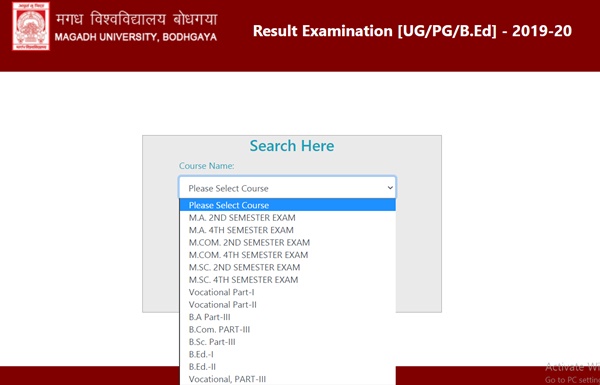
Students Click on above direct website link and choose course name and enter roll number and submit then you will get marksheet.