JNTUK R19 2-1 Computer Organization Material PDF Download

JNTUK R19 2-1 Computer Organization Material PDF Download

Students those who are studying JNTUK R19 CSE, IT Branch, Can Download Unit wise R19 2-1 Computer Organization Material PDFs below.

jntuk-materials

JNTUK R19 2-1 Computer Organization Material PDF Download

Course Objectives: The course objectives of Computer Organization are to discuss and make student familiar with the

  • Principles and the Implementation of Computer Arithmetic
  • Operation of CPUs including RTL, ALU, Instruction Cycle and Busses
  • Fundamentals of different Instruction Set Architectures and their relationship to the CPU Design
  • Memory System and I/O Organization
  • Principles of Operation of Multiprocessor Systems and Pipelining

Course Outcomes: By the end of the course, the student will

  • Develop a detailed understanding of computer systems
  • Cite different number systems, binary addition and subtraction, standard, floating-point, and micro operations
  • Develop a detailed understanding of architecture and functionality of central processing unit
  • Exemplify in a better way the I/O and memory organization
  • Illustrate concepts of parallel processing, pipelining and inter processor communication

UNIT-1

Basic Structure of Computers: Basic Organization of Computers, Historical Perspective, Bus Structures, Data Representation: Data types, Complements, Fixed Point Representation. Floating, Point Representation. Other Binary Codes, Error Detection Codes.

Computer Arithmetic: Addition and Subtraction, Multiplication Algorithms, Division Algorithms.

Download UNIT-1 Material PDF | Reference-2

UNIT-2

Register Transfer Language and Microoperations: Register Transfer language. Register Transfer Bus and Memory Transfers, Arithmetic Micro operations, Logic Micro Operations, Shift Micro Operations, Arithmetic Logic Shift Unit.

Basic Computer Organization and Design: Instruction Codes, Computer Register, Computer Instructions, Instruction Cycle, Memory – Reference Instructions. Input –Output and Interrupt, Complete Computer Description.

Download UNIT-2 Material PDF | Reference-2

UNIT-3

Central Processing Unit: General Register Organization, STACK Organization. Instruction Formats, Addressing Modes, Data Transfer and Manipulation, Program Control, Reduced Instruction Set Computer.

Microprogrammed Control: Control Memory, Address Sequencing, Micro Program example, Design of Control Unit.

Download UNIT-3 Material PDF | Reference-2

UNIT-4

Memory Organization: Memory Hierarchy, Main Memory, Auxiliary Memory, Associative Memory, Cache Memory, Virtual Memory.

Input-Output Organization: Peripheral Devices, Input-Output Interface, Asynchronous data transfer, Modes of Transfer, Priority Interrupts, Direct Memory Access.

Download UNIT-4 Material PDF | Reference-2

UNIT-5

Multi Processors: Introduction, Characteristics of Multiprocessors, Interconnection Structures, Inter Processor Arbitration.

Pipeline: Parallel Processing, Pipelining, Instruction Pipeline, RISC Pipeline, Array Processor.

Download UNIT-5 Material PDF


e-Resources:

Modules / Lectures

Link-2

Text Books:

1) Computer System Architecture, M. Morris Mano, Third Edition, Pearson, 2008.

2) Computer Organization, Carl Hamacher, Zvonko Vranesic, Safwat Zaky, 5/e, McGraw Hill, 2002.

Reference Books:

1) Computer Organization and Architecture, William Stallings, 6/e, Pearson, 2006.

2) Structured Computer Organization, Andrew S. Tanenbaum, 4/e, Pearson, 2005.

3) Fundamentals of Computer Organization and Design, Sivarama P. Dandamudi, Springer, 2006.

JNTUK R19 2-1 OOPS C++ Material PDF Download

JNTUK R19 2-1 OOPS C++ Material PDF Download

Students those who are studying JNTUK R19 CSE, IT Branch, Can Download Unit wise R19 2-1 Object Oriented Programming through C++ Material PDFs below.

jntuk-materials

JNTUK R19 2-1 Object Oriented Programming through C++ Material PDF Download

Course Objectives:

  • Describe the procedural and object oriented paradigm with concepts of streams, classes, functions, data and objects
  • Understand dynamic memory management techniques using pointers, constructors, destructors
  • Describe the concept of function overloading, operator overloading, virtual functions and polymorphism
  • Classify inheritance with the understanding of early and late binding, usage of exception handling, generic programming
  • Demonstrate the use of various OOPs concepts with the help of programs

Course Outcomes: By the end of the course, the student

  • Classify object oriented programming and procedural programming
  • Apply C++ features such as composition of objects, operator overloads, dynamic memory allocation, inheritance and polymorphism, file I/O, exception handling
  • Build C++ classes using appropriate encapsulation and design principles
  • Apply object oriented or non-object oriented techniques to solve bigger computing problems

UNIT-1

Introduction to C++: Difference between C and C++, Evolution of C++, The Object Oriented Technology, Disadvantage of Conventional Programming, Key Concepts of Object Oriented Programming, Advantage of OOP, Object Oriented Language.

Download UNIT-1 Material PDF | Reference-2

UNIT-2

Classes and Objects &Constructors and Destructor: Classes in C++, Declaring Objects, Access Specifiers and their Scope, Defining Member Function, Overloading Member Function, Nested class, Constructors and Destructors, Introduction, Constructors and Destructor, Characteristics of Constructor and Destructor, Application with Constructor, Constructor with Arguments parameterized Constructor, Destructors, Anonymous Objects.

Download UNIT-2 Material PDF | Reference-2

UNIT-3

Operator Overloading and Type Conversion & Inheritance: The Keyword Operator, Overloading Unary Operator, Operator Return Type, Overloading Assignment Operator (=), Rules for Overloading Operators, Inheritance, Reusability, Types of Inheritance, Virtual Base ClassesObject as a Class Member, Abstract Classes, Advantages of Inheritance, Disadvantages of Inheritance.

Download UNIT-3 Material PDF | Reference-2

UNIT-4

Pointers & Binding Polymorphisms and Virtual Functions: Pointer, Features of Pointers, Pointer Declaration, Pointer to Class, Pointer Object, The this Pointer, Pointer to Derived Classes and Base Class, Binding Polymorphisms and Virtual Functions, Introduction, Binding in C++, Virtual Functions, Rules for Virtual Function, Virtual Destructor.

Download UNIT-4 Material PDF

UNIT-5

Generic Programming with Templates & Exception Handling: Definition of class Templates, Normal Function Templates, Over Loading of Template Function, Bubble Sort Using Function Templates, Difference between Templates and Macros, Linked Lists with Templates, Exception Handling, Principles of Exception Handling, The Keywords try throw and catch, Multiple Catch Statements, Specifying Exceptions. Overview of Standard Template Library, STL Programming Model, Containers, Sequence Containers, Associative Containers, Algorithms, Iterators, Vectors, Lists, Maps.

Download UNIT-5 Material PDF


e-Resources:

Modules / Lectures

Link-2

Text Books:

1) A First Book of C++, Gary Bronson, Cengage Learning.

2) The Complete Reference C++, Herbert Schildt, TMH.

Reference Books:

1) Object Oriented Programming C++, Joyce Farrell, Cengage.

2) C++ Programming: from problem analysis to program design, DS Malik, Cengage Learning

3) Programming in C++, Ashok N Kamthane, Pearson 2nd Edition

JNTUK R19 2-1 Python Programming Material PDF Download

JNTUK R19 2-1 Python Programming Material PDF Download

Students those who are studying JNTUK R19 CSE, IT Branch, Can Download Unit wise R19 2-1 Python Programming Material PDFs below.

jntuk-materials

JNTUK R19 2-1 Python Programming Material PDF Download

Course Objectives:

  • The Objectives of Python Programming are
  • To learn about Python programming language syntax, semantics, and the runtime environment
  • To be familiarized with universal computer programming concepts like data types, containers
  • To be familiarized with general computer programming concepts like conditional execution, loops & functions
  • To be familiarized with general coding techniques and object-oriented programming

Course Outcomes:

  • Develop essential programming skills in computer programming concepts like data types, containers
  • Apply the basics of programming in the Python language
  • Solve coding tasks related conditional execution, loops
  • Solve coding tasks related to the fundamental notions and techniques used in objectoriented programming

UNIT-1

Introduction: Introduction to Python, Program Development Cycle, Input, Processing, and Output, Displaying Output with the Print Function, Comments, Variables, Reading Input from the Keyboard, Performing Calculations, Operators. Type conversions, Expressions, More about Data Output.

Data Types, and Expression: Strings Assignment, and Comment, Numeric Data Types and Character Sets, Using functions and Modules.

Decision Structures and Boolean Logic: if, if-else, if-elif-else Statements, Nested Decision Structures, Comparing Strings, Logical Operators, Boolean Variables. Repetition Structures: Introduction, while loop, for loop, Calculating a Running Total, Input Validation Loops, Nested Loops.

Download UNIT-1 Material PDF |Reference-2 | Reference-3

UNIT-2

Control Statement: Definite iteration for Loop Formatting Text for output, Selection if and if else Statement Conditional Iteration The While Loop

Strings and Text Files: Accessing Character and Substring in Strings, Data Encryption, Strings and Number Systems, String Methods Text Files.

Download UNIT-2 Material PDF | Reference-2

UNIT-3

List and Dictionaries: Lists, Defining Simple Functions, Dictionaries Design with Function: Functions as Abstraction Mechanisms, Problem Solving with Top Down Design, Design with Recursive Functions, Case Study Gathering Information from a File System, Managing a Program’s Namespace, Higher Order Function.

Modules: Modules, Standard Modules, Packages.

Download UNIT-3 Material PDF | Reference-2

UNIT-4

File Operations: Reading config files in python, Writing log files in python, Understanding read functions, read(), readline() and readlines(), Understanding write functions, write() and writelines(), Manipulating file pointer using seek, Programming using file operations

Object Oriented Programming: Concept of class, object and instances, Constructor, class attributes and destructors, Real time use of class in live projects, Inheritance , overlapping and overloading operators, Adding and retrieving dynamic attributes of classes, Programming using Oops support Design with Classes: Objects and Classes, Data modeling Examples, Case Study An ATM, Structuring Classes with Inheritance and Polymorphism

Download UNIT-4 Material PDF | Reference-2

UNIT-5

Errors and Exceptions: Syntax Errors, Exceptions, Handling Exceptions, Raising Exceptions, User-defined Exceptions, Defining Clean-up Actions, Redefined Clean-up Actions.

Graphical User Interfaces: The Behavior of Terminal Based Programs and GUI -Based, Programs, Coding Simple GUI-Based Programs, Other Useful GUI Resources. Programming: Introduction to Programming Concepts with Scratch.

Download UNIT-5 Material PDF | Reference-2


e-Resources:

Modules / Lectures

Text Books:

1) Fundamentals of Python First Programs, Kenneth. A. Lambert, Cengage.

2) Python Programming: A Modern Approach, Vamsi Kurama, Pearson.

Reference Books:

1) Introduction to Python Programming, Gowrishankar.S, Veena A, CRC Press.

2) Introduction to Programming Using Python, Y. Daniel Liang, Pearson.

JNTUK R19 2-1 Software Engineering Material PDF Download

JNTUK R19 2-1 Software Engineering Material PDF Download

Students those who are studying JNTUK R19 CSE, IT Branch, Can Download Unit wise R19 2-1 Software Engineering (Principles of Software Engineering) Material PDFs below.

jntuk-materials

JNTUK R19 2-1 Software Engineering Material PDF Download

Course Objectives: This course is designed to:

  • Give exposure to phases of Software Development, common process models including Waterfall, and the Unified Process, and hands-on experience with elements of the agile process
  • Give exposure to a variety of Software Engineering practices such as requirements analysis and specification, code analysis, code debugging, testing, traceability, and version control
  • Give exposure to Software Design techniques

Course Outcomes: Students taking this subject will gain software engineering skills in the following areas:

  • Ability to transform an Object-Oriented Design into high quality, executable code
  • Skills to design, implement, and execute test cases at the Unit and Integration level
  • Compare conventional and agile software methods

UNIT-1

The Nature of Software, The Unique Nature of WebApps, Software Engineering, The Software Process, Software Engineering Practice, Software Myths. A Generic Process Model, Process Assessment and Improvement, Prescriptive Process Models, Specialized Process Models, The Unified Process, Personal and Team Process Models, Process Technology.

Download UNIT-1 Material PDF | Reference-2

UNIT-2

Agility, Agility and the Cost of Change, Agile Process, Extreme Programming (XP), Other Agile Process Models, A Tool Set for the Agile Process, Software Engineering Knowledge, Core Principles, Principles That Guide Each Framework Activity, Requirements Engineering, Establishing the Groundwork, Eliciting Requirements, Developing Use Cases, Building the Requirements Model, Negotiating Requirements, Validating Requirements.

Download UNIT-2 Material PDF | Reference-2 | Ref-3

UNIT-3

Requirements Analysis, Scenario-Based Modeling, UML Models That Supplement the Use Case, Data Modeling Concepts, Class-Based Modeling, Requirements Modeling Strategies, FlowOriented Modeling, Creating a Behavioral Model, Patterns for Requirements Modelling, Requirements Modeling for WebApps.

Download UNIT-3 Material PDF

UNIT-4

Design within the Context of Software Engineering, The Design Process, Design Concepts, The Design Model, Software Architecture, Architectural Genres, Architectural Styles, Assessing Alternative Architectural Designs, Architectural Mapping Using Data Flow, Components, Designing Class-Based Components, Conducting Component-Level Design, Component-Level Design for WebApps, Designing Traditional Components, Component-Based Development.

Download UNIT-4 Material PDF | Reference-2

UNIT-5

The Golden Rules, User Interface Analysis and Design, Interface Analysis, Interface Design Steps, WebApp Interface Design, Design Evaluation, Elements of Software Qualtiy Assurance, SQA Tasks, Goals & Metrics, Statistical SQA, Software Reliability, A Strategic Approach to Software Testing, Strategic Issues, Test Strategies for Conventional Software, Test Strategies for Object-Oriented Software, Test Strategies for WebApps, Validation Testing, System Testing, The Art of Debugging, Software Testing Fundamentals, Internal and External Views of Testing, White-Box Testing, Basis Path Testing.

Download UNIT-5 Material PDF | Reference-2


e-Resources:

Modules / Lectures

Text Books:

1) Software Engineering a practitioner’s approach, Roger S. Pressman, Seventh Edition, McGraw Hill Higher Education.

2) Software Engineering, Ian Sommerville, Ninth Edition, Pearson.

Reference Books:

1) Software Engineering, A Precise Approach, PankajJalote, Wiley India, 2010.

2) Software Engineering, Ugrasen Suman, Cengage.

MP Vyapam Group 2 Admit Card 2021 (Released) @ peb.mp.gov.in

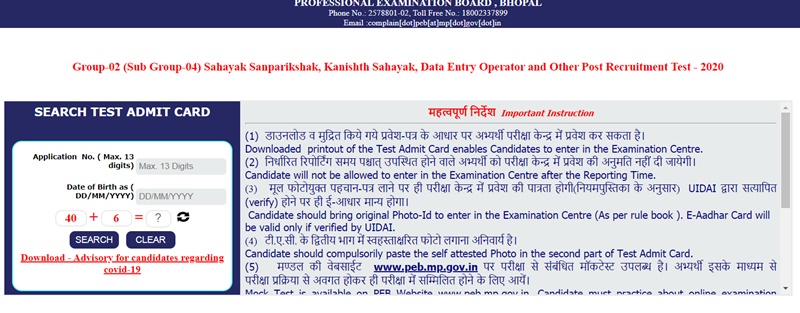
MPPEB Group 2 Admit Card/ Call Letter 2021 Download: Madhya Pradesh Professional Examination Board (MPPEB) also known as MP Vyapam is going to organize the written test for Group 2 (Sub Group-4) Posts – Data Entry Operator, Sahayak Sanparikshak, Kanishth Sahayak & Other Posts from 29th January to 4th February 2021. All the applicants have to prepare hard to crack the examination as the competition is higher for the MP Group II posts. Before going to attend the written test round, applicants have to download MP Vyapam Group II Admit Card 2021 to carry to the examination.

As every one of the competitors aware, the admit card/hall ticket is the most required document to carry to the examination. The hall ticket download link will e activated shortly on MP Vyapam official website, peb.mp.gov.in. As soon as the admit card link activated on the MPPEB official page, by tapping on the link, aspirants can download the exam call letter. After downloading it, take a printout of it and keep it safe to carry to the examination. Hall ticket is the must to carry document; the admit card verification will be done before allowing the candidates to proceed with the test. Candidates who fail to show the admit card at the time of verification will lose the chance to attend the test. The MP Vyapam Group II hall ticket release date, downloading process, and guidelines for the examination are given in the following article.

MP Vyapam Group 2 Admit Card 2021 @ peb.mp.gov.in

MP Vyapam Group 2 Admit Card 2021

Madhya Pradesh Professional Education Board is also known as MP Vyapam in the usual scenario. This is the state government organization that looks after various government-related works in the state. Annually, the organization announces various job notifications for the government-affiliated to it. MP Vyapam has recently released the notification for 250 Group 2 (Sub Group-4) Posts – Data Entry Operator, Sahayak Sanparikshak, Kanishth Sahayak & Other Posts to fill up the vacant positions in government schools of Madhya Pradesh. A large number of aspirants with suitable qualifications have applied for MP Vyapam Group 2 posts during the application dates. The MPPEB will shortlist the aspirants based on their merit in various rounds such as written tests, interview rounds. Candidates have to score good merit in all the rounds to get the job as a high school teacher in the state of Madhya Pradesh.  

MP Vyapam Assistant Gr 1 SG-4 Admit Card 2020 – Important Details

Name Of The OrganizationMadhya Pradesh Professional Examination Board (MPPEB)
Name Of The PostsGroup 2 (Sub Group-4) Posts – Data Entry Operator, Sahayak Sanparikshak, Kanishth Sahayak & Other Posts
Total Number Of Posts250 Posts
Exam Date29th January to 04th February 2021
CategoryAdmit Cards
Admit Card AvailabilityReleased on 21st January 2021
Official Portalpeb.mp.gov.in

Download MPPEB Group 2 Admit Card/ Hall Ticket 2021 & Exam City Center Name Details @ peb.mp.gov.in

The MPPEB board has scheduled the written test round for Group 2 (Sub Group 4) posts from 29th January to 4th February 2021. All the applicants who are going to participate in the written test round and waiting for the hall ticket can visit the official website, peb.mp.gov.in to download the exam call letter. The hall ticket/admit card is likely to be released before 10 days of the examination [tentatively]. Hence the hopefuls can check the official website on a frequent basis to download their hall tickets.  

Download MPPEB Group II hall ticket 2021 and observe the details of,

  • Examination venue
  • Date of the test
  • Timings of the test
  • Candidate’s name
  • Register number/hall ticket number
  • Date of birth of the candidate
  • Father’s/Mother’s Name
  • Candidate’s signature
  • Candidate’s Photograph
  • And other details, guidelines.

Hopefuls competing for the MP Vyapam Group 2 (Sub Group-4) Posts – Data Entry Operator, Sahayak Sanparikshak, Kanishth Sahayak & Other Posts,  and other posts will have to attend the test along with the admit cards. Also, candidates need to carry any of the valid identity proof copy along with the hall ticket. The identity proof that the competitors can carry is,  

  • Aadhar Card
  • PAN Card
  • Passport
  • Driving Licence
  • Ration Card
  • Or any others.

Madhya Pradesh Vyapam Group II Sub Gr IV Admit Card 2021Available Now

Steps to download MP Vyapam Gr II hall ticket 2021

  1. Go to MP Vyapam Website, peb.mp.gov.in or directly click on the hall ticket download link provided below.
  2. On the homepage, you can find the admit card download link for all the announced posts.
  3. Click on the relevant link and enter the login credentials.
  4. Tap on the submit button.
  5. The admit card gets downloaded. Check all the details carefully from it.
  6. Take a printout of it and keep it safe; carry the admit card and identity proof while going to the examination.
IS Released MP Vyapam Group 2 Admit Card 2021?

Yes MPPEB Released Admit Card.

What are the Exam Dates of MP Vyappam Group 2?

29th January to 04th February 2021

What are the Documents Needed to carry along with Admit card to exam hall?

Any Govt Identification ID which is mentioned above.

OU MBA 2nd Sem Results 2020-21 (Released) – MBA II Sem Results @ osmania.ac.in

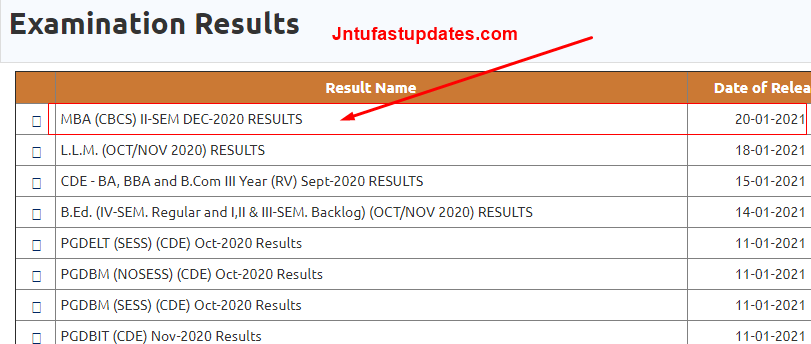
OU MBA 2nd Sem Results 2020-21: Osmania University has released OU MBA 2nd Sem Results 2020 at www.osmania.ac.in. Students may check their MBA (CBCS) II SEM DEC-2020 results below.

OU MBA 2nd Sem Results 2020-21 – MBA II Sem Results @ osmania.ac.in

osmania university

Students who had appeared for the Osmania University MBA 2nd Sem exams in December 2020, Can check their results from links given below.

Details Osmania University MBA 2nd Sem Result 2020

OrganizationOsmania University
Name of the ExaminationMBA (CBCS) 2nd Sem Dec 2020
OU MBA Result Release date20-01-2021
Status of OU MBA 2nd ResultAvailable Now
Official Websitewww.osmania.ac.in

OU MBA 2nd Sem Results Dec 2020Released on 20-01-2021

How to Check OU MBA 1st Sem Results 2020

1. Visit the Osmania University official website or Follow the above given URL

2. Enter 12 Digit “Hall Ticket Number”. Example : 100419673001, 100419673002 .

3. Hit “Submit” & you can view your result.

4. Save or Print it for future reference.

Note : Results Announced on 20-01-2021.

You may visit www.osmania.ac.in website to get more details about this Osmania University results.

Magadh University Result 2021 Part 3 (Released) – Part 1 2 B.A B.Com B.Sc Results @ magadhuniversity.ac.in

Magadh University Result 2021 Part 3 BA B.Sc B.Com: Magadh University announced the UG results for Part 3 B.A B.Com B.Sc courses at magadhuniversity.ac.in. Aspirants who had appeared for Magadh University B.Com, BA, B.SC Part 3 exams in December month 2020 can check the result from the official website. University has also declared the results for various other UG and PG courses. Hence the hopefuls undergoing education under Magadh University can head to the official portal to check latest updates. UG Results part 3 have been announced for various courses. Candidates can check Magadh University results, marks, and grade by visiting the official Website.

Magadh University Results 2020 Part 3 For B.A B.Com B.Sc @ magadhuniversity.ac.in

Magadh University Result 2019

Magadh University is one of the most well-established universities in the state of Bihar. The university was formed in the year 1962. The university offers various undergraduate and postgraduate degree courses in the state of Bihar. The university offers various UG courses B.Sc. (Hons) Mathematics, B.Sc. (Hons) Physics, B.Sc. (Hons) Home Science Resource Management, B.Sc. (Hons) Statistics, B.Sc. Applied Physical Sciences, B.Sc. (Hons) Zoology, B.Sc. Applied Physical Sciences (Electronics), B.A. (Hons) Urdu, B.A. Vocational Studies, B.Sc. Home Science (Pass), B.B.E., B.B.A, B.B.M Etc, and PG Courses  M.A. English, M.A. Geography, M.A. Hindi, M.A. Economics, M.A. History, M.A. Music, M.A. Mathematics, M.A. Persian, M.A. Philosophy Etc. Yearly, a large number of students are undergoing education from Magadh University. The university follows the semester system and conducts exams yearly twice.

Magadh University UG B.A,B.Sc, B.Com Result 2021 – Important Details

Name of the University Magadh University
Website magadhuniversity.ac.in
Name of the Exam Magadh University UG Part 3 Ba, B.Com, B.SC
Date of the Exam 1st to 10th December 2020
Category Results
Declaration of Results Released on 20th Jan

Download Magadh University B.A B.Com B.Sc Part 3 Results 2020

Students who have appeared for the UG  exams in the month of June can download Magadh University results 2021 for BA, B.Sc, B.Com courses. Magadh University released the results for Graduate degree courses for part 1, part 2. Students can check the results by visiting the website and by giving the details such as their register number, and other details at the requisite columns.

Magadh University BA B.com B.SC Part 3 Results Dec 2020-2021 – Released on 20th Jan, 2021

Magadh University BA B.Com B.Sc Part 1 Result 2020Available Shortly

Magadh University BA B.Sc B.Com Part 2 Results 2020 – Available Now

Magadh University BA Part 1 Results 2019 – Available Here

Magadh University B.Com Part 1 Results 2019– Available Here

Magadh University B.SC Part 1 Results 2019 – Available Here

Magadh University B.Com Part 2 Results 2019 – Available Here

Magadh University result 2021

How to Check Magadh University UG Results 2021 Online?

  • Visit the magadh University Official Website, www.magadhuniversity.ac.in
  • Search for the UG Results 2021 Link
  • Click on the link and enter the college code and password.
  • Click on submit button
  • The Magadh University results appears on the screen.
  • Check the result, marks, and grade and take a printout for further reference.
IS Released Magadh University Result 2021?

yes, Magadh University results For Part 3 Exams Released on 20th January 2021.

When Magadh University held Part 3 Exams?

From 1st dec to 10th December 2020.

For Which Courses Magadh University results will be released?

UG & PG Courses.

How Can WE check Magadh University Part 1 2 3 result?

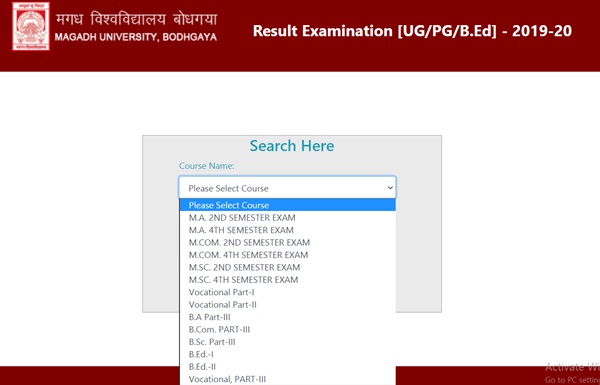
Students Click on above direct website link and choose course name and enter roll number and submit then you will get marksheet.

Bihar Police Sepoy Admit Card 2021 (Released) – Written Exam Date, Call Letter

Bihar Police Sepoy Admit Card 2021 Download, Exam Date: Bihar Police Department & Central Selection Board of Constable (CSBC) has recently drafted a notification for 551 Sepoy (Home Guard) posts. Many of the suitable candidates having an interest in Police Department jobs have sent their applications within the specified application dates. The Bihar Police Department is going to organize the written test round for Sepoy posts on 24th January 2021. All the applicants can get ready for the written test round. This is the competition is expected to be higher for the home guard posts in Bihar.

Aspirants applied for Bihar Sepoy posts can start their preparation for the written test round to crack the exam. Before going to appear for the Bihar Sepoy written test, all the contenders must have to download Bihar Sepoy admit card 2020, as it is the must to carry a document to the examination. The hall tickets of the candidates will be checked at the examination hall. Before entering the exam hall, one must show their exam call letter to the invigilator. Otherwise, their entry to the examination will be prohibited. The admit card contains the information of examination venue, date, and timings. Contenders can check all the details clearly from the admit card and proceed to the examination. As soon as the hall ticket releases, the competitors can take a printout of it and keep it safe for the exam purpose. More details such as Bihar Police Sepoy admit card release date, downloading process, and other information are provided in this article.

Bihar Police Sepoy Admit Card 2021 (Released) – Written Exam Date, Call Letter

Bihar Police Sepoy Admit Card 2021

Bihar Police Department & Central Selection Board of Constable is the state government organization that hires the police force for the safety and security of the state. This organization releases various notifications to select the candidates for the police department. Recently, CSBC Bihar announced a recruitment notification for 551 Sepoy (Home Guard) posts. During the application dates, a large number of aspirants seeking to get state government jobs in Bihar have applied for the announced posts. The organization received lakhs of applications from aspirants who are desirous to work for the police department. CSBC Bihar is going to conduct the written test round, physical eligibility test, medical test, and document verification rounds to select the candidates for Sepoy jobs. Candidates qualifying the selection process with good merit will be shortlisted for the announced posts.

Bihar Police Home Guard Admit Card 2021 – Important Details

Organization NameBihar Police Department & Central Selection Board of Constable
Post NameSepoy (Home Guard)
No Of Posts551
Exam Date24th January 2021
CategoryAdmit Card
Admit Card Release DateReleased on 20th Jan
Official Sitecsbc.bih.nic.in

Download Bihar Police Sepoy Admit Card 2021, Exam City Centers List @ csbc.bih.nic.in

CSBC Bihar is likely to organize the written test round for police sepoy posts in August or September months [tentatively]. Soon, the department will announce the written test dates. The written test will be conducted in a large number of examination centers in Bihar state. Aspirants who had applied for CSBC Police Home Guard posts can get ready for the written test round with a good grounding. Before going to compete for the written test round, aspirants will have to download Bihar Police Sepoy admit card 2020 from the official portal, csbc.bih.nic.in. The admit cards will be accessible to download before 10 days of the exam date. Hence the aspirants can keep checking the CSBC portal to download their admit cards. As soon as the hall ticket link provided by the department, by clicking on it, the contenders can download the call letters. After downloading the hall ticket, check all the details from it.

  • Examination venue
  • Date of the test
  • Timings of the test
  • Candidate’s name
  • Register number/hall ticket number
  • Date of birth of the candidate
  • Father’s/Mother’s Name
  • Candidate’s signature
  • Candidate’s Photograph

Hopefuls competing for the Bihar Police Constable Sepoy written test will have to attend the test along with the admit cards. Also, candidates need to carry any of the valid identity proof copy along with the hall ticket. The identity proof that the competitors can carry is,

  • Aadhar Card
  • PAN Card
  • Passport
  • Driving Licence
  • Ration Card
  • Or any others.

Contenders are advised to reach the examination hall before 30 minutes of the exam scheduled time. Do not forget to carry the admit card and identity proof to the examination. To avoid any sort of difficulties while attending to the exam, contenders must follow the exam guidelines given by the CSBC.

Download Bihar Police Sepoy Home Guard Admit Card 2021Available Now

List of Centers (by Roll Numbers) for the Written Exam to be held on 24th January, 2021 for the post of Home Guard Constables

Steps to Download CSBC Bihar Constable Sepoy Admit Card 2021

  • Visit the CSBC Bihar website, csbc.bih.nic.in.
  • Search the Bihar Police Constable Sepoy Hall Ticket download link in organization website.
  • Click the download link and enter the required details like Name and registration no.
  • Submit the details and it will display on the screen after some time.
  • Check the information in Bihar CSBC Police Constable Hall Ticket 2021.
  • Save or download the admit card and take a printout.
IS Released Bihar Police Sepoy Admit Card 2021?

Yes Bihar Police Home guard Admit card released

What is the Bihar Police Home Guard Written Exam date?

24th January 2021

How can i Download Bihar Homeguard Sepoy Admit Card 2021?

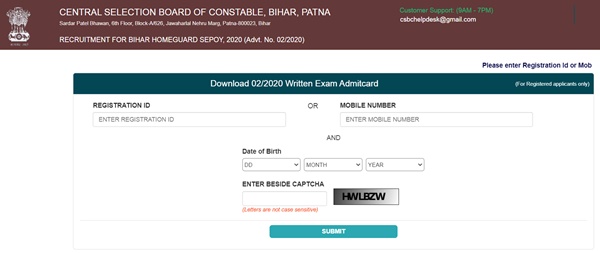
Click on Above Direct link and Enter register number or mobile number and date of birth and captcha and submit or else refer official website.

TS SBTET C-18 III & V Semesters End Exam Question Paper Pattern (Revised)

0

TS SBTET C-18 III & V Semesters End Exam Question Paper Pattern (Revised)

ts sbtet

SBTET- Pre-Exams- Revised End Semester Examination pattern in view of existing covid-19 pandemic situation for all C18 III & V (Odd) semesters for the Academic Year 2020-2021-communicated- Reg.

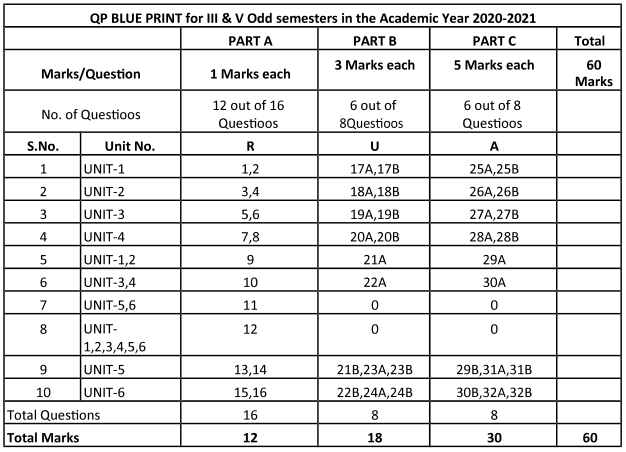
With reference to the subject cited, as per the C18 Curriculum, Mid-I, Mid-II & End Exams are to be conducted for III & V Odd semesters. However, after Examining the Pandemic situation, the Committee recommended to conduct single End Examination of three hours duration instead of Mid-I, Mid-II & End Exams to minimise physical contact of the students for all III & V semesters in the Academic Year 2020-2021 as per the following blue print vide reference cited above.

QP BLUE PRINT for III & V Odd semesters in the Academic Year 2020-2021

It is further decided to scale up the marks secured by the student for 60 to 80 marks and distribute the marks in the ratio of 25%, 25% and 50% marks to MIDl, MID2 and End Examinations respectively and process the semester result of the student.

If any student fails in the Examination the Mid Sem I & II marks awarded during this exam holds good and he has to appear the end examination in the supplementary for 40 Marks, pass criteria will be as per the existing C-18 Curriculum rules and regulations.

If any student absent in this examination the Mid I & II Examination are also treated as absent. All the Principals are requested to inform the revised Examination pattern of C18 III & V semesters exams for the Academic Year 2020-2021 to all Staff and Students with vide publicity.

JNTUH Migration Certificate Online Application form – Apply Procedure

JNTUH Migration Certificate Online: Welcome to the JNTUH Online student services. This service helps mainly for applicants who can apply online and to get the transcripts and some of the certificates to their door steps with very few mouse clicks. This service is enabled for users across the globe.

Using this service the candidates can obtain transcripts for the following certificates

  • Transcripts of Marks Memos
  • Transcripts of CMM
  • Transcripts of PC

and obtain the following Certificates/Applications

  • Migration
  • Medium certificates
  • WES Application

JNTUH Migration Certificate Online Application form – Apply Procedure

jntuh

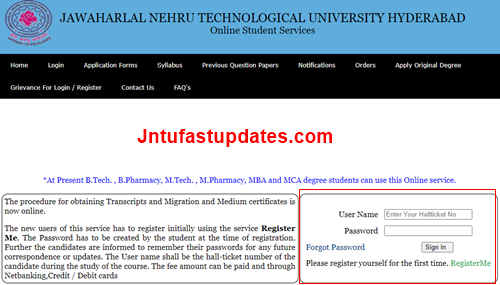
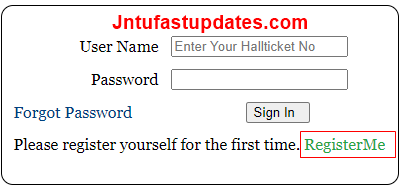
The procedure for obtaining Transcripts and Migration and Medium certificates is now online. The new users of this service has to register initially using the service Register Me. The Password has to be created by the student at the time of registration. Further the candidates are informed to remember their passwords for any future correspondence or updates. The User name shall be the hall-ticket number of the candidate during the study of the course. The fee amount can be paid either by making online Payment. The user can pay through Netbanking, Master/Visa Credit/Debit cards.

Step by Step Procedure to Apply JNTUH Migration Certificate Online

Step 1: Visit JNTUH Students Services Website; Click Here

jntuh-student-services

Step 2: You need to register yourself for the first time. Click on “Register Me“.

jntuh-student-services-registration

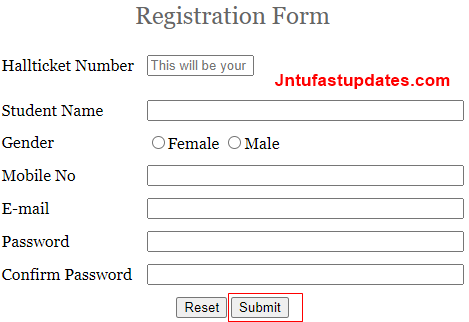
Step 3: Fill the given required details to register & Hit “Submit“.

jntuh-student-services-registration-form-filling

Step 4: The following message will be displayed. “Successfully Registered. Please Login.

Step 5: Now login by using User Name (Enter your Hallticket number) & Password.

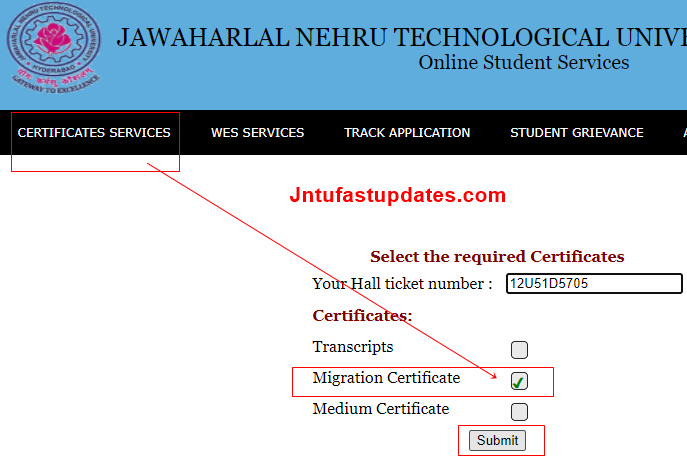
Step 6: You will be redirected to Dashboard, Now click on CERTIFICATES SERVICES.

Step 7 : Select Memos/Certificates (Only 1 copy can be obtained for Migration Certificate & WES Application)

Fee Details :

  • Migration Certificate : Rs. 100/-
  • Medium Certificate : Rs. 100/-

Step 8 : Preferred Delivery Mode

Select the mode in which you want to get the transcripts & Hit on “Submit Application“.

  • By Hand” – JNTUH Exam Branch Counters (Can collect transcripts after receiving SMS alert.)

Note: The candidates are informed to collect their transcripts from the service counters at exam branch JNTUH, within seven days after receiving the sms/email. If not collected within seven days, the candidate has to forego the claim of the transcripts.Under any circumstances the transcripts will not be issued after seven days of receiving sms/email.

  • By Post” (You Have ToEnter Your present postal address)

Step 9: Details/Conformation page will be displayed, where you can view the details & other things. Verify the details & hit “Pay”. Then you will be redirected to Payment gateway where you can pay the given amount through Credit Card / Debit Card / Internet Banking.

Step 10: After the payment is done you will be redirected back to JNTUH website, where you will get Transaction ID, Amount Paid & Transaction Status. You can even download the acknowledgement for the same in pdf format.

Step 11: Track Application Status after you login by giving your “Application Number”.

Note :

  • *At Present B.Tech. , B.Pharmacy, M.Tech. , M.Pharmacy, MBA and MCA degree students can use this Online service.
  • Dispatch service available within India. International dispatching will be enabled soon.
  • Please contact Help Desk phone number: 9491283135 for enquiries/queries related to Student Services Portal.
  • or send mails related to online student services(OSS) to the mail id : support.oss@jntuh.ac.in

FREQUENTLY ASKED QUESTIONS (FAQ’S)

1. How to apply for online student service?

Ans. Open the JNTUH website (jntuh.ac.in) and click on the online student service link at the home page. It will redirect to online student service portal. (OR) by using the url: https://studentservices.jntuh.ac.in/oss.

2. What are the other certificates, in addition to transcript, that I can obtain using this portal service?

Ans. You can also apply for migration and medium certificate an additional to transcripts.

3. I have forgotten my online student service portal password. How can I get my password?

Ans. Click on forgot password link available at the home page of online student service portal. It will ask to enter your hall ticket number, registered mobile number & email-id for verification. Once the verification is successful, you will receive your password to your registered email-id.

4.When I tried to apply for a online service in online student service portal, I am getting a response -invalid hall ticket number or data not available. Why?

Ans. The Candidates who passed their degree during or after the academic year mentioned below can only avail this service.

  • B.Tech—2000 to till date,
  • B.Pharmacy- 2009 batch to till date,
  • M.Tech – 2009 batch to till date,
  • M.Pharmacy –2009 batch to till date,
  • MBA – 2005 batch to till date,
  • MCA – 2005 batch to till date.

5. Am I eligible to apply in online student service?

Ans: Same as the answer for Q.no.4

6. I received my provisional from an autonomous college, affiliated to JNTUH. Am I eligible to apply for transcripts?

Ans. No, colleges which are affiliated and non-autonomous, are only eligible for applying transcripts in online student service.

7. After applying (preferred mode: by hand) within how many days can I collect my consignment from JNTUH exam branch service counter?

Ans. The candidates are informed to collect their transcripts from the service counters at exam branch JNTUH, within seven days after receiving the sms/email. If not collected within seven days, the candidate has to forego the claim of the transcripts. Under any circumstances, the transcripts will not be issued after seven days of receiving the sms/email.

8. How long it takes to get my Certificates after applying in online student service?

Ans. The printing and dispatching process will be completed within 2 working days after the payment is approved.

9. Can I apply for online student service in tatkal service?

Ans. There is no tatkal service to online student service.

10.I have lost my Acknowledgement receipt. Where can I get it ?

Ans. It is also sent to your registered email id, Hence you can login to your mail and can take the printout whenever you require.

11. I got an Acknowledgement. What should I do after that?

Ans. You keep that printout for further reference. In case if you have not received the applied certificates, then you can contact, Exam Branch, JNTUH with the printout of acknowledgement, at the student service counter no 1.

12.As I am trying to track using the consignment number, it shows the consignment number given is not valid.What should I do?

Ans: Consignment number received by you is correct. It will be trackable once postal/courier service picks and updates their database. You are advised to try again at the respective the postal / courier portals on the following day.

13.How to apply online transcript for Original Degree certificate?

Ans: At present, there is no transcript service for Original Degree certificate.

14. I have applied for transcripts and received SMS/email to collect them from University counter. What identification proof should I bring for receiving my certificates?

Ans: You should confirm your registered mobile number (which is used during registration) with dispatch clerk at the exam branch student service .No other proof is required .

15. What are different stages until the consignment reaches my residential address?
Ans:

  • PAYMENT APPROVED – After payment approved
  • PRINTING – Printing of applied certificates
  • INPROCESS – checking of applied certificates with address slip
  • DISPATCHEDBYPOST – Dispatched the applied certificates by post
  • DISPATCHEDBYHAND – Dispatched the applied certificates to service counter
  • DELIVERED – the applied certificates received by the candidate.

16. For any clarification or information regarding transcripts, whom should I contact?

Ans: You should contact JNTUH Exam Branch at Email:support.oss@jntuh.ac.in or at helpline no. 9491283135 during 10:30 AM to 5:00 PM on all working days.

How to apply for online student service?

Open the JNTUH website (jntuh.ac.in) and click on the online student service link at the home page. It will redirect to online student service portal. (OR) by using the url: https://studentservices.jntuh.ac.in/oss.

What are the other certificates, in addition to transcript, that I can obtain using this portal service?

You can also apply for migration and medium certificate an additional to transcripts.

Migration Cerificate Fee?

Rs 100, Only 1 copy can be obtained for Migration Certificate.