JNTUK R19 2-2 Computer Architecture and Organization Material PDF Download

JNTUK R19 2-2 Computer Architecture and Organization Material PDF Download

Students those who are studying JNTUK R19 ECE Branch, Can Download Unit wise R19 2-2 Computer Architecture and Organization (CAO) Material/Notes PDFs below.

jntuk-materials

JNTUK R19 2-2 Computer Architecture and Organization Material PDF Download

OBJECTIVES:

  • To understand the architecture of amodern computer with its variousprocessingunits. Also the Performance measurement of thecomputersystem.
  • To understand the memory management systemofcomputer.
  • To Understand the various instructions, addressingmodes
  • To Understand the concept of I/Oorganization

UNIT-1

Basic Structure Of Computers: Functional unit, Basic Operational concepts, Bus structures, System Software, Performance, The history of computer development.

Machine Instruction and Programs: Instruction and Instruction Sequencing: Register Transfer Notation, Assembly Language Notation, Basic Instruction Types.

Download UNIT-1 Material PDF

UNIT-2

Addressing Modes, Basic Input/output Operations, The role of Stacks and Queues in computer programming equation. Component of Instructions: Logic Instructions, shift and Rotate Instructions

Type of Instructions: Arithmetic and Logic Instructions, Branch Instructions, Addressing Modes, Input/output Operations

Download UNIT-2 Material PDF

UNIT-3

INPUT/OUTPUT ORGANIZATION: Accessing I/O Devices, Interrupts: Interrupt Hardware, Enabling and Disabling Interrupts, Handling Multiple Devices, Direct Memory Access,

Buses: Synchronous Bus, Asynchronous Bus, Interface Circuits, Standard I/O Interface: Peripheral Component Interconnect (PCI) Bus, Universal Serial Bus (USB)

Download UNIT-3 Material PDF | Reference-2

UNIT-4

The MEMORY SYSTEMS: Basic memory circuits, Memory System Consideration, ReadOnly Memory: ROM, PROM, EPROM, EEPROM, Flash Memory, Cache Memories: Mapping Functions, INTERLEAVING

Secondary Storage: Magnetic Hard Disks, Optical Disks,

Download UNIT-4 Material PDF

UNIT-5

Processing Unit: Fundamental Concepts: Register Transfers, Performing an Arithmetic Or Logic Operation, Fetching A Word From Memory,Execution of Complete Instruction, Hardwired Control,

Micro programmed Control: Microinstructions, Micro program Sequencing, Wide Branch Addressing Microinstructions with next –Address Field

Download UNIT-5 Material PDF | Reference-2


TEXT BOOKS:

  1. Computer Organization, Carl Hamacher, ZvonksVranesic, SafeaZaky, 5thEdition, McGrawHill, 2011.
  2. Computer Architecture and Organization, John P. Hayes ,3rdEdition, McGrawHill, 2002.

REFERENCE BOOKS:

  1. Computer Organization and Architecture – William Stallings SixthEdition,Pearson/PHI
  2. Structured Computer Organization – Andrew S. Tanenbaum, 4th EditionPHI/Pearson, 2012.
  3. Fundamentals or Computer Organization and Design, – Sivaraama Dandamudi Springer Int.Edition, 2003.
  4. “Computer Organization and Design: The Hardware/Software Interface” by DavidA. Patterson and John L.Hennessy, 1998.
  5. J .P. Hayes, “Computer Architecture and Organization”, McGraw-Hill,1998

OUTCOMES:

  • Students can understand the architecture ofmoderncomputer.
  • They can analyze the Performance of a computer usingperformanceequation
  • Understanding of differentinstructiontypes.
  • Students can calculate the effective address of an operand byaddressingmodes
  • They can understand how computer stores positive andnegativenumbers.
  • Understand the concepts of I/O Organization and Memorysystems.
JNTUK R19 2-2 Analog Communications Material/Notes PDF Download

JNTUK R19 2-2 Analog Communications Material/Notes PDF Download

Students those who are studying JNTUK R19 ECE Branch, Can Download Unit wise R19 2-2 Analog Communications Material/Notes PDFs below.

jntuk-materials

JNTUK R19 2-2 Analog Communications Material/Notes PDF Download

OBJECTIVES:

  • Familiarize with the fundamentals of analog communicationsystems.
  • Familiarize with various techniques for analog modulation and demodulation of signals.
  • Distinguish the figure of merits of various analog modulationmethods.
  • Develop the ability to classify and understand various functional blocks of radio transmitters andreceivers.
  • Familiarize with basic techniques for generating and demodulating various pulse modulatedsignals.

UNIT-1

AMPLITUDE MODULATION : Introduction to communication system, Need for modulation, Frequency Division Multiplexing , Amplitude Modulation, Definition, Time domain and frequency domain description, single tone modulation, power relations in AM waves, Generation of AM waves, square law Modulator, Switching modulator, Detection of AM Waves; Square law detector, Envelope detector.

Download UNIT-1 Material PDF

UNIT-2

DSB & SSB MODULATION: Double side band suppressed carrier modulators, time domain and frequency domain description, Generation of DSBSC Waves, Balanced Modulators, Ring Modulator, Coherent detection of DSB-SC Modulated waves, COSTAS Loop. Frequency domain description, Frequency discrimination method for generation of AM SSB Modulated Wave, Time domain description, Phase discrimination method for generating AM SSB Modulated waves. Demodulation of SSB Waves, Vestigial side band modulation: Frequency description, Generation of VSB Modulated wave, Time domain description, Envelope detection of a VSB Wave pulse Carrier, Comparison of AM Techniques, Applications of different AM Systems, FDM.

Download UNIT-2 Material PDF

UNIT-3

ANGLE MODULATION: Basic concepts, Frequency Modulation: Single tone frequency modulation, Spectrum Analysis of Sinusoidal FM Wave, Narrow band FM, Wide band FM, Constant Average Power, Transmission bandwidth of FM Wave – Generation of FM Waves, Detection of FM Waves: Balanced Frequency discriminator, Zero crossing detector, Phase locked loop. Comparison of FM & AM.

Download UNIT-3 Material PDF

UNIT-4

TRANSMITTERS & RECEIVERS: Radio Transmitter – Classification of Transmitter, AM Transmitter, Effect of feedback on performance of AM Transmitter, FM Transmitter – Variable reactance type and phase modulated FM Transmitter, frequency stability in FM Transmitter. Radio Receiver – Receiver Types – Tuned radio frequency receiver, Super hetro dyne receiver, RF section and Characteristics – Frequency changing and tracking, Intermediate frequency, AGC, FM Receiver, Comparison with AM Receiver, Amplitude limiting. Communication Receivers, extensions of super heterodyne principle and additional circuits.

Download UNIT-4 Material PDF

UNIT-5

NOISE: Review of noise and noise sources, noise figure, Noise in Analog communication Systems, Noise in DSB& SSB System, Noise in AM System, Noise in Angle Modulation Systems, Threshold effect in Angle Modulation System, Pre-emphasis & de-emphasis

PULSE MODULATION: Types of Pulse modulation, PAM (Single polarity, double polarity) PWM: Generation & demodulation of PWM, PPM, Generation and demodulation of PPM, Time Division Multiplexing, TDM Vs FDM

Download UNIT-5 Material PDF


TEXT BOOKS:

  1. Principles of Communication Systems – H Taub & D. Schilling, Gautam Sahe,TMH, 3rd Edition,2007.
  2. Principles of Communication Systems – Simon Haykin, John Wiley, 2nd Edition,2007.
  3. Modern Digital and Analog Communication Systems –B.P.Lathi, Zhi Ding, Hari Mohan Gupta, Oxford University Press, 4th Edition, 2017

REFERENCE BOOKS:

  1. Electronics & Communication System – George Kennedy and Bernard Davis,TMH 2004.
  2. Communication Systems– R.P. Singh, SP Sapre, Second Edition TMH,2007.
  3. Electronic Communication systems – Tomasi, Pearson, fourth Edition,2007.

OUTCOMES:

  • Differentiate various Analog modulation and demodulationschemes and their spectralcharacteristics
  • Analyze noise characteristics of various analog modulationmethods
  • Analyze various functional blocks of radio transmitters andreceivers
  • Design simple analog systems for various modulationtechniques.

JNTUK R19 2-2 EM Waves and Transmission Lines Material PDF Download

JNTUK R19 2-2 EM Waves and Transmission Lines Material PDF Download

Students those who are studying JNTUK R19 ECE Branch, Can Download Unit wise R19 2-2 Electromagnetic Waves and Transmission Lines Material/Notes PDFs below.

jntuk-materials

JNTUK R19 2-2 EM Waves and Transmission Lines Material PDF Download

OBJECTIVES:

  • Fundamentals of steady electric and magnetic fields using variouslaws
  • Apply the concept of static and time varying Maxwell equations and power flow using pointingtheorem
  • Wave characteristics in different media for normal and obliqueincidence
  • Implement various concepts of transmission lines and impedancemeasurements

UNIT-1

Transmission Lines – I : Types, Parameters, T&π Equivalent Circuits, Transmission Line Equations,Primary & Secondary Constants, Expressions for Characteristic Impedance, Propagation Constant, Phase and GroupVelocities, Infinite Line, Lossless lines, distortion less lines, Illustrative Problems.

Download UNIT-1 Material PDF

UNIT-2:

Transmission Lines – II: Input Impedance Relations, SC and OC Lines, Reflection Coefficient, VSWR. Low loss radio frequency lines and UHF Transmission lines, UHF Lines as Circuit Elements; ImpedanceTransformations,λ/8,λ/4 andλ /2 Lines –. Smith Chart – Construction and Applications, Quarter wave transformer,Single Stub Matching, Illustrative Problems.

Download UNIT-2 Material PDF

UNIT-3

Review of Co-ordinate Systems, Electrostatics: Coulomb’s Law, Electric Field Intensity, Electric Flux Density,Gauss Law and Applications, Electric Potential, Maxwell’s Two Equations for Electrostatic Fields, Energy Density, Illustrative Problems. Convection and Conduction Currents, Dielectric Constant, Poisson’s and Laplace’s Equations; Capacitance – Parallel Plate, Coaxial Capacitors, Illustrative Problems.

Download UNIT-3 Material PDF

UNIT-4

Magneto Statics: Biot-Savart Law, Ampere’s Circuital Law and Applications, Magnetic Flux Density,Maxwell’s Two Equations for Magnetostatic Fields, Magnetic Scalar and Vector Potentials, Forces due to MagneticFields, Ampere’s Force Law, Inductances and Magnetic Energy. IllustrativeProblems. Maxwell’s Equations (Time Varying Fields): Faraday’s Law and Transformer EMF, Inconsistency of Ampere’sLaw and Displacement Current Density, Maxwell’s Equations in Different Final Forms and Word Statements.Conditions at a Boundary Surface.Illustrative Problems.

Download UNIT-4 Material PDF

UNIT-5:

EM Wave Characteristics : Wave Equations for Conducting and Perfect Dielectric Media, UniformPlane Waves – Definition, All Relations Between E & H, Sinusoidal Variations, Wave Propagation in Lossydielectrics, lossless dielectrics, free space, wave propagation in good conductors, skin depth, Polarization & Types,Illustrative Problems. Reflection and Refraction of Plane Waves – Normal and ObliqueIncidences, for both Perfect Conductor and Perfect Dielectrics, Brewster Angle, Critical Angle and Total InternalReflection, Surface Impedance. Poynting Vector and Poynting Theorem.Illustrative Problems.

Download UNIT-5 Material PDF


TEXT BOOKS:

  1. Elements of Electromagnetic – Matthew N.O. Sadiku, Oxford Univ. Press, 3rd ed.,2001.
  2. Electromagnetic Waves and Radiating Systems – E.C. Jordan and K.G. Balmain, PHI, 2nd Edition, 2000.

REFERENCE BOOKS:

  1. Electromagnetic Field Theory and Transmission Lines –GSN Raju, Pearson Education 2006
  2. Engineering Electromagnetic – William H. Hayt Jr. and John A. Buck, TMH, 7th ed., 2006.
  3. Electromagnetic Field Theory and Transmission Lines: G SasiBhushana Rao, WileyIndia 2013.
  4. Networks, Linesand Fields John D. Ryder, Second Edition, PearsonEducation, 2015.

OUTCOMES:

  • Determine E and H using various laws and applications of electric & magneticfields
  • Apply the Maxwell equations to analyze the time varying behavior of EMwaves
  • Gain the knowledge in uniform plane wave concept and characteristics of uniformplane wave invariousmedia
  • Calculate Brewster angle, critical angle and total internalreflection
  • Derive andCalculate the expressions for input impedance of transmission lines,reflection coefficient, VSWR etc. using smithchart

JNTUK R19 2-2 Electronic Circuit Analysis Material/Notes PDF Download

JNTUK R19 2-2 Electronic Circuit Analysis Material/Notes PDF Download

Students those who are studying JNTUK R19 ECE Branch, Can Download Unit wise R19 2-2 Electronic Circuit Analysis (ECA) Material/Notes PDFs below.

jntuk-materials

JNTUK R19 2-2 Electronic Circuit Analysis Material/Notes PDF Download

OBJECTIVES:

  • To learn hybrid-pi parameters at high frequency and compare with low frequency parameters.
  • Learn and understand the purpose of cascading of single stage amplifiers and derive the overall voltagegain.
  • Analyze the effect of negative feedback on amplifier characteristics and derive the characteristics.
  • Learn and understand the basic principle of oscillator circuits and perform the analysis of different oscillatorcircuits.
  • Compare and analyze different Power amplifiers like Class A, Class B, Class C, Class AB and other types ofamplifiers.
  • Analyze different types of tuned amplifiercircuits.

UNIT-1

Small Signal High Frequency Transistor Amplifier models: BJT: Transistor at high frequencies, Hybrid- π common emitter transistor model, Hybrid π conductance, Hybrid π capacitances, validity of hybrid π model, determination of highfrequency parameters in terms of low-frequency parameters , CE short circuit current gain, current gain with resistive load, cut-off frequencies, frequency response and gain bandwidth product.

FET: Analysis of common Source and common drain Amplifier circuits at high frequencies.

Download UNIT-1 Material PDF | Reference-2

UNIT-2

Multistage Amplifiers: Classification of amplifiers, methods of coupling, cascaded transistor amplifier and its analysis, analysis of two stage RC coupled amplifier, high input resistance transistor amplifier circuits and their analysis-Darlington pair amplifier, Cascode amplifier, Boot-strap emitter follower, Differential amplifier using BJT.

Download UNIT-2 Material PDF | Reference-2

UNIT-3

Feedback Amplifiers: Feedback principle and concept, types of feedback, classification of amplifiers, feedback topologies, Characteristics of negative feedback amplifiers, Generalized analysis of feedback amplifiers, Performance comparison of feedback amplifiers, Method of analysis of feedback amplifiers.

Download UNIT-3 Material PDF | Reference-2

Unit-4

Oscillators: Oscillator principle, condition for oscillations, types of oscillators, RC-phase shift and Wien bridge oscillators with BJT and FET and their analysis, Generalized analysis of LC Oscillators, Hartley and Colpitt’s oscillators using BJT, Frequency and amplitude stability of oscillators.

Download UNIT-4 Material PDF | Reference-2

UNIT-5

Power Amplifiers: Classification of amplifiers(A to H), Class A power Amplifiers, Class B Push-pull amplifiers, Complementary symmetry push pull amplifier, Class AB power amplifier, Class-C power amplifier, Thermal stability and Heatsinks.

Tuned Amplifiers: Introduction, Q-Factor, small signal tuned amplifier, capacitance single tuned amplifier, double tuned amplifiers, , staggered tunedamplifiers

Download UNIT-5 Material PDF | Reference-2


TEXT BOOKS:

  1. Integrated Electronics- J. Millman and C.C. Halkias, Tata McGraw-Hill,1972.
  2. Electronic Devices and Circuits Theory – Robert L. Boylestad and LouisNashelsky, Pearson/Prentice Hall, Tenth Edition,2009.
  3. Electronic Devices and Integrated Circuits – B.P. Singh,Rekha , Pearson publications, 2006

REFERENCE BOOKS:

  1. Electronic Circuit Analysis and Design – Donald A. Neaman, McGrawHill,2010.
  2. Microelectronic Circuits-Sedra A.S. and K.C. Smith, Oxford University Press,Sixth Edition,2011.
  3. Electronic Circuit Analysis-B.V.Rao, K.R.Rajeswari, P.C.R.Pantulu,K.B.R.Murthy, PearsonPublications.

OUTCOMES:

  • Design and analysis ofsmall signal high frequency transistor amplifier using BJT and FET.
  • Designandanalysisofmultistageamplifiersusing BJTandFETandDifferential amplifier using BJT.
  • Derive the expressions for frequency ofoscillation and condition for oscillation of RC and LC oscillators and their amplitude and frequency stabilityconcept.
  • Know the classification of the power and tuned amplifiers and their analysiswith performance comparison.

TS Inter 1st Year Assignment Work Hall Tickets 2021 Download (Released) @ tsbie.cgg.gov.in

TS Inter 1st Year Assignment Work Hall Tickets 2021 Download for Environmental, Ethics And Human Values Exams: Telangana Intermediate 1st Year Environmental, Ethics And Human Values Hall Tickets 2021 are Released. All the Principals Of Government / Govt. Sector / Private Junior Colleges; and Students of Intermediate 1st Year (General & Vocational) are hereby informed that due to Covid -19 pandemic, the Ethics & Human Values and Environmental Education Examinations shall held as an “Assignment Work from Home“.

Students can write allotted questions as an assignment and submit to the principal of concerned junior College Physically or by registered or through mail in pdf format to college. Students can submit the Assignment Work from 01-04-2021 to 20-04-2021.

Also Check: TS Inter 1st Year Assignment Work Model Papers 2021

TS Inter 1st Year Assignment Work Hall Tickets 2021 Download @ tsbie.cgg.gov.in

Download Telangana Intermediate 1st Year Hall Tickets 2021

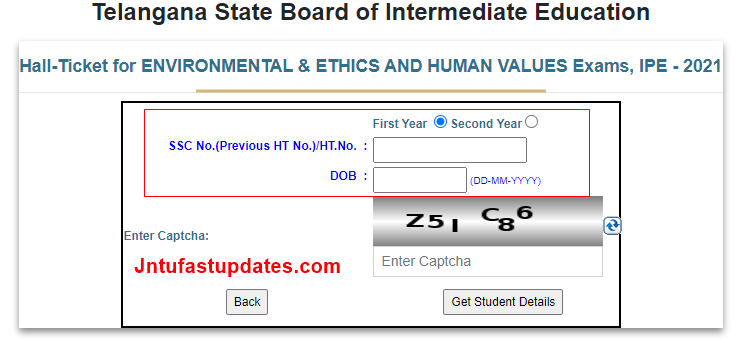
First Year Students Can download Hall Ticket from website https://tsbie.cgg.gov.in. from 01-04-2021. Students should mention their Hall Ticket Number on the assignment work.

Download Environmental, Ethics and Human Values Exams Hall Tickets 2021Available Now

Also Download: TS Inter 1st Year Hall Ticket 2021

2nd year (Regular) students who have not yet qualified these examinations can also submit ‘Assignment Work‘ with their 1st Year Hall Ticket, Old (Private) students can write these exams with their previous 2nd Year Hall Ticket Number.

TS Inter 1st Year Assignment Work Model Papers 2021 (English, Telugu, Urdu)

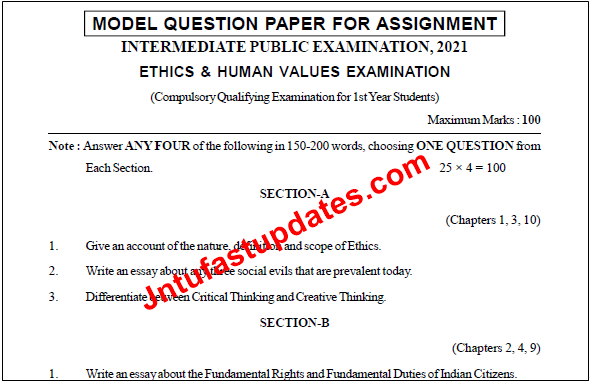
TS Inter 1st Year Ethics And Human Values & Environmental Education Model Papers 2021: Telangana State Board of Intermediate Education (TSBIE) has released Ethics And Human Values & Environmental Education Assignment Work Model Question Papers 2021 at tsbie.cgg.gov.in.

TS Inter Environmental Education & Ethics And Human Values Model Papers 2021

Students Can Download Telangana Intermediate 1st Year Assignment Work (Ethics And Human Values & Environmental Education) Model/Sample Question papers 2021 from official website, tsbie.cgg.gov.in. This is the Compulsory Qualifying Examination for 1st Year Students.

Also Download: TS Inter 1st Year Assignment Work Hall Tickets 2021

Download TSBIE Ethics And Human Values & Environmental Education Papers 2021

Students can write allotted questions as an assignment and submit to the principal of concerned junior College Physically or by registered or through mail in pdf format to college. Students can submit the Assignment Work from 01-04-2021 to 20-04-2021.

TSBIE ETHICS and HUMAN VALUES ASSIGNMENT Model Question Paper IPE 2021

English Version

Telugu Version

Urdu Version

TSBIE ENVIRONMENTAL EDUCATION ASSIGNMENT Model Question Paper IPE 2021

English Version

Telugu Version

Urdu Version

Andhra University Postponement of MBA 1st Semester Examination April 2021

Andhra University Postponement of MBA 1st Semester Examination April 2021

Andhra University

Sub : M.B.A. I Semester Examination Organisation Behaviour Postponement from 03-04-2021 to 04-04-2021 – Orders-issued

Having considered the letter under reference (1) cited, it is hereby directed to inform that the M.B.A. I Semester Examination date has been postponed from 03-04-2021 to 04-04-2021 2.00 PM to 5.00 PM (Organisation Behaviour w.e.f 2015-16 AB and 2019-2020) as per the request of the Head of the Department of Commerce & Mgt. Studies, College of Arts & Commerce, AU.

Download the Official Notification Here: Click Here

KVS Online Admission 2021-22 (Started) | Apply Online for Class 1 to 11 Kendriya Vidyalaya Registration

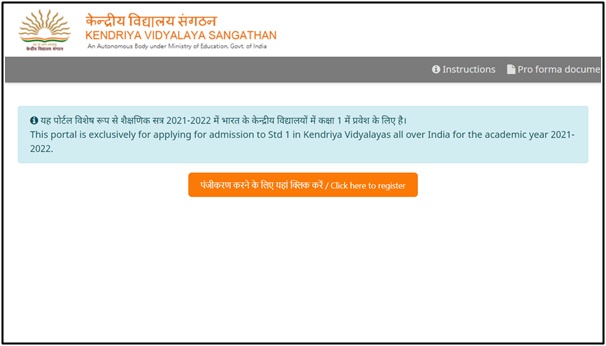
KVS Online Admission 2021 Application Form Apply For Class 1 to 11 Registration form: Kendriya Vidyalaya Sangathan (KVS) is going to start the registrations for admissions from 1st April onwards. Aspirants seeking to get admission in KVS for class 1st can start registering through the KVS website, kvsangathan.nic.in. Interested aspirants can fill the online application forms by 19th April at 7 PM. While the class 2nd and other classes [except class XI] online applications will be accepted during 8th April – 15th April. For all the classes except class XI the admission process will be ended y 31st May, Monday. The admission process for class XI will be started within 10 days after the declaration of class X results. The KVS will display the admission list & admissions for Class-XI within 20 days after the declaration of class X results. Students aspiring to get admission in KVS can check the dates clearly from the KVS portal and apply for admissions within the specified application dates. Aspirants seeking to check more details like KVS eligibility criteria for admission, selection process, important dates, the application process, and other important details from this article.

KVS Online Admission Form 2021-22 (Started) | Apply Online for Class 1 to 11 Kendriya Vidyalaya Registration

KVS Online Admission 2021

Kendriya Vidyalaya Sangathan (KVS) is the central government organization that runs various schools across the nation. KVS offers admission every year for students. KVS is also having 3 schools outside the nation.  Overall, 1193 schools were functioning in India and abroad. This is one of the most popular educational organizations that many students aspiring to get admission. KVS every year offers admissions to students based on the number of seats. Students with good merit will be filtered to get admission. Those who are waiting keenly for KVS admission notification 2021 can check it on the KVS portal. The notification is presently accessible on KVS’s official website, kvsangathan.nic.in. KVS Admission Application form 2021 is accessible from 20th July onwards. Students who are having the matching eligibility criteria can apply online at KVS official website.

KVS Admission 2021-22 – Important Details

Name of the OrganizationKendriya Vidyalaya Sangathan (KVS)
Name Affiliation BoardCentral Board of Secondary Education (CBSE)
Application CategoryKVS Admission 2021-22 (Class 1st to 12th)
Academic Session2021-2022
Mode of ApplicationOnline & Offline
KVS Official Websitekvsangathan.nic.in
Official KVS Admission Portalkvsonlineadmission.kvs.gov.in

KVS Admission 2021 – Eligibility Criteria

KVS Admissions 2021 – Reservation

CategoryReservation % 
Schedule Tribe (ST)7.5%
Schedule Caste (SC)15%
Differently abled candidates3%
Economically weaker sections (EWS) of the society25%

KVS Admissions 2021-22 – Age Limit

ClassMinimum age as of 31st March of the year in which admission is soughtMaximum age as of 31st March of the year in which admission is sought
Class I5 years7 years
Class II6 years8 years
Class III7 years9 years
Class IV8 years10 years
Class V9 years11 years
Class VI10 years12 years
Class VII11 years13 years
Class VIII12 years14 years
Class IX13 years15 years
Class X14 years16 years

KVS Admission Priority-wise

  • 1st Preference = Central Government employees Children.
  • 2nd Preference = Army and Ex-Army’s children.
  • 3rd Preference = Government employees’ children.
  • 4th Preference = Single girl child quota.
  • 5th Preference = Private or self-employed personnel’s Children.

Defense/central and state government job Holders – Priority Hierarchy

  • 1st pref. to ward of transferable central govt. staff and ex-servicemen.
  • 2nd pref. for non-transferable central government worker and ex-servicemen.
  • 3rd to ward of PSU/ autonomous bodies/ Institute if Higher Learning of GOI.
  • 4th to transferable state government employees.
  • 5th pref. to ward of state government non-transferable employees.
  • Last to children of any category if seats are vacant.

Kendriya Vidyalaya Required Documents For Admission

  • Birth Certificate (Age proof) for Class-I.
  • Proof of relationship for Grandchildren of KVS employees.
  • Proof of relationship for Grandchildren of PSU employees and Members of Parliament.
  • Proof of residence
  • Certificate of disability/handicapped
  • Category certificate (SC/ST/EWS/OBC/BPL)
  • Certificate of retirement for uniformed defense employees.
  • Certificate showing the no. of transfers.

KVS Admission 2021 Detailed Eligibility Criteria for Class 1 to Class 11

Class 1st Admission

  • 15% Seats are reserved for SC Category.
  • 7.5% Seats are reserved for ST Category.
  • In the first phase of admission, 10 seats (Out of 40) to be filled as per RTE Provisions (25% of seats) and 10 seats will be filled from all applicants of SC / ST / EWS / BPL/ OBC Category.
  • In the Second Phase of admission, remaining seats are filled as per category wise.

Class 2 to Class 8 Admission

  • KVS authority is not conducting any admission test for admission in class II to Class VIII.
  • The admission process will be done on the basis of the Category System.
  • If the number of applicants are more then, the number of seats then the department will be followed the lottery system.

Admission in Class 9th

  • KVS Department will be organizing the Admission Test for admission in Class 9th. Candidates can get admission on the basis of merit. The merit list will be prepared category wise.
  • In admission test questions will be asked from various subjects like English, Hindi, Maths, Social Science and Science.
  • The duration of the admission test is 03 Hours.
  • Question Paper will be of 100 Marks and 20 Marks for each subject.
  • Candidates must score 33% marks to qualify the test while the SC / ST / Divyang category candidates have to secure a minimum of 25% Marks.

Class 11th Admission

  • Students will have to get the marks in their class X as mentioned below.
  • Humanities Stream- All students who have passed the class X examination
  • Science Stream- Students must have obtained at least 60% marks aggregate in all the subjects.
  • Commerce Stream- Students must have obtained a minimum 55% marks aggregate in all the subjects.

KVS admission 2021: Admission under MP quota

Under the MP quota, the member of Lok Sabhaand Rajya Sabha are given the special permission to recommend a certain number of students for admission.

  • The recommendation by the MPs will be made from class 1 up to class 11 only.
  • The admission will be granted only at the starting of the academic year. No admission will be given under the MP quota after the academic year has already started.
  • The students who are recommended must satisfy all the eligibility criteria.
  • The admission will be given beyond the strength of the class.

KVS Admission 2021-22: Application Fee

No registration fee is applicable to online/ offline admission forms.

Applicants can collect the application form from the respective school principal free of cost.

No fee to be charged from the children admitted under the 25% RTE quota.

KVS Admission 2021 – 22 – Important Dates

Release of KVS Admission Guidelines26 March 2021
Release of KVS Admission AdvertisementFourth week of March 2021
KVS Online Registration for Class-I01 April 2021 (Thursday) 10:00 AM onwards
Last Date of KVS Online Registration for Class-I19 April 2021 (Monday) till 07:00 PM (19 days)
(a) Declaration of Provisional select and waitlist of registered candidates (b) Admission of eligible candidates of the selected list in the following order: RTEFrom the Service Priority Category (I and II) onlyThe shortfall of Reservation Quota after admission in (1) and (2) above1st list on 23 April 2021 (Friday) 2nd list on 30 April 2021 (Friday) (if seats remain vacant) 3rd list on 05 May 2021 (Wednesday) (if seats remain vacant)
Declaration of the provisional select list of candidates as per priority service category for unreserved seats, if any (keeping the leftover reserved seats blocked)03 May 2021 (Monday) to 05 May 2021 (Wednesday) (3 days)
Extended date for Second Notification for offline registrations for admissions to be made under RTE Provisions, SC/ST, and OBC(NCL) if sufficient applications not received in online modeNotification on 10 May 2021 (Monday) Registration from 10 May 2021 (Monday) to 13 May 2021 (Thursday) Display of list and Admissions 15 May 2021 (Saturday) to 20 May 2021 (Thursday)
Registration for Class-II onwards (except Class-XI)- Subject in offline mode to availability of vacancies in a particular class08 April 2021 (Thursday) to 15 April 2021 (Thursday)
Declaration of the list of Class-II onwards19 April 2021 at 04:00 PM (Monday)
Admission for Class-II onwards20 April 2021 (Tuesday) to 27 April 2021 (Tuesday)
Last date of admission for all classes except class XI31 May 2021 (Monday)
For KV students: Registration for admission in Class-XIWithin 10 days after the declaration of class X results
KV students: Display of admission list & admissions for Class-XI.Within 20 days after the declaration of class X results
Non-KV students: Registration, display of admission list & admissions in Class-XI (Subject to availability of vacancies)After the admissions of KV students in class XI
Last date of admission for class XI30 days from the date of declaration of class-X results by CBSE

Click Here to apply for KVS Admissions 2021 For Class 1 to 11Application Started

Kendriya Vidyalaya Admission Form/Application form 2021

  • KVS Admission 2021 – 22 official notification is available on its portal, kvsangathan.nic.in
  • Also, KVS Admission Notification will be printed on various newspapers.
  • KVS application form will be accessible offline from the school’s office.
  • The admission forms can be available at principal’s office for free of cost.
  • Parents/students have to fill up the application form with all correct details.
  • After filling up the application carefully, attach all the required documents along with the application form and submit it at the KVS office before the last date.
  • Must to remember is that, all the documents need to be attested by a gazetted officer and the application form must be filled with accurate information.
What is the KVS Class 1 Admission 2021-22 Registration Dates?

Starts from April 1st and Ends on 19 April 2021 (Monday) till 07:00 PM

What is the KVS Class 2 to 10th Admission 2021-22 Registration Dates?

Registration for Class II and above will be invited on the basis of availability of seats from 08.04.2021, 8:00 am to 15.04.2021 till 4:00 pm in offline mode.

How can We Apply Online Registration for KVS Admissions 2021?

We have mentioned detailed procedure in the above post or refer official website i.e kvsonlineadmission.kvs.gov.in

JNTUK R19 2-2 Database Management Systems Material PDF Download

JNTUK R19 2-2 Database Management Systems Material PDF Download

Students those who are studying JNTUK R19 CSE Branch, Can Download Unit wise R19 2-2 Database Management Systems (DBMS) Material/Notes PDFs below.

jntuk-materials

JNTUK R19 2-2 Database Management Systems Material PDF Download

OBJECTIVES:

  • To introduce about database management systems
  • To give a good formal foundation on the relational model of data and usage of Relational Algebra
  • To introduce the concepts of basic SQL as a universal Database language
  • To demonstrate the principles behind systematic database design approaches by covering conceptual design, logical design through normalization
  • To provide an overview of physical design of a database system, by discussing Database indexing techniques and storage techniques

UNIT-1

Introduction: Database system, Characteristics (Database Vs File System), Database Users(Actors on Scene, Workers behind the scene), Advantages of Database systems, Database applications. Brief introduction of different Data Models; Concepts of Schema, Instance and data independence; Three tier schema architecture for data independence; Database system structure, environment, Centralized and Client Server architecture for the database.

Download UNIT-1 Material PDF | Reference-2

UNIT-2

Relational Model: Introduction to relational model, concepts of domain, attribute, tuple, relation, importance of null values, constraints (Domain, Key constraints, integrity constraints) and their importance

BASIC SQL: Simple Database schema, data types, table definitions (create, alter), different DML operations (insert, delete, update), basic SQL querying (select and project) using where clause, arithmetic & logical operations, SQL functions(Date and Time, Numeric, String conversion).

Download UNIT-2 Material PDF | Reference-2

UNIT-3

Entity Relationship Model: Introduction, Representation of entities, attributes, entity set, relationship, relationship set, constraints, sub classes, super class, inheritance, specialization, generalization using ER Diagrams.

SQL: Creating tables with relationship, implementation of key and integrity constraints, nested queries, sub queries, grouping, aggregation, ordering, implementation of different types of joins, view(updatable and non-updatable), relational set operations.

Download UNIT-3 Material PDF | Reference-2

UNIT-4

Schema Refinement (Normalization): Purpose of Normalization or schema refinement, concept of functional dependency, normal forms based on functional dependency(1NF, 2NF and 3 NF), concept of surrogate key, Boyce-codd normal form(BCNF), Lossless join and dependency preserving decomposition, Fourth normal form(4NF), Fifth Normal Form (5NF).

Download UNIT-4 Material PDF | Reference-2

UNIT-5

Transaction Concept: Transaction State, Implementation of Atomicity and Durability, Concurrent Executions, Serializability, Recoverability, Implementation of Isolation, Testing for Serializability, Failure Classification, Storage, Recovery and Atomicity, Recovery algorithm.

Indexing Techniques: B+ Trees: Search, Insert, Delete algorithms, File Organization and Indexing, Cluster Indexes, Primary and Secondary Indexes , Index data Structures, Hash Based Indexing: Tree base Indexing, Comparison of File Organizations, Indexes and Performance Tuning

Download UNIT-5 Material PDF | Reference-2


TEXT BOOKS:

1) Database Management Systems, 3/e, Raghurama Krishnan, Johannes Gehrke, TMH

2) Database System Concepts,5/e, Silberschatz, Korth, TMH

REFERENCE BOOKS:

  1. Introduction to Database Systems, 8/e C J Date, PEA.
  2. Database Management System, 6/e Ramez Elmasri, Shamkant B. Navathe, PEA
  3. Database Principles Fundamentals of Design Implementation and Management, Corlos Coronel, Steven Morris, Peter Robb, Cengage Learning.

e-Resources:

1) NPTEL

OUTCOMES:

  • Describe a relational database and object-oriented database
  • Create, maintain and manipulate a relational database using SQL
  • Describe ER model and normalization for database design
  • Examine issues in data storage and query processing and can formulate appropriate solutions
  • Outline the role and issues in management of data such as efficiency, privacy, security, ethical responsibility, and strategic advantage