JNTUK R19 2-1 Signals and Systems Material PDF Download

JNTUK R19 2-1 Signals and Systems Material PDF Download

Students those who are studying JNTUK R19 ECE Branch, Can Download Unit wise R19 2-1 Signals and Systems Material PDFs below.

jntuk-materials

JNTUK R19 2-1 Signals and Systems Material PDF Download

Course Objectives: This course is designed to:

  • To study about signals andsystems.
  • To analyze the spectral characteristics of signal using Fourier series and Fouriertransforms.
  • To understand the characteristics of systems.
  • To introduce the concept of sampling process
  • To know various transform techniques to analyze the signals and systems.

UNIT-1

INTRODUCTION: Definition of Signals and Systems, Classification of Signals, Classification of Systems, Operations on signals: time-shifting, time-scaling, amplitudeshifting, amplitude-scaling. Problems on classification and characteristics of Signals and Systems. Complex exponential and sinusoidal signals, Singularity functions and related functions: impulse function, step function signum function and ramp function. Analogy between vectors and signals, orthogonal signal space, Signal approximation using orthogonal functions, Mean square error, closed or complete set of orthogonal functions, Orthogonality in complex functions. Related Problems.

Download UNIT-1 Material PDF | Reference-2

UNIT-2

FOURIER SERIES AND FOURIER TRANSFORM: Fourier series representation of continuous time periodic signals, properties of Fourier series, Dirichlet’s conditions, Trigonometric Fourier series and Exponential Fourier series, Relation between Trigonometric and Exponential Fourier series, Complex Fourier spectrum. Deriving Fourier transform from Fourier series, Fourier transform of arbitrary signal, Fourier transform of standard signals, Fourier transform of periodic signals, properties of Fourier transforms, Fourier transforms involving impulse function and Signum function. Introduction to Hilbert Transform.RelatedProblems.

Download UNIT-2 Material PDF | Reference-2

UNIT-3

ANALYSIS OF LINEAR SYSTEMS: Introduction, Linear system, impulse response, Response of a linear system, Linear time invariant (LTI) system, Linear time variant (LTV) system, Concept of convolution in time domain and frequency domain, Graphical representation of convolution, Transfer function of a LTI system, Related problems. Filter characteristics of linear systems. Distortion less transmission through a system, Signal bandwidth, system bandwidth, Ideal LPF, HPF and BPF characteristics, Causality and Poly-Wiener criterion for physical realization, relationship between bandwidth and rise time.

Download UNIT-3 Material PDF | Reference-2

UNIT-4

CORRELATION: Auto-correlation and cross-correlation of functions, properties of correlation function, Energy density spectrum, Parseval’s theorem, Power density spectrum, Relation between Convolution and correlation, Detection of periodic signals in the presence of noise by correlation, Extraction of signal from noise by filtering.

SAMPLING THEOREM : Graphical and analytical proof for Band Limited Signals, impulse sampling, Natural and Flat top Sampling, Reconstruction of signal from its samples, effect of under sampling – Aliasing, Introduction to Band Pass sampling, Related problems.

Download UNIT-4 Material PDF | Reference-2

UNIT-5

LAPLACE TRANSFORMS: Introduction, Concept of region of convergence (ROC) for Laplace transforms, constraints on ROC for various classes of signals, Properties of L.T’s, Inverse Laplace transform, Relation between L.T’s, and F.T. of a signal. Laplace transform of certain signals using waveformsynthesis.

Z–TRANSFORMS: Concept of Z- Transform of a discrete sequence. Region of convergence in Z-Transform, constraints on ROC for various classes of signals, Inverse Ztransform, properties of Z-transforms. Distinction between Laplace, Fourier and Z transforms.

Download UNIT-5 Material PDF


Text Books:

1. Signals, Systems & Communications – B.P. Lathi, BS Publications, 2003.

2. Signals and Systems – A.V. Oppenheim, A.S. Willsky and S.H. Nawab, PHI, 2nd Edn, 1997

3. Signals & Systems – Simon Haykin and Van Veen, Wiley, 2ndEdition, 2007

Reference Books:

1. Principles of Linear Systems and Signals – BP Lathi, Oxford University Press, 2015

2. Signals and Systems – T K Rawat , Oxford University press, 2011

Course Outcomes:

  • Differentiate the various classifications of signals andsystems
  • Analyze the frequency domain representation of signals using Fourierconcepts
  • Classify the systems based on their properties and determine the response ofLTI Systems.
  • Know the sampling process and various types of samplingtechniques.
  • Apply Laplace and z-transforms to analyze signals and Systems (continuous &discrete).
JNTUK R19 2-1 MEFA Material/Notes PDF Download

JNTUK R19 2-1 MEFA Material/Notes PDF Download

Students those who are studying JNTUK R19 ECE, EEE Branch, Can Download Unit wise R19 2-1 Managerial Economics & Financial Analysis Material PDFs below.

jntuk-materials

JNTUK R19 2-1 MEFA Material/Notes PDF Download

Course Objectives: This course is designed to:

  • The Learning objectives of this paper are to understand the concept and nature of Managerial Economics and its relationship with other disciplines and also to understand the Concept of Demand and Demandforecasting.
  • To familiarize about the Production function, Input Output relationship, Cost-Output relationship and Cost-Volume-ProfitAnalysis.
  • To understand the nature of markets, Methods of Pricing in the different market structures and to know the different forms ofBusiness organization and the concept of Business Cycles.
  • To learn different Accounting Systems, preparation of Financial Statement and uses of different tools for performanceevaluation.
  • Finally, it is also to understand the concept of Capital, Capital Budgeting and the techniques used to evaluate Capital Budgetingproposals.

UNIT-1

Introduction to Managerial Economics and demand Analysis: Definition of Managerial Economics –Scope of Managerial Economics and its relationship with other subjects –Concept of Demand, Types of Demand, Determinants of Demand- Demand schedule, Demand curve, Law of Demand and its limitations- Elasticity of Demand, Types of Elasticity of Demand and Measurement- Demand forecasting and Methods of forecasting, Concept of Supply and Law of Supply.

Download UNIT-1 Material PDF | Reference-2

Unit-2

Theories of Production and Cost Analyses: Theories of Production function- Law of Variable proportions-Isoquants and Isocosts and choice of least cost factor combination-Concepts of Returns to scale and Economies of scale-Different cost concepts: opportunity costs, explicit and implicit costs-Fixed costs, Variable Costs and Total costs –Cost –VolumeProfit analysis-Determination of Breakeven point(problems)-Managerial significance and limitations of Breakeven point.

Download UNIT-2 Material PDF | Reference-2

Unit-3

Introduction to Markets, Theories of the Firm & Pricing Policies: Market Structures: Perfect Competition, Monopoly, Monopolistic competition and Oligopoly – Features – Price and Output Determination – Managerial Theories of firm: Marris and Williamson’s models – other Methods of Pricing: Average cost pricing, Limit Pricing, Market Skimming Pricing, Internet Pricing: (Flat Rate Pricing, Usage sensitive pricing) and Priority Pricing, Business Cycles : Meaning and Features – Phases of a Business Cycle. Features and Evaluation of Sole Trader, Partnership, Joint Stock Company – State/Public Enterprises and their forms.

Download UNIT-3 Material PDF | Reference-2

Unit-4

Introduction to Accounting & Financing Analysis: Introduction to Double Entry System, Journal, Ledger, Trail Balance and Preparation of Final Accounts with adjustments – Preparation of Financial Statements-Analysis and Interpretation of Financial Statements-Ratio Analysis – Preparation of Funds flow and cash flow analysis (Problems)

Download UNIT-4 Material PDF | Reference-2

Unit-5

Capital and Capital Budgeting: Capital Budgeting: Meaning of Capital-Capitalization-Meaning of Capital Budgeting-Time value of money- Methods of appraising Project profitability: Traditional Methods(pay back period, accounting rate of return) and modern methods(Discounted cash flow method, Net Present Value method, Internal Rate of Return Method and Profitability Index)

Download UNIT-5 Material PDF | Reference-2


Text Books:

1. A R Aryasri, Managerial Economics and Financial Analysis, The McGraw – Hill companies.

Reference Books:

1. Varshney R.L, K.L Maheswari, Managerial Economics, S. Chand & CompanyLtd,

2. JL Pappas and EF Brigham, Managerial Economics, Holt, R & W; New editionedition

3. N.P Srinivasn and M. SakthivelMurugan, Accounting for Management, S. Chand & CompanyLtd,

4. MaheswariS.N,AnIntroduction to Accountancy, Vikas Publishing House PvtLtd

5. I.M Pandey, Financial Management , Vikas Publishing House PvtLtd

6. V. Maheswari, Managerial Economics, S. Chand & CompanyLtd.

Course Outcomes:

  • The Learner is equipped with the knowledge of estimating the Demand and demand elasticities for aproduct.
  • The knowledge of understanding of the Input-Output-Cost relationships and estimation of the least cost combination ofinputs.
  • The pupil is also ready to understand the nature of different markets and Price Output determination under various market conditions and also to have the knowledge of different BusinessUnits.
  • The Learner is able to prepare Financial Statements and the usage of various Accounting tools forAnalysis.
  • The Learner can able to evaluate various investment project proposals with the help of capital budgeting techniques for decisionmaking.

SVU DDE Admission Notification 2021 (UG/PG) – Apply Online @ svudde.in

0

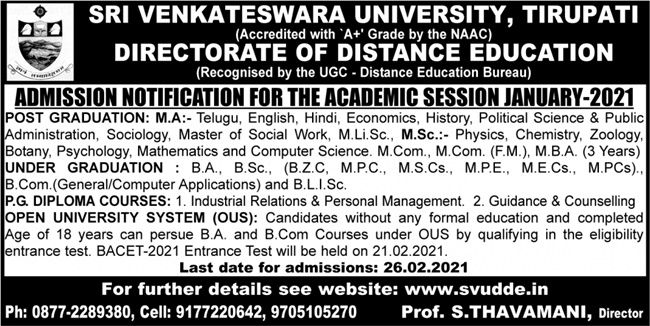
SVU DDE Admission Notification 2021 (UG/PG): Sri Venkateswara University has released asmission notification for the academic session January 2021. Eligible candidates can Apply Online for admission into UG, PG and other Cousrses at www.svudde.in.

SVU DDE Admission Notification 2021 (UG/PG) – Apply Online @ svudde.in

SVU DDE Admission Notification 2021

POST GRADUATION: M.A:- Telugu, English, Hindi, Economics, History, Political Science & Publil dministration, Sociology, Master of Social Work, M.Li.Sc., M.Sc.:- Physics, Chemistry, Zoology Botany, Psychology, Mathematics and Computer Science. M.Com., M.Com. (F.M.), M.B.A. (3 Years)

UNDER GRADUATION : B.A., B.Sc., (B.Z.C, M.P.C., M.S.Cs., M.P.E., M.E.Cs., M.PCs). B.Com.(GeneraI/Computer Applications) and B.L.I.Sc.

P.G. DIPLOMA COURSES: 1. Industrial Relations & Personal Management. 2. Guidance & Counselling

OPEN UNIVERSITY SYSTEM (OUS): Candidates without any formal education and complete( ge of 18 years can persue B.A. and B.Com Courses under OUS by qualifying in the eligibility entrance test. BACET-2021 Entrance Test will be held on 21.02.2021.

SVU DDE Admission Important Dates 2021

The Distance Education Bureau, University Grants Commission,
New Delhi, had recognized the courses offered by the Directorate of Distance Education, S.V. University, Tirupati, under Category-I Higher Educational Institution, since our University was accredited with NAAC “A+”grade.

At present, the Directorate of Distance Education is offering 26 programmes in U.G. (05) / P.G. (19) / P.G. Diploma (02) streams.

For U.G., P.G. and P.G. Diploma programmes :

  • Online registration of admission application starts from : 25.01.2021
  • Last date for payment of course fee : 26.02.2021
  • Last date for submission of application through online : 28.02.2021

For BACET-2021 :

  • Under Open University System (OUS) the candidates who have completed 18 years of age as on 31.12.2020 and qualified in the BACET-2021 conducted by the D.D.E., are eligible to apply for B.A. / B.Com. (OUS) courses only. 
  • Online registration for BACET application : 25.01.2021
  • Last date for payment of registration fee : 17.02.2021
  • Last date for registration : 17.02.2021
  • Entrance test will be held on : 21.02.2021
  • Publication of entrance test results : 23.02.2021
  • Last date for payment of course fee : 26.02.2021

SVU-DDE Admission Notification January-2021

Courses and fee Stucture January-2021

DEB Recognition letter November,2019

Programmes Prohibited

FAQs related to Distance Education Bureau

JNTUK R19 2-1 Data Structures Material PDF Download

JNTUK R19 2-1 Data Structures Material PDF Download

Students those who are studying JNTUK R19 CSE, IT Branches, Can Download Unit wise R19 2-1 Data Structures Material PDFs below.

jntuk-materials

JNTUK R19 2-1 Data Structures Material PDF Download

Course Objectives: This course is designed to:

  • Introduce the fundamental concept of data structures and abstract data types
  • Emphasize the importance of data structures in developing and implementing efficient algorithms
  • Describe how arrays, records, linked structures, stacks, queues, trees, and graphs are represented in memory and used by algorithms

Course Outcomes: After completing this course a student will be able to:

  • Summarize the properties, interfaces, and behaviors of basic abstract data types
  • Discuss the computational efficiency of the principal algorithms for sorting & searching
  • Use arrays, records, linked structures, stacks, queues, trees, and Graphs in writing programs
  • Demonstrate different methods for traversing trees

UNIT-1

Data Structures – Definition, Classification of Data Structures, Operations on Data Structures, Abstract Data Type (ADT), Preliminaries of algorithms. Time and Space complexity. Searching – Linear search, Binary search, Fibonacci search. Sorting- Insertion sort, Selection sort, Exchange (Bubble sort, quick sort), distribution (radix sort), merging (Merge sort) algorithms.

Download UNIT-1 Material PDF | Reference-2 | Reference-3

UNIT-2

Linked List: Introduction, Single linked list, Representation of Linked list in memory, Operations on Single Linked list-Insertion, Deletion, Search and Traversal ,Reversing Single Linked list, Applications on Single Linked list- Polynomial Expression Representation, Addition and Multiplication, Sparse Matrix Representation using Linked List, Advantages and Disadvantages of Single Linked list, Double Linked list-Insertion, Deletion, Circular Linked list-Insertion, Deletion.

Download UNIT-2 Material PDF | Link-2

UNIT-3

Queues: Introduction to Queues, Representation of Queues-using Arrays and using Linked list, Implementation of Queues-using Arrays and using Linked list, Application of Queues-Circular Queues, Deques, Priority Queues, Multiple Queues.

Stacks: Introduction to Stacks, Array Representation of Stacks, Operations on Stacks, Linked list Representation of Stacks, Operations on Linked Stack, Applications-Reversing list, Factorial Calculation, Infix to Postfix Conversion, Evaluating Postfix Expressions.

Download UNIT-3 Material PDF | Link-2

UNIT-4

Trees: Basic Terminology in Trees, Binary Trees-Properties, Representation of Binary Trees using Arrays and Linked lists. Binary Search Trees- Basic Concepts, BST Operations: Insertion, Deletion, Tree Traversals, Applications-Expression Trees, Heap Sort, Balanced Binary TreesAVL Trees, Insertion, Deletion and Rotations.

Download UNIT-4 Material PDF | Link-2

UNIT-5

Graphs: Basic Concepts, Representations of Graphs-Adjacency Matrix and using Linked list, Graph Traversals (BFT & DFT), Applications- Minimum Spanning Tree Using Prims & Kruskals Algorithm, Dijkstra’s shortest path, Transitive closure, Warshall’s Algorithm.

Download UNIT-5 Material PDF | Link-2


e-Resources:

Modules / Lectures

Link-2

Text Books:

1) Data Structures Using C. 2nd Edition.Reema Thareja, Oxford.

2) Data Structures and algorithm analysis in C, 2nded, Mark Allen Weiss.

Reference Books:

1) Fundamentals of Data Structures in C, 2nd Edition, Horowitz, Sahni, Universities Press.

2) Data Structures: A PseudoCode Approach, 2/e, Richard F.Gilberg, Behrouz A. Forouzon, Cengage.

3) Data Structures with C, Seymour Lipschutz TMH

ANU Degree 3rd, 5th Sem Exam Fee Notification March 2021

6

ANU Degree Notification 2021: Acharya Nagarjuna University (ANU) has announced Degree 3rd, 5th semesters Examination fee Notification March 2021 at nagarjunauniversity.ac.in. Students can check their ANU UG III, V Sem Exam Fee Schedule and Exam Dates 2021 below.

ANU Degree 3rd, 5th Sem Exam Fee Notification March 2021

Acharya Nagarjuna University (ANU)

Sub:- ANU – Degree Exams — U.G. 3rd and 5th Semesters Regular and Supplementary Examinations March, 2021 — Date of Commencement and Schedule for payment of Examination Fee — Communicated — Reg.

ANU UG III, V Sem Examination Fee Schedule Details 2021:

Name of the UniversityAcharya Nagarjuna University
Name of the ExaminationDegree 3rd, 5th Sem March 2021
CategorieExamination Fee Schedule
StatusReleased
Official Websitenagarjunauniversity.ac.in

I am by direction, herewith issuing the following schedule for the 3rd and 5U Semesters U.G. Regular and Supplementary Degree Examinations of B.Sc./ B.Com. /B.A./B.C.A./BAOL/BHM/BBM/BBM(Hons.)/B.Sc(ASLP)/B.Sc.(HS) Examinations of March, 2021

Extension of date for payment Of Examination fee and also commencement of examinations for UG. Courses 3rd and 5th Sernesters examinations of March, 2021

1Last date for payment of fee without late fee05-03-2021
2)Last date for submission of gallies by colleges 1n Triplicate to the O/o. A.C.E., A.N.U. on or before.08-03-2021
3Date of commencement of Internal Practical examinations of 3rd and 5th Semesters15.03.2021 to 22.03.2021
4)Date of commencement of Theory examinations of 3rd and 5th Semesters31-03-2021
7)Fee Particulars:

Whole examination fee (Theory only) per each semester 1st and 3rd Semesters

Rs.560/-
Whole examination fee (Theory only) per 5th SemesterRs.710/-
Practical Examinations fee per each practical (Internal)Rs.75/-
For B.Com.Course 5th Semester fee for each project workRs.300/ –
For BHM Course whole examination fee (Theory only) per each semester 1st and 3rd SemestersRs.1130/-
For BHM Course whole examination fee (Theory only) per 5th SemesterRs.1180/-

Fee for 3rd, 5th Semesters Supplementary Students

a) B.A, B.Com, B.Sc, B.Sc(H.S), B.Sc(ASLP), BCA, BBA, B.B.M, B.A(O.L), BBM(Hons):

  • Exam Fee for single paper appearance: Rs. 300-00
  • Two Papers appearance: Rs. 400-00
  • Three papers appearance : Rs. 450-00
  • Four or more papers (1st & 3rd Semesters): Rs. 560-00
  • Four or more papers (5th Semester): Rs. 710-00

b) Bachelor of Hotel Management:

SI.NoName of the ExamFee (Rs.)
1For single paper fee320
2For two papers fee420
3For three papers fee560
4For four papers fee670
5For five papers fee860
6For six or more papers fee (3rd Sem)

For six or more papers fee (5th Sem)

1130

1180

NOTE:- The Schedule for 1st Semester Examinations will be informed later.

The above are the examination fee particulars for payment of fee for March, 2021 Regular and Supplementary Examinations of 3rd and 5th Semesters through Online Challan in Examination Fee A/c No. 30908794589 of Acharya Nagarjuna University.

The Principals of all the affiliated Degree Colleges of ANU area arc requested to pay the exams fees course wise, year wise and separately Original Degree Certificate fee i.e. B.Sc, B.Com, B.A, B.C.A, BAOL, BHM, BBM, BBM (Hons.), B.Sc (ASLP), B.Sc. (HS), BHM 1st, 3rd and 5th Semesters, on a separate online challans for each course along with detailed list of students with the Registered Nos.

Download the Official Notification Here: Click Here

TS SBTET Diploma C18 (3rd, 5th Sem), C16S 7th Sem Notification Feb 2021

0

TS SBTET Diploma C18 (3rd, 5th Sem), C16S 7th Sem Notification Feb 2021

ts sbtet

SBTET – Exams – Diploma Semester End Examination- C18 Scheme III & V Semesters & C16S VII Semester- Regular Examinations -February- 2O21-Modified Notification-Reg.

With reference to the subject cited above, I furnish herewith the detailed notification inviting applications from eligible candidates of C-18 scheme 3rd & 5th semesters attending online classes commenced w.e.f 01-09-2020 (the students who have not undergone industrial training) & C16S VII Semester to appear for the Regular examinations February-2021 commencing in the last week of February-2021 for the courses as mentioned in the Annexure-II and further the revised Question Paper Blue print (C18 Scheme only) is made available in Annexure-I in view of the COVID situation. The Time duration for C18 (III & V Semesters) & C16 Scheme (VII Semester) is of 03 Hours. A Separate notification will be issued for the students who are attending 5th semester classes as from 18-12-2020.

In this regard, it is informed that the regular candidates who are intend to appear for the examinations can approach the Polytechnics where they are studying (or) visit sbtet.telangana.gov.in for making fee payment online. After downloading the Hall Ticket from sbtet.telangana.gov.in the candidate has to obtain the signature of the concerned Head of Section/Principal before appearing for the examination. Further, Principals are requested to give the necessary instructions to the Head of Sections to sign on the hall tickets for subjects after thorough verification of eligibility.

The Principals of the concerned Polytechnics/institutions where Regular exams are being conducted are requested to ensure that the syllabus should be completed on or before 20-02-2021.

Schedule of Examination Fee Payment:

Schedule
Commencement of theory examinations22-02-2021
Date of Commencement for payment of examination fee through Online25-01-2021
Last date for payment of examination fee without penalty to all candidates06-02-2021
Last date for payment of examination fee with penalty to all candidates.08-02-2021
Last date for payment of examination fee and submission of aoolication form (UNDER TATKAL SCHEME)10-02-2021
ee payment under Premium TatkalBefore Examination

Fee Details:

Fee for whole or part examinationRs.650/-
Certificate fee for C-16S VII Semester StudentsRs.600/-
a) Late Fee (penalty)
b) Tatkal Fee (Including Examination fee)
Rs.400/-
Rs.3000/-
Premium Tatkal (Includinq Examination fee)Rs.5000/-
  1. Colleges can pay examination fee online for bulk students from college login (or) Students can pay fee individually from sbtet.telangana.gov.in. Transfer of Examination centre of the students is not permitted under any circumstances.
  2. A copy of this Notification is to be displayed on the Notice board of the Institution for information of the candidates and wide publicity shall be given among the students by circulating a copy of the Notification in the class rooms.
  3. For any clarifications please call SBTET help desk 040-23222192 during working hours or email to sbtet-helpdesk@telangana.gov.in.

Download the Official Notification Here: Click Here

JNTU Kakinada Started B.Tech in Food Engineering

JNTU Kakinada Started B.Tech in Food Engineering

According to a recent data, the food processing industry is expected to expand at a compound annual growth rate (CGAR) of 11.5% in upcoming financial years. The growth is estimated to reach a value of Rs 15,971.9 billion in FY 2023 from current Rs 9,00,000 crore.

The union government has set a target of achieving 3% of international food trade in the coming years from the current levels of 1.5%.

The food processing sector is growing globally. Skilled professionals are in great need starting from food collection, transit, supply chain management, processing, value addition, cold chain management and up to consumer end. A meagre 1% growth rate in food processing industries will lead to 5 lakhs direct and 15 lakh indirect employments.

As a sunrise industry, Food Processing has huge potential in Andhra Pradesh and AP Food Processing Society is promoting Food Industry in the state withan attractive Food Processing policy 2020-25 prepared under the guidance of Hon’ble Chief Minister. Currently, Andhra Pradesh has the highest share of 14.1 % in employment in Food Processing Industry among all other states, with growing demand for technical manpower, especially for undergraduates.

Even though, there are many institutions in India, there are only few institutions in the state offering B.Tech course in Food Technology.Also, the undergraduate courses is often needed to be strengthen and not in line with the industry expectations. As such there is scope for more B.Tech courses with practical, engineering & communicational skills.

The demand for under graduates is more in the organized sector. Lack of sufficient engineering skills is one of the main draw backs with most of the B. Tech courses. To fill this gap, institutions have started B. Tech course in Food Engineering. However none of institutions in AP have started B. Tech in Food Engineering. Even though AP tops share of employment in Food Processing.

JNTUK has started M. Tech Course in Food Processing Technology in the academic year 2010- 11 with a financial support of Rs. 75 lakhs from MoFPI. Over the years it has been developed as one of the best PG courses in India with modern infrastructure and state of art laboratories.Most of the students from first nine batches have got placements in leading food industries and academic institutions. Viz. Shama Foods (IFFFCO group Shama, Dubai), Nestle, ITC, CPF, Godrej Tyson, Tata Coffee, Tata Global Beverages, MTR, Olam, Bambino, Naturo, Vimta labs, Jain Framfresh Foods etc. (The maximum package is Rs.6 lakhs/annum. Average salary is around Rs. 30,000/- month).

JNTUK had started Food Testing Laboratory in 2014 with financial assistance of Rs. 1.56 Crores from Ministry of Food Processing Industries (MoFPI), New Delhi. Testing facilities are regularly being used by regulatory bodies, Food Industries, PT Laboratories and NGO like Akshayapatra among others.

Food Testing Laboratory has been just up graded to test Antibiotics, Pesticide Residues, and heavy metals with a financial support of Rs. 4.4 crores form Andhra Pradesh Food Processing Society (APFPS) in 2018.

JNTUK College of engineering is one of the oldest engineering colleges offering B. Tech in all the core engineering subjects. Infrastructure for basic engineering & sciences subjects to be covered in the first year is already availablein the college.

As such, as all the sate of art infrastructure is already available, JNTUK started B. Tech in Food Engineering in this Academic year 2020-21:

  • No. of Seats- 60
  • Eligibility- Passed 10+2 with minimum 50% marks in physics, chemistry, and mathematics as main subjects.
  • Duration- 4 years Admission through- EAMCET
  • College code:JNKFSF

Employment potentials: Food Industries, R&D organizations, Colleges and universities, Regulatory authorities (FSSAI, BIS, Spice Board& Various fields related to food), Food Corporation of India, Department of food & public Distribution, Central Warehousing Corporation.

Nature of job: Production supervisors/in- charges, Quality Assurance, Assistant Professors, Food Research Analysts, R&D scientists, etc.

Other than jobs, candidates can also become an entrepreneur in food processing start-ups and grow as potential as the graduate.

Interested persons can pursue higher education

Average entry-level salary- INR 4 lakh to 6 lakh per annum.

B. Tech in Food Engineering at JNTUK opens a new opportunity for the students to select a course with huge employment potential.

JNTUH Guidelines to Conduct of 1st Mid Exams of B.Tech / B.Pharmacy 1-1 Sem and other issues

JNTUH Guidelines to Conduct of 1st Mid Exams of B.Tech / B.Pharmacy 1-1 Sem and other issues

jntuh

Sub: Conduct of I- mid term examinations of I year B.Tech. & I Year B. Pharm. courses and other issues – Reg.

The Principals of the colleges offering I Year I Sem. B.Tech & B.Pharm courses are informed to follow the same guidelines as specified in our earlier letter (vide ref cited above), for conducting the first midterm examinations of I Year BTech/BPharm courses. Further the following additional guidelines need to be followed:

1) The parent colleges need to identify the host colleges for their students to write the exams, after taking the choices from the students. It is advised to identify one college in each district.

2) The question papers may be sent to host colleges in the encrypted form by mail or printed question papers. If parent colleges prefer to send printed question papers the sufficient number of question papers subject-wise need to be sent to the host colleges. All the question papers of one subject need to be bundled separately and all these bundles of one session need to be kept in one envelope and sealed. Sufficient number of answer booklets are also to be packed for each host college along with the question papers.

3) For this mid examinations of I year B. Tech. & B. Pharm. courses, either Parent Colleges send the stationery to host colleges or Parent College may request the host colleges to issue their pre-printed stationary for writing the midterm examinations. If the host college stationery is used, stationery charges also need to be paid by parent college along with
i) center charges @ Rs.20/- per candidate per subject and
ii) the postal charges of dispatching the used answer scripts to parent colleges. All these charges need to be paid to host colleges directly by the parent colleges.

4) There shall be no arrangement from the University examination branch to dispatch the question papers and stationery to the host colleges. Similarly the used answer booklets need to be sent to the parent colleges directly to their address after completion of last midterm exam.

5) The first midterm examinations of I year B. Tech. shall be conducted from 27-01- 2021; Further on 24-01-2021 and 25-01-2021 class work need to be continued. There shall be two examinations on each day i.e. from 9:30 AM to 10:50AM in the forenoon session and from 1:30PM to 2:50PM in the afternoon session.

6) If sufficient syllabus is not covered for I year I sem. B. Pharm. Course due to late admissions, the I-midterm exams may be differed by a few days. A separate schedule for the upload of B. Pharm. Midterm marks shall be issued.

7) Similarly the midterm examination for Engineering Drawing subject may also be differed and conducted after the commencement of the class work on the campus.

8) The time-tables of the first midterm examinations I year B. Tech.& B.Pharm. courses are already kept at Here.

9) A sizable number of answer booklets of the students who indulged in mass copying have been found by the evaluators while doing spot valuation.Such cases were treated as malpractice by the malpractice committee and the performance of the students in these subjects has been cancelled. Hence it is informed to be extra vigilant while conducting the mid-term exams.

The cooperation of the Principals is highly solicited.

Download the Official Notification Here: Click Here

JNTUK R16 4-1 Computer Networks Material PDF Download

JNTUK R16 4-1 Computer Networks Material PDF Download

Students those who are studying JNTUK R16 ECE Branch, Can Download Unit wise R16 4-1 Computer Networks Material/Notes PDFs below.

jntuk-materials

JNTUK R16 4-1 Computer Networks Material PDF Download

OBJECTIVES:

  • Understand state-of-the-art in network protocols, architectures, and applications.
  • Process of networking research
  • Constraints and thought processes for networking research
  • Problem Formulation—Approach—Analysis

UNIT-1

Introduction: Network Topologies WAN, LAN, MAN. Reference models- The OSI Reference Model- the TCP/IP Reference Model – A Comparison of the OSI and TCP/IP Reference Models

Download UNIT-1 Material PDF

UNIT-2

Physical Layer – Fourier Analysis – Bandwidth Limited Signals – The Maximum Data Rate of a Channel – Guided Transmission Media, Digital Modulation and Multiplexing: Frequency Division Multiplexing, Time Division Multiplexing, Code Division Multiplexing Data Link Layer Design Issues, Error Detection and Correction, Elementary Data Link Protocols, Sliding Window Protocols

Download UNIT-2 Material PDF

UNIT-3

The Data Link Layer – Services Provided to the Network Layer – Framing – Error Control – Flow Control, Error Detection and Correction – Error-Correcting Codes – Error Detecting Codes, Elementary Data Link Protocols- A Utopian Simplex Protocol-A Simplex Stop and Wait Protocol for an Error free channel-A Simplex Stop and Wait Protocol for a Noisy Channel, Sliding Window Protocols-A One Bit Sliding Window Protocol-A Protocol Using Go-Back-N- A Protocol Using Selective Repeat

Download UNIT-3 Material PDF

UNIT-4

The Medium Access Control Sublayer-The Channel Allocation Problem-Static Channel Allocation-Assumptions for Dynamic Channel Allocation, Multiple Access Protocols-Aloha-Carrier Sense Multiple Multiple Access ProtocolsCollision-Free Protocols-Limited Contention Protocols-Wireless LAN Protocols, Ethernet-Classic Ethernet Physical Layer-Classic Ethernet MAC Sublayer Protocol-Ethernet Performance-Fast Ethernet Gigabit Ethernet-10-Gigabit Ethernet-Retrospective on Ethernet, Wireless Lans-The 802.11 Architecture and Protocol Stack-The 802.11 Physical Layer-The802.11 MAC Sublayer Protocol-The 805.11 Frame Structure-Services

Download UNIT-4 Material PDF | Reference-2

UNIT-5

Design Issues-The Network Layer Design Issues – Store and Forward Packet Switching-Services Provided to the Transport layer- Implementation of Connectionless Service-Implementation of Connection Oriented ServiceComparison of Virtual Circuit and Datagram Networks, Routing Algorithms-The Optimality principle-Shortest path Algorithm, Congestion Control Algorithms-Approaches to Congestion Control-Traffic Aware RoutingAdmission Control-Traffic Throttling-Load Shedding.

Download UNIT-5 Material PDF | Reference-2

UNIT-6

Transport Layer – The Internet Transport Protocols: Udp, the Internet Transport Protocols: Tcp Application Layer –The Domain Name System: The DNS Name Space, Resource Records, Name Servers, Electronic Mail: Architecture and Services, The User Agent, Message Formats, Message Transfer, Final Delivery

Download UNIT-6 Material PDF | Reference-2


TEXT BOOKS:

1. Computer Networks, Tanenbaum and David J Wetherall, 5th Edition, Pearson Edu, 2010

2. Computer Networks: A Top Down Approach, Behrouz A. Forouzan, FirouzMosharraf, McGraw Hill Education

REFERENCE BOOKS:

1. Larry L. Peterson and Bruce S. Davie, “Computer Networks – A Systems Approach” (5th ed), Morgan Kaufmann/ Elsevier, 2011

OUTCOMES:

1. Understand OSI and TCP/IP models

2. Analyze MAC layer protocols and LAN technologies

3 .Design applications using internet protocols

4 .Understand routing and congestion control algorithms

5 .Understand how internet works

JNTUK R16 4-1 Digital Image Processing Material PDF Download

JNTUK R16 4-1 Digital Image Processing Material PDF Download

Students those who are studying JNTUK R16 ECE Branch, Can Download Unit wise R16 4-1 Digital Image Processing Material/Notes PDFs below.

jntuk-materials

JNTUK R16 4-1 Digital Image Processing Material PDF Download

Course Objectives: Students undergoing this course are expected to:

1. Familiarize with basic concepts of digital image processing and different image transforms

2. Learn various image processing techniques like image enhancement, restoration, segmentation and compression

3. Understand color fundamentals and different color models

4. Understand wavelets and morphological image processing

UNIT-1

Introduction: Introduction to Image Processing, Fundamental steps in digital image processing, components of an image processing system, image sensing and acquisition, image sampling and quantization, some basic relationships between pixels, an introduction to the mathematical tools used in digital image processing. Image Transforms: Need for image transforms, Discrete Fourier transform (DFT) of one variable, Extension to functions of two variables, some properties of the 2-D Discrete Fourier transform, Importance of Phase, Walsh Transform. Hadamard transform, Haar Transform, Slant transform, Discrete Cosine transform, KL Transform, SVD and Radon Transform, Comparison of different image transforms.

Download UNIT-1 Material PDF

UNIT-2

Intensity Transformations and Spatial Filtering: Background, Some basic intensity transformation functions, histogram processing, fundamentals of spatial filtering, smoothing spatial filters , sharpening spatial filters, Combining spatial enhancement methods Filtering in the Frequency Domain: Preliminary concepts, The Basics of filtering in the frequency domain, image smoothing using frequency domain filters, Image Sharpening using frequency domain filters, Selective filtering.

Download UNIT-2 Material PDF

UNIT-3

Image Restoration and Reconstruction: A model of the image degradation / Restoration process, Noise models, restoration in the presence of noise only-Spatial Filtering, Periodic Noise Reduction by frequency domain filtering, Linear, Position –Invariant Degradations, Estimating the degradation function, Inverse filtering, Minimum mean square error (Wiener) filtering, constrained least squares filtering ,geometric mean filter ,image reconstruction from projections.

Download UNIT-3 Material PDF

UNIT-4

Image compression: Fundamentals, Basic compression methods: Huffman coding, Golomb coding, Arithmetic coding, LZW coding, Run-Length coding, Symbol-Based coding, Bit-Plane coding, Block Transform coding, Predictive coding Wavelets and Multiresolution Processing: Image pyramids, subband coding, Multiresolution expansions, wavelet transforms in one dimensions & two dimensions, Wavelet coding.

Download UNIT-4 Material PDF

UNIT-5

Image segmentation: Fundamentals, point, line, edge detection, thresholding, region –based segmentation. Morphological Image Processing: Preliminaries, Erosion and dilation, opening and closing, basic morphological algorithms for boundary extraction, thinning, gray-scale morphology, Segmentation using morphological watersheds.

Download UNIT-5 Material PDF

UNIT-6

Color image processing: color fundamentals, color models, pseudo color image processing, basics of full color image processing, color transformations, smoothing and sharpening. Image segmentation based on color, noise in color images, color image compression.

Download UNIT-6 Material PDF


TEXT BOOKS:

1. R. C. Gonzalez and R. E. Woods, Digital Image Processing, 3rd edition, Prentice Hall, 2008.

2. Jayaraman, S. Esakkirajan, and T. Veerakumar,” Digital Image Processing”, Tata McGraw-Hill Education, 2011.

REFERENCE BOOKS:

1. Anil K.Jain, “Fundamentals of Digital Image Processing”, Prentice Hall of India, 9th Edition, Indian Reprint, 2002.

2. B.Chanda, D.Dutta Majumder, “Digital Image Processing and Analysis”, PHI, 2009.

Course Outcomes: After undergoing the course students will be able to

1. Perform image manipulations and different digital image processing techniques

2. Perform basic operations like – Enhancement, segmentation, compression,Image transforms and restoration techniques on image.

3. Analyze pseudo and fullcolor image processing techniques.

4. Apply various morphological operators on images