JNTUH B.Tech 3-1 (R13,R09,R07,R05) Regular/Supply Results Nov 2016

JNTUH B.Tech 3-1 (R13,R09,R07,R05) Regular/Supply Results Nov 2016, jntuh 3-1 regular results nov 2016, jntuh 3-1 r09 supply results, jntuh 3-1 sem r07 supply results, jntuh b.tech 3-1 regular results.

Check: JNTUH 3-1 Results 2016 Here

jntuh

JNTUH B.Tech 3-1 (R13,R09,R07,R05) Regular/Supply Results Nov 2016

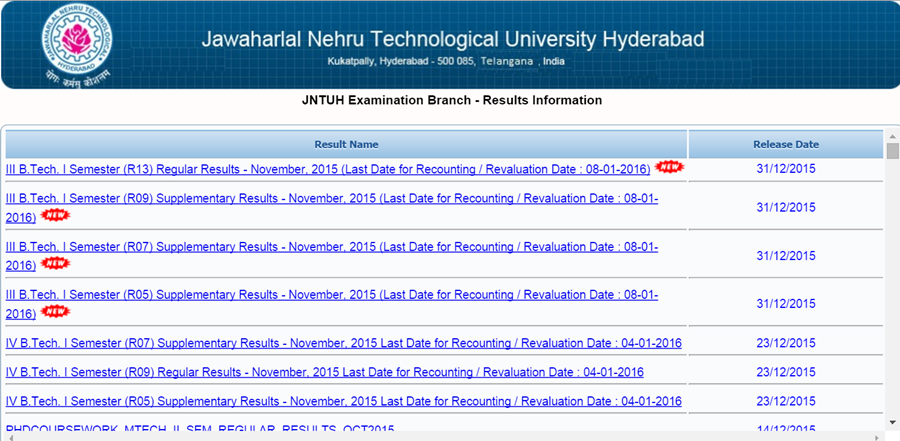
JNTU hyderabad has Successfully Conducted B.Tech 3-1 semester Regular and Supplementary Examinations in the month of November 2015. Students Are eagerly waiting For Know Their 3-1 Results 2015. JNTUH was held 3-1 Sem Supply Exams for R13, R09, R07 & R05 Regulations. JNTUH Declared B.Tech 3-1 Regular/supplementary Exam Results 2015 To day. Check Your Results From Below Given Links.

The Following Examination Results are Released by JNTUH

  • III B.Tech. I Semester (R05) Supplementary Results – Nov, 2015
  • III B.Tech. I Semester (R07) Supplementary Results – Nov, 2015
  • III B.Tech. I Semester (R09) Supplementary Results – Nov, 2015
  • III B.Tech. I Semester (R13) Regular/Supplementary Results – Nov, 2015

jntuh 3-1 results nov 2015

Get JNTUH 3-1 Sem Regular/Supply Results Nov 2015 From Below Links :

JNTUH III B.Tech. I Semester (R05) Supplementary Results – nov, 2015 

JNTUH III B.Tech. I Semester (R07) Supplementary Results – nov, 2015

JNTUH III B.Tech. I Semester (R09) Supplementary Results – nov, 2015

JNTUH III B.Tech. I Semester (R13) Regular/Supplementary Results – nov, 2015

Last Date for Recounting / Revaluation Date: 08-01-2015

Telangana GROUP -2 Services Syllabus PDF Download

0

Telangana GROUP -2 Services Syllabus PDF Download

tspsc-e1446976529461

Applications are invited Online from qualified candidates through the proforma Application to be made available on Commission’s WEBSITE (www.tspsc.gov.in) to the posts of GROUP – II SERVICES in the State of Telangana.

  • i. Submission of ONLINE applications from Dt. 31/12/2015
  • ii. Last date for submission of ONLINE applications Dt. 09/02/2016
  • iii. Hall Tickets can be downloaded 07 days before commencement of Examination.

PAPER-I: GENERAL STUDIES AND GENERAL ABILITIES

PAPER-II: HISTORY, POLITY AND SOCIETY

PAPER-III: ECONOMY AND DEVELOPMENT

PAPER-IV TELANGANA MOVEMENT AND STATE FORMATION

PAPER-I: GENERAL STUDIES AND GENERAL ABILITIES

1. Current Affairs – Regional, National & International. 2. International Relations and Events. 3. General Science; India’s Achievements in Science and Technology 4. Environmental Issues; Disaster Management- Prevention and Mitigation Strategies. 5. World Geography, Indian Geography and Geography of Telangana State. 6. History and Cultural Heritage of India. 7. Society, Culture, Heritage, Arts and Literature of Telangana. 8. Policies of Telangana State. 9. Social Exclusion, Rights Issues and Inclusive Policies. 10. Logical Reasoning; Analytical Ability and Data Interpretation. 11. Basic English. (10th Class Standard)

PAPER-II: HISTORY, POLITY AND SOCIETY

I. Socio-Cultural History of India and Telangana.

1. Salient features of Indus Valley Civilization: Society and Culture. -Early and Later Vedic Civilizations; Religious Movements in Sixth Century B.C. –Jainism and Buddhism. Socio, Cultural Contribution of Mauryas, Guptas, Pallavas, Chalukyas, Cholas Art and Architecture – Harsha and the Rajput Age. 2. The Advent of Islam and the Establishment of Delhi Sultanate-Socio, Cultural Conditions under the Sultanate –Sufi and Bhakti Movements. The Mughals: Social and Cultural Conditions; Language, Literature, Art and Architecture. Rise of Marathas and their contribution to Culture; Socio-Cultural conditions in the Deccan under the Bahamanis and Vijayanagara – Literature, Art and Architecture. 3. Advent of Europeans: Rise and Expansion of British Rule: Socio-Cultural Policies – Cornwallis, Wellesley, William Bentinck, Dalhousie and others. The Rise of Socio-Religious Reform Movements in the Nineteenth Century. Social Protest Movements in India –Jotiba and Savithribai Phule, Ayyankali, Narayana Guru, Periyar Ramaswamy Naicker, Gandhi, Ambedkar etc. 4. Socio-Cultural conditions in Ancient Telangana- Satavahanas, Ikshvakus, Vishnukundins, Mudigonda and Vemulawada Chalukyas. Religion, Language, Literature, Art and Architecture; Medieval Telangana – Contribution of Kakatiyas, Rachakonda and Devarakonda Velamas, Qutub Shahis; Socio – Cultural developments: Emergence of Composite Culture. Fairs, Festivals, Moharram, Ursu, Jataras etc. 5. Foundation of AsafJahi Dynasty- from Nizam –ul- Mulk to Mir Osaman Ali Khan – SalarJung Reforms Social system and Social conditions-Jagirdars, Zamindars, Deshmuks, and Doras- Vetti and Bhagela system and position of Women. Rise of Socio-Cultural Movements in Telangana: Arya Samaj, Andhra Maha Sabha, Andhra Mahila Sabha, Adi-Hindu Movements, Literary and Library Movements. Tribal and Peasant Revolts: Ramji Gond, Kumaram Bheemu, and Telangana Peasant Armed Struggle – Police Action and the End of Nizam Rule.

II. Overview of the Indian Constitution and Politics.

1. Evolution of Indian Constitution – Nature and salient features – Preamble. 2. Fundamental Rights – Directive Principles of State Policy – Fundamental Duties. 3. Distinctive Features of Indian Federalism – Distribution of Legislative and Administrative Powers between Union and States. 4. Union and State Governments – President – Prime Minister and Council of Ministers; Governor, Chief Minister and Council of Ministers – Powers and Functions. 5. Rural and Urban Governance with special reference to the 73rd and 74th Amendments. 6. Electoral System: Free and fair Elections, Malpractices; Election Commission; Electoral Reforms and Political Parties. 7. Judicial System in India – Judicial Activism. 8. a) Special Provisions for Scheduled Castes, Scheduled Tribes, Backward Classes, Women and Minorities. b) Welfare Mechanism for Enforcement – National Commission for Scheduled Castes, National Commission for Scheduled Tribes and National Commission for Backward Classes. 9. Indian Constitution: New Challenges.

III. Social Structure, Issues and Public Policies.

1. Indian Social Structure: Salient Features of Indian society: Caste, Family, Marriage, Kinship, Religion, Tribe, Women, Middle class – Socio-cultural Features of Telangana Society. 2. Social Issues: Inequality and Exclusion: Casteism, Communalism, Regionalism, Violence against Women, Child Labour, Human trafficking, Disability and Aged. 3. Social Movements: Peasant’s Movements, Tribal movements, Backward Class Movements, Dalit Movements, Environmental Movements, Women’s Movements, Regional Autonomy Movements, Human Rights Movements. 4. Telangana Specific Social Issues: Vetti, Jogini, Devadasi System, Child labour, Girl child , Flourosis, Migration, Farmer’s and Weaver’s Distress. 5. Social Policies and Welfare Programmes: Affirmative Policies for SCs, STs, OBC, Women, Minorities, Labour, Disabled and Children; Welfare Programmes; Employment, Poverty Alleviation Programmes; Rural and Urban Women and Child Welfare, Tribal Welfare.

PAPER-III: ECONOMY AND DEVELOPMENT

I. Indian Economy: Issues and Challenges.

1. Growth and Development : Concepts of Growth and Development – Relationship between Growth and Development 2. Measures of Economic Growth: National Income- Definition, Concepts and Methods of measuring National Income; Nominal and Real Income. 3. Poverty and Unemployment : Concepts of Poverty – Income based Poverty and Non-Income based poverty ; Measurement of Poverty; UnemploymentDefinition, Types of Unemployment 4. Planning in Indian Economy : Objectives, Priorities, Strategies, and Achievements of Five year Plans – 12th FYP; Inclusive Growth – NITI Aayog

II. Economy and Development of Telangana.

1. Telangana Economy in undivided Andhra Pradesh (1956-2014)- Deprivations (Water(Bachavat Committee), Finances (Lalit, Bhargava, Wanchu Committees) and Employment(Jai Bharat, Girglani Committees)) and Under Development. 2. Land Reforms in Telangana : Abolition of Intermediaries: Zamindari, Jagirdari and Inamdari;Tenancy Reforms ;Land ceiling; Land alienation in Scheduled Areas 3. Agriculture and Allied Sectors: Share of Agriculture and Allied sectors in GSDP; Distribution of land holdings; Dependence on Agriculture; IrrigationSources of Irrigation; Problems of Dry land Agriculture; Agricultural credit. 4. Industry and Service Sectors: Industrial Development; Structure and Growth of Industry sector- Micro, Small and Medium Enterprises (MSME) sector; Industrial Infrastructure; Industrial Policy of Telangana; Structure and Growth of Service sector.

III. Issues of Development and Change.

1. Development Dynamics: Regional Inequalities in India – Social Inequalities – Caste, Ethnicity (tribe), Gender and Religion; Migration; Urbanisation. 2. Development and Displacement: Land Acquisition Policy; Resettlement and Rehabilitation. 3. Economic Reforms: Growth, Poverty and Inequalities – Social Development (education and health); Social Transformation; Social Security. 4. Sustainable Development: Concept and Measurement; Sustainable Development Goals.

PAPER-IV TELANGANA MOVEMENT AND STATE FORMATION

I. The idea of Telangana (1948-1970)

1. Historical Background: Telangana as a distinctive cultural unit in Hyderabad Princely State, its geographical, cultural, socio, political and economic features- people of Telangana- castes, tribes, religion, arts, crafts, languages, dialects, fairs, festivals and important places in Telangana. Administration in Hyderabad Princely State and Administrative Reforms of Salar Jung and Origins of the issue of Mulkis-Non-Mulkis; Employment and Civil Services Rules under Mir Osman Ali Khan, VII Nizam’s Farman of 1919 and Definition of Mulki – Establishment of Nizam’s Subjects League known as the Mulki League 1935 and its Significance; Merger of Hyderabad State into Indian Union in 1948- Employment policies under Military Rule and Vellodi,1948-52; Violation of Mulki-Rules and Its Implications. 2. Hyderabad State in Independent India- Formation of Popular Ministry under Burgula Ramakrishna Rao and 1952 Mulki-Agitation; Demand for Employment of Local people and City College Incident- Its importance. Justice Jagan Mohan Reddy Committee Report, 1953 – Initial debates and demand for Telangana State-Reasons for the Formation of States Reorganization Commission (SRC) under Fazal Ali in 1953-Main Provisions and Recommendations of SRC-Dr. B. R. Ambedkar’s views on SRC and smaller states. 3. Formation of Andhra Pradesh, 1956: Gentlemen’s Agreement – its Provisions and Recommendations; Telangana Regional Committee, Composition, Functions and performance-Violation of Safeguards-Migration from Coastal Andhra Region and its Consequences-Post-1970 development Scenario in Telangana-Agriculture, Irrigation, Power, Education, Employment, Medical and Health etc. 4. Violation of Employment and Service Rules: Origins of Telangana AgitationProtest in Kothagudem and other places, Fast unto Death by Ravindranath; 1969 Agitation for Separate Telangana. Role of Intellectuals, Students, Employees in Jai Telangana Movement. 5. Formation of Telangana Praja Samithi and Course of Movement – the Spread of Telangana Movement- Major Events, Leaders and Personalities- All Party Accord – Go 36 – Suppression of Telangana Movement and its Consequences-The Eight Point and Five-Point Formulas-Implications.

II. Mobilisational phase (1971 -1990)

1. Court Judgements on Mulki Rules- Jai Andhra Movement and its Consequences- Six Point Formula 1973, and its Provisions; Article 371-D, Presidential Order, 1975-Officers (Jayabharat Reddy) Committee Report- G.O. 610 (1985); its Provisions and Violation- Reaction and Representations of Telangana Employees 2. Rise and Spread of Naxalite Movement, causes and consequences – AntiLandlord Struggles in Jagityala-Siricilla, North Telangana; Rytu-Cooli Sanghams; Alienation of Tribal Lands and Adivasi Resistance- Jal, Jungle, and Zamin. 3. Rise of Regional Parties in 1980’s and Changes in the Political, SocioEconomic and Cultural fabric of Telangana- Notion of Telugu Jathi and suppression of Telangana identity- Expansion of new economy in Hyderabad and other parts of Telangana; Real Estate, Contracts, Finance Companies; Film, Media and Entertainment Industry; Corporate Education and Hospitals etc; Dominant Culture and its implications for Telangana self respect, Dialect, Language and Culture. 4. Liberalization and Privatisation policies in 1990’s and their consequences – Emergence of regional disparities and imbalances in political power, administration, education, employment- Agrarian crisis and decline of Handicrafts in Telangana and its impact on Telangana Society and economy. 5. Quest for Telangana identity-intellectual discussions and debates- political and ideological efforts – Growth of popular unrest against regional disparities, discrimination and under development of Telangana.

III. Towards Formation of Telangana State (1991-2014)

1. Public awakening and Intellectual reaction against discrimination -formation of Civil society organisation, Articulation of separate Telangana Identity; Initial organisation raised the issues of separate Telangana; Telangana Information Trust-Telangana Aikya Vedika, Bhuvanagiri Sabha- Telangana Jana Sabha, Telangana Maha Sabha- Warangal Declaration- Telangana Vidyarthula Vedika etc.,Efforts of Telangana Congress & BJP in highlighting the issue. 2. Establishment of Telangana Rashtra Samithi in 2001, Political Realignment and Electoral Alliances in 2004 and later Phase of Telangana Movement – TRS in UPA- Girgliani Committee-Telangana Employees Joint Action Committee- Pranab Mukherjee Committee- 2009-Elections-AlliancesTelangana in Election Manifestos- The agitation against Hyderabad as Freezone – and Demand for separate Statehood- Fast-Unto-Death by K.Chandra Shekar Rao-Formation of Political Joint Action Committee (2009) 3. Role of Political Parties-TRS, Congress, B.J.P., Left parties, T.D.P., M.I.M and other political parties such as Telangana Praja Front, Telangana United Front etc., Dalit-Bahujan Sanghams and Grass roots Movement organisations – Other Joint Action Committees and popular protests- Suicides for the cause of Telangana. 4. Cultural Revivalism in Telangana; other symbolic expressions in Telangana Movement- Literary forms- performing arts and other cultural expressionswriters, poets, singers, intellectuals, Artists, Journalists, Students, Employees, Advocates, Doctors, NRIs, women, Civil society groups, organised and unorganised sectors, castes, communities and other social groups in transforming the agitation into a mass movement- -Intensification of Movement, Forms of Protest and Major events: Sakalajanula Samme, NonCooperation Movement; Million March, etc 5. Parliamentary Process; UPA Government’s stand on Telangana- All-Party Meeting- Anthony Committee- Statements on Telangana by Central Home Minister – Sri Krishna Committee Report and its Recommendations, AP Assembly and Parliamentary proceedings on Telangana, Declaration of Telangana State in Parliament, Andhra Pradesh State Reorganization Act, 2014- Elections and victory of Telangana Rashtra Samithi and the first Government of Telangana State.

Download Official Syllabus PDF Here : Click Here

ANU Degree (UG) I Year I Sem Results Oct 2015 – Manabadi, Schools9, Anu.ac.in

3

ANU Degree (UG) I Year I Sem Results Oct 2015 are available at manabadi, schools9 and www.anu.ac.in. Acharya Nagarjuna University BA, B.Sc, B.Com, BBA, BBM, BCA 1st sem results.

anu degree results 2015

ANU Degree (UG) I Year I Sem Results Oct 2015

ANU Degree 1st Sem Result :  Acharya Nagarjuna University has announced Degree 1st sem exaination results for BA, B.Sc, B.Com, BBA, BBM, BCACandidates who had appeared in Acharya Nagarjuna University (ANU) UG 1st sem Exam, conducted in the month of October/November 2015 check your results from below provided links. Now the applicants will search the ANU degree BA, B.Sc, B.Com, BBA, BBM, BCA 1st Semester Exam Result 2015 on various internet sites. Official website of Acharya Nagarjuna University (ANU) @ www.anu.ac.in.

The ANU conducted BA, B,Sc, B.Com( Gen & Computer), BCA ext exams in semester wise in UG Degree level first time and there also lot of changes are held in this process and some of them are
  •  New CBCS pattern is introduced by the ANU and throw out AP state.
  •  There shall be two semesters for each year.
  •  For each semester there shall be internal and external examinations are introduced.
  •  The syllabus is completely changed and it is useful for present technology.

ANU Degree 1st sem RESULTS AVAILABLE Now

Way to get ANU UG Odd Semester Exam Result 2015

  1. Students have log on the official page of Acharya Nagarjuna University (ANU)@ www.anu.ac.in
  2. Navigate your courser on the Result link and after that search here UG Odd Sem Exam Result 2015 and click on it.
  3. Select your course and enter Roll No and click on submit button.
  4. Print your Result for future use.

Subject Codes FOR B.Com ( General and computers):-

  • ENGLISH -ENG1S
  • TELUGU – TE1S
  • SANSKRI – SAN1S
  • URDU – URD1S
  • HUMAN VALUES AND PROFESSIONA ETHICS – HVE1S
  • COMMUNICATION AND SOFTSKILLS – CSS1S
  • FINANCIAL ACCOUNTING-I :: BCO1S-1
  • BUSINESS ECONOMICS – BCO3S-3
  • BUSINESS ORGANIZATION-BCO2S-2
  • FINANCIAL ACCOUNTING – RES1S-1
  • BUSINESS ORGANIZATION(Restricted) – RES1S-2
  • FUNDAMENTALS OF COMPUTERS:::RES1S-1CA


About ANU :

Acharya Nagarjuna University is a university in the region of Namburu, Guntur, Andhra Pradesh, India. It is one of several major universities in the country, covering many colleges and institutes of districts in the region. It is located in Nagarjuna Nagar, Namburu, in the northern part of Guntur City, a major centre of learning for the state of Andhra Pradesh.

JNTUK 4-1 B.Tech Regular/Supple Exams Results Released 2015

JNTUK 4-1 B.Tech Regular/Supple Exams Results Released 2015JNTUK

JNTUK 4-1 B.Tech Supple Exams Results Released 2015 Check Your Results From Below Links:

JNTUK 4-1 (R10,R07,R05) Regular/Supply Results Nov 2015 Released: Check here

4-1 B.Tech (R10) Regular Exams Results Released 2015

4-1 B.Tech (R07,R05) Supple Exams Results Released 2015

JNTUK 4-1 B.Tech Supple Exams Results Released 2015 Check your results From Links given below.

Click Here To Check JNTUK 4-1 Results Nov 2015

Note : Last Date for Recounting/Revaluation/Challenge By Revaluation: 

JNTUK Procedure for Revaluation/ Recounting / Challenge Valuation

Check Results:

jntuk 4-1 results, jntuk b.tech regular and supply results 2015, jntuk 4th year 1st sem b.tech results , jntuk 4-1 results are released.jntuk b.tech r10 4-1 regular results are released.jntuk 4-1 results with percentage and total manabadi schools9

Amity University to come to Andhra Pradesh

Amity University to come to Andhra Pradesh

Amity-University

Giving a huge fillip to the state’s Higher Education chapter, Amity University has come forward to set up a campus in Andhra Pradesh’s capital city Amaravati.

The University will be operational and open for admissions from its own campus by 2017. A delegation led by Dr. Atul Chauhan, Chancellor and President of Amity University called on Andhra Pradesh Chief Minister Sri. N Chandrababu Naidu at his residence in Hyderabad.

Explaining the Chief Minister of the university’s achievements, Dr. Atul Chauhan informed him that theirs is one of the few universities that offer over 250 different courses in various fields. He also said that the university also holds the record of operationalizing in West Bengal in a record 7 months’ time.

He explained the University that began in 2005 saw rapid growth and grew into setting up 11 universities, 20 campuses and 18 schools. He said that their faculty included experienced members from across the world with students from over 60 countries enrolling for Amity University.

“Our University serves with a purpose to provide quality education so that Indian students do not have to go abroad, while, foreign students show interest in our institutions. We want to contribute towards your vision of transforming Andhra Pradesh into a knowledge and education hub”, he added.

The Chief Minister said that he wants to encourage best universities in the world to set up their campuses in the state. Stating that the students’ hailing from the state hold potential to excel in any field, he wants to build a campus that offers professional and value-based education for students.

He asked the delegation to bring international expertise to construct best campuses in Amaravati. He also suggested to offer joint degree programs for students in collaboration with foreign universities.

Meanwhile, Dr. Atul Chauhan suggested setting up Incubator campuses in the state. This, he said, will not only provide research-oriented learning experience to the students, but also, encourage student exchange programs.

JNTUK M.Tech/M.Pharmacy I Sem Regular/Supply Exams Fee Notification Dec 2015

JNTUK M.Tech/M.Pharmacy I Sem Regular/Supply Exams Fee Notification Dec 2015. jntu kakinada m.tech and m.pharmacy I sem End Examination fee notification 2015.JNTUK

JNTUK M.Tech/M.Pharmacy I Sem Regular/Supply Exams Fee Notification Dec 2015

M.TECH / M.PHARMACY I SEMESTER REGULAR EXAMINATIONS
FOR 2015 ADMITTED BATCHES ONLY
AND
SUPPLEMENTARY EXAMINATIONS FOR
M.TECH/M.PHARMACY I SEMESTER 2010 TO 2014 ADMITTED BATCHES
ONLY

CANDIDATES APPEARING FOR THE ABOVE EXAMINATIONS COMMENCING FROM 01-02-2016 ARE INFORMED THAT THE APPLICATIONS WILL BE RECEIVED AS PER THE TIME SCHEDULE GIVEN BELOW:

EXAM REGISTRATION LAST DATE

Without Late Fee 02-01-2016

With Late Fee of Rs.100/- 06-01-2016

With Late fee of Rs.1000/- 09-01-2016

For More Details Visit JNTUK Official Website or Contact your college staff to know More Information.

JNTUK Announces New Programme in Entrepreneurship from III B.Tech- I Sem onwards

JNTUK Announces New Programme in Entrepreneurship from III B.Tech- I Sem onwards

JNTUK Kakinada wishes to offer Minor/Specialization in Technology Entrepreneurship to its Constituent and Affiliated students (from III B.Tech- I Sem onwards) with Entrepreneurial mindset.JNTUK

About the Program:

JNTUK Kakinada wishes to offer Specialization course in Technology Entrepreneurship as an optional additional learning in Bachelors of Engineering. JNTU Kakinada. Students pursuing their B.Tech. and having an entrepreneurial mind set and are self-motivated and self-disciplined with ability for self learning will now have an option to work for their additional optional coursework at JNTUK empanelled incubator. Brief idea about the programs is described below

Specialization in Technology Entrepreneurship: There are no credits and hours of engagement in the specialization. The student will be evaluated on the basis of any of the following points:

  1. Revenue Realized – The team should have been able to earn revenue either from a single product or cumulatively for all its products
  2. Profits Generated – The team should have been able to generate a profit either from a single product or cumulatively for its products
  3. Angel/Venture Funding – The team should have been able to raise an angel or venture capital funding for its startup by way of dilution of equity shares.
  4. Patent Granted – The team should be able to win a Patent Grant in India or anywhere in the world for its product.

What is the Minor/Specialization Degree?

The concept of having a Major Degree (Like Electronics, Computer Science, Mechanical, Civil etc) and then having an additional Minor degree is available only in foreign universities like Stanford, Harvard, MIT etc and IIT’s in India till now.

Recognizing the global changes that is happening, JNTK is introducing specialization in technology entrepreneurship for its engineering students where this additional learning will be provided by JNTUK approved Technology Business Incubators (TBI). Students can now major in any subject like Electronics, Computer Science, Electrical, Mechanical, Civil etc, and do a Minor/Specialization in Technology Entrepreneurship.

APPLICATION for the PROGRAMME

Download Official Notification here – Click Here

New Startup Programme for Students of Andhra Pradesh

JNTUK B.Tech/B.Pharmacy External Lab Examination Schedule For 1-2, 2-2 & 3-2 sem’s

JNTUK B.Tech/B.Pharmacy External Lab Examination Schedule For 1-2, 2-2 & 3-2 sem’sJNTUK

Sub : JNTUK – Examination Branch – Conduct of Laboratory Examinations – Intimation –Regarding.

All the Principals of the affiliated colleges are hereby informed that the following Laboratory Examinations are scheduled to be conducted in respective colleges without any disturbing the regular class works as detailed below. Hence, the Principals are requested to make necessary arrangement for smooth conduct of the examinations.

I B.Pharmacy I Semester Regular/Supplementary 30.12.2015 to 06.01.2016

I B.Tech II Semester Supplementary 18.01.2016 to 23.01.2016

I B.Pharmacy II Semester Supplementary 18.01.2016 to 23.01.2016

II B.Tech II Semester Supplementary 06.01.2016 to 12.01.2015

II B.Pharmacy II Semester Supplementary 06.01.2016 to 12.01.2016

III B.Tech II Semester Supplementary 30.12.2015 to 05.01.2016

III B.Pharmacy II Semester Supplementary 30.12.2015 to 05.01.2016


The above laboratory examinations reports are to be submitted to the Controller of Examinations Office, JNTUK, Kakinada in person to the above mentioned dates without fail.

For More Details Visit JNTUK Official Website OR Contact Respective college’s.

Download Notification Here – Click Here

Apply Online For 18252 Vacancies : RRB Non Technical Recruitment 2016 Notification

22

Apply Online For 18252 Vacancies : RRB Non Technical Recruitment 2016 Notification

RRB-Non-Technical-Recruitment-2016-Notification

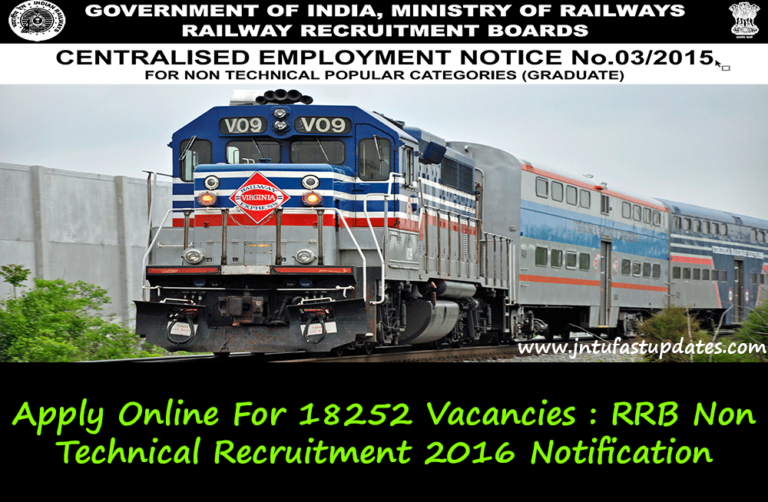
The railway recruitment board has issued an employment notification of RRB 2016 recruitment. Through this RRB fill up total 18252 Non Technical vacant posts. It is good chance for that job seeker who wants to get railway jobs 2016 and have desire to work in this railway recruitment department as nontechnical staff.

If you were looking for railway jobs in India, the latest Railway Recruitment Board (RRB) notification ­2016 to fill 18252 jobs in Indian Railways must excite you.With Indian Railways being the 2nd largest rail network in the world, we don’t need any introduction about this massive organization that is managed by Govt of India`s Ministry of Railways. Railway Recruitment Board (RRB) are responsible for the recruitment of Group C positions & currently there are 21 RRBs functioning across India. Through these boards ­ exams, selections, interviews & various other tests for that particular zone is conducted.

Important Dates :

Date of publication: 26.12 2015

Date & Time of Closing: 25.01.2016 up to 23.59 Hrs.

Tentative dates/slot of Common Computer Based Test/Examination: MARCH-MAY, 2016.

ONLINE applications are invited from eligible Indian Nationals for the above mentioned posts. Applications complete in all respects should be submitted only ONLINE to the concerned Railway Recruitment Board as mentioned in Para -16 of General Instructions of this notification, till 23.59 hrs of closing date.

ΙΜΡΟRΤΑΝΤΙΝSΤRUCΤΙΟΝS

Candidates are required to apply only through ONLINE mode. No other mode for submission of application is allowed.

Name of the posts:

Commercial Apprentice (CA): 703 Posts

Traffic Apprentice (TA): 1645 Posts

Inquiry cum Reservation Clerk (ECRC): 127 Posts

Goods Guard: 7591 Posts

Junior Accounts assistant cum Typist (JAA): 1205 Posts

Senior Clerk cum typist: 869 Posts

Assistant Station Master (ASM): 5942 Posts

Transport Assistant: 166 Posts

Senior Time Keeper: 04 Posts

 Number of the posts: 18252 vacancies 

1. CANDIDATES TO ENSURE THEIR ELIGIBILITY BEFORE APPLYING: The candidates applying for the post(s) of Commercial Apprentice (CA), Traffic Apprentice (TA), Enquiry-Cum-Reservation Clerk (ECRC), Goods Guard, Senior Clerk-Cum-Typist, Junior Accounts Assistant-Cum-Typist (JAA), Assistant Station Master (ASM), Traffic Assistant & Senior Time Keeper must ensure that they fulfill all eligibility conditions prescribed for the post(s) on the date of submitting application. Admission of the candidates for the CBT for the posts notified in this notification would be on the basis of the information furnished by them in the ONLINE application. If at any stage of recruitment orthereafter, it is found that any information furnished by the candidate in his application is false sincorrect or the candidate has suppressed any relevant information or the candidate otherwise does not satisfy the eligibility criteria for the post(s), his/her candidature Will be cancelled forthWith.

There shall be single stage common CBT (Computer Based Test) for all the notified categories followed by aptitude Test/Typing skill Test wherever necessary as mentioned in Para – 8 of this notification. Only single application (i.e. common for all notified categories) is required to be submitted ONLINE by the candidate. The candidate is required to exercise option for the post(s) as per his/her eligibility. After final submission of the application, the option for all those posts/categories once exercised shall be final.

The candidate is also required to exercise five preferences of cities for allotment of online exam centre. Efforts will be made to accommodate preferences for cities as far as feasible. However, RRBs reserve the right to allot exam centres in other cities also depending upon exigencies.

2. EXAMINATION FEE: No examination fee for candidates belonging to SC/ST/Ex-Servicemen / Women / Minorities / Transgenders/Persons with Disabilities and Economically backward classes (refer to General Instructions Para 4). For UR/OBC male candidates not coming within the purview of exempted categories, as above, examination fee is Rs 100/(Rupees One Hundred Only).

3. HOW TO APPLY: Candidates are required to apply through ONLINE mode to ANY ONE RRB ONLY, on the website of concerned Railway Recruitment Board (RRB) as indicated in Para 16. Detailed instructions for filling up ONLINE applications are available on the website of RRB(s). Brief Instructions to fill up of the same are given in Para Nos. 5 and 5 (A) of this notification. Application to more than one RRB will lead to rejection of all the applications.

4. LAST DATE FOR RECEIPT OF APPLICATIONS: The ONLINE application, complete in all respects, can be submitted to RRB concerned up to 25.01.2016 till 23.59 Hrs. No physical copy of application / document is required to be sent to RRBS.

5. SAME DAY EXAMINATION: Common CBT (Examination) is scheduled to be held on the same day(s) by all participating RRBs tentatively during MARCH-MAY, 2016.

6. NEGATIVE MARKING: There shall be penalty (negative marking) in CBT/Examination and marks shall be deducted for each wrong answer (G) 1/3 of the marks allotted for each question.

7. ELECTRONIC GADGETS BANNED:

(a) Mobile phones, pagers, laptops, calculators or any other communication devices are not allowed inside the premises where the examination is being conducted. Any infringement of these instructions shall entail disciplinary action including ban from future examinations.

(b) Candidates are advised in their own interest not to bring any of the banned items including mobile phones/pagers to the venue of the examination, as arrangement for safe-keeping cannot be assured.

RRBs are located at

Ahmedabad, Ajmer,Allahabad, Bangalore, Bhopal, Bhubaneshwar, Bilaspur, Chandigarh, Chennai, Gorakhpur, Guwahati, Jammu, Kolkata, Malda, Mumbai, Muzaffarpur, Patna, Ranchi, Secunderabad, Siliguri, Thiruvananthapuram.

Vacancies will be divided across all the 21 RRBs.This means, all selected candidates will get posted within their state or neighbouring state only because of zonal division limitations. You can apply for any one RRB only.

Education Qualification: Read official Notification, link Given below

Age Limitation: Read official Notification, link Given below

Pay Scale: Read official Notification, link Given below

Selection Procedure: Read official Notification, link Given below

How To Apply for RRB Non Technical Recruitment 2016? : Read official Notification, link Given below

Required Documents: Read official Notification, link Given below

Important Links:-

Official Notification in English

Official Website: – www.indianrailways.gov.in or www.rrbappreg.net

Online Application Form Links

Every recruitment notification, addresses of official websites of RRBs and RRCs are invariably indicated so that candidates refer to those authentic websites/advertisements only. Please always refer https://t.co/kN48q6gksT

Official website of Railway Recruitment Boards (RRBs)

Official website of Railway Recruitment Boards (RRBs)
Name of RRBs
Ahmedabad
Ajmer
Allahabad
Bangalore
Bhopal
Bhubaneshwar
Bilaspur
Chandigarh
Chennai
Gorakhpur
Guwahati
Jammu
Kolkata
Malda
Mumbai
Muzaffarpur
Patna
Ranchi
Secunderabad
Siliguri
Trivendrum

JNTUK B.Tech/ B.Pharm 1-2 Supply Exams Jumbling centers List Dec 2015

JNTUK B.Tech/ B.Pharm 1-2 Supply Exams Jumbling centers List Dec 2015, JNTU Kakinda 1-2 Supply Exams Jumbling Centers List For All Districts college wise Released. Check your Center with Roll Number/ Hall ticket From Below.

JNTUK

JNTUK B.Tech/ B.Pharm 1-2 Supply Exams Jumbling centers List Dec 2015 :

JNTU Kakinada University is Planned to Continue the Same Jumbling Process to All the Semesters. JNTUK University has Announced the Jumbling Confirmed news for JNTUK 1-2 Supply Jumbling Centers List Dec 2015. Which are Going to Conducts from 29-12-2015. So, Primarily JNTUK Released the Jumbling Centers list for writing the Exams by Students from one college to another college without matching the same. JNTUK has Allotted the Jumbling Centres With in 15 Kms Maximum Otherwise given a Self Center.

Aslo Read : JNTUK B.Tech 1-2 (R13,R10) Supply Exam Time Tables Dec/Jan Nov 2015-16

Updated on 24th December 2015

West Godavari List

Prakasam District

Vizianagaram District

Vishakapatnam District

Krishna District

Guntur District

Srikakulam District

East Godavari District

Also Read : JNTUK B.Pharmacy 1-2 Sem (R13,R10) Supply Exams Time tables Jan 2016